
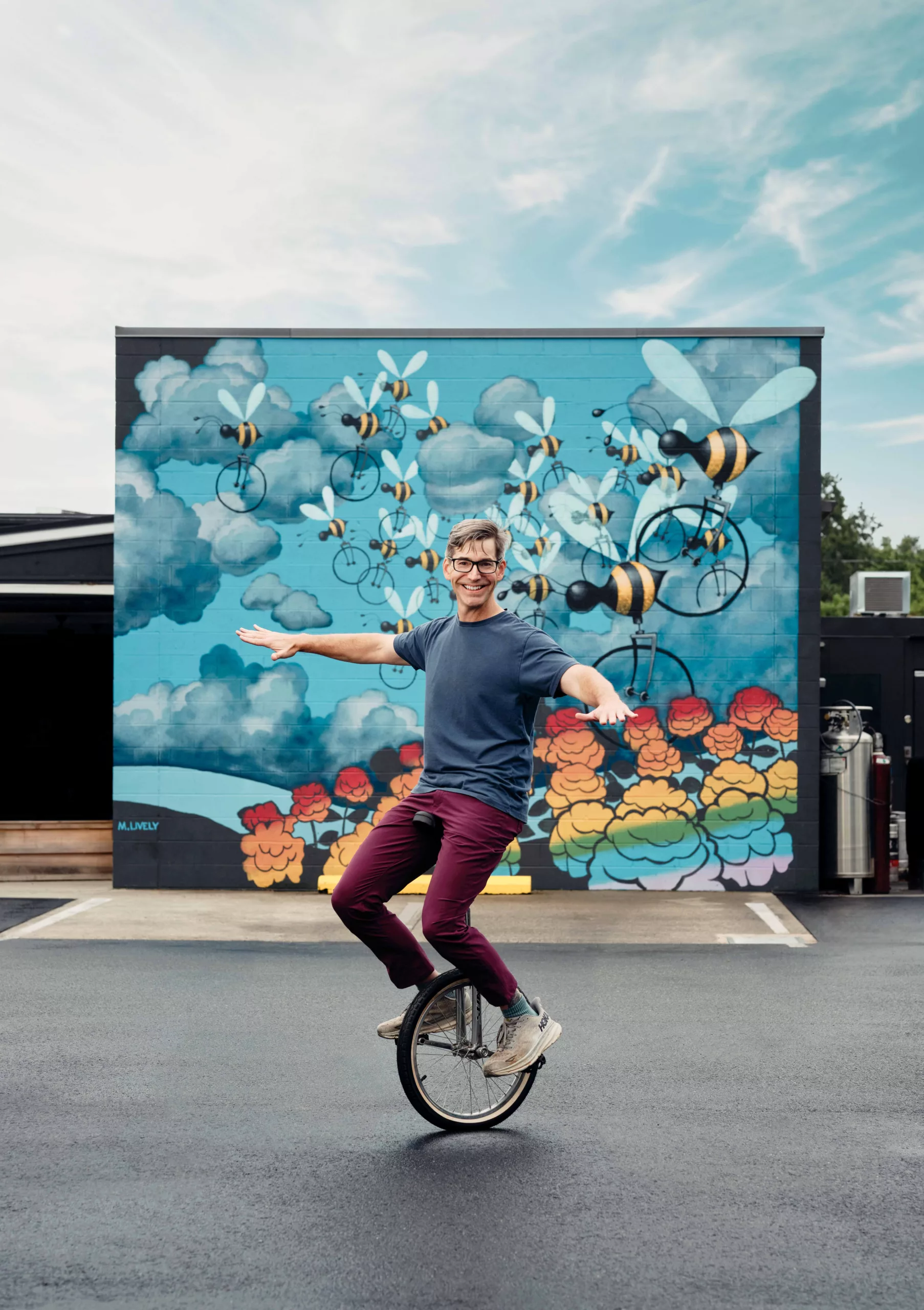
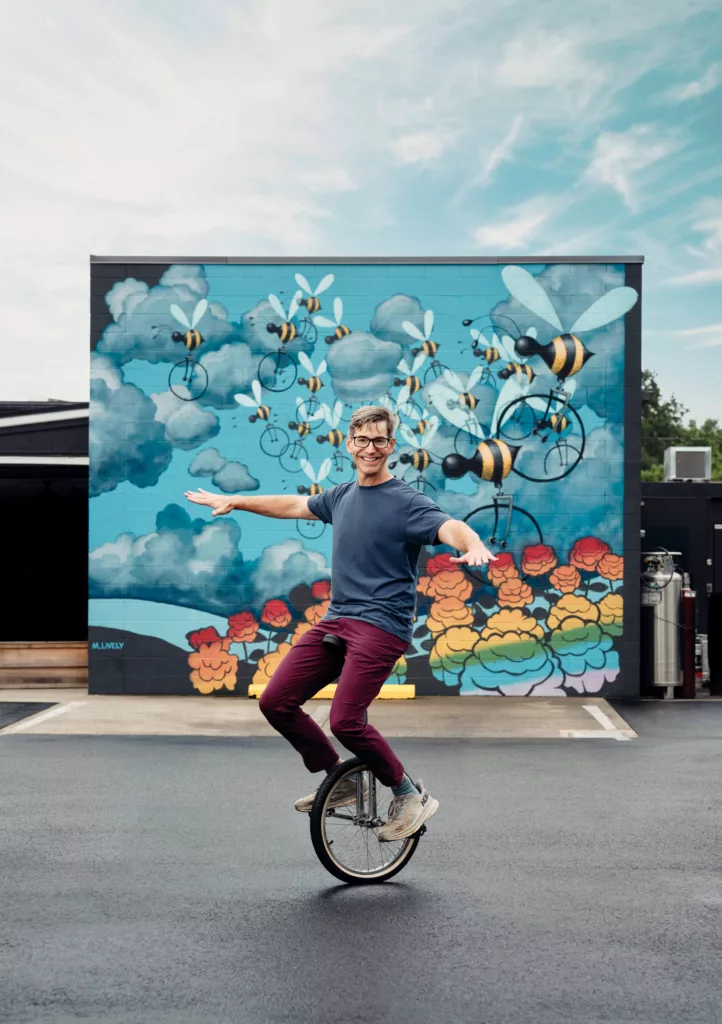
If you’ve driven around Richmond, you’ve probably spotted a few bees pedaling unicycles. No, not supernatural insects buzzing around the city. These beecycles are the creations of artist Matt Lively.
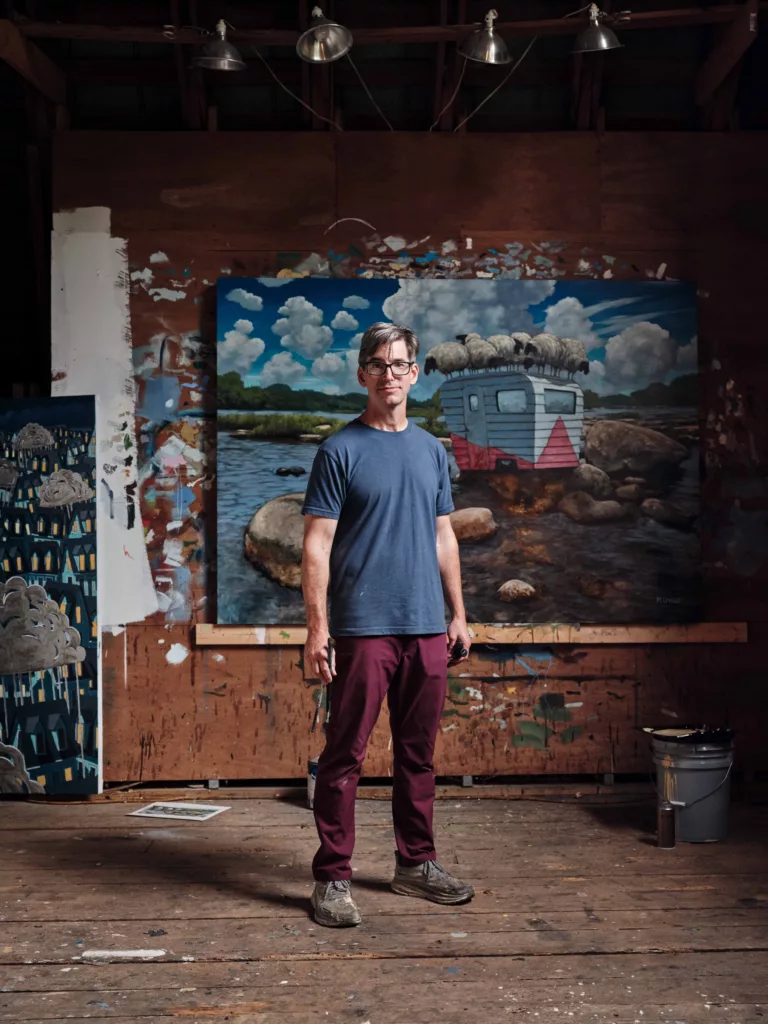
Lively’s first love will always be sculpting, but his creative murals are all over Virginia—from Richmond to Norfolk, Loudoun, Petersburg, Gloucester, Sandston, and more. He studied sculpture at Virginia Commonwealth University and became a studio artist, always preparing for his next painting or gallery showing. When he saw people creating murals, “it looked fun,” Lively explains, so he threw his hat in the ring and joined the movement. After completing his first, his art and his talent took off.
Extraordinary Extracurriculars
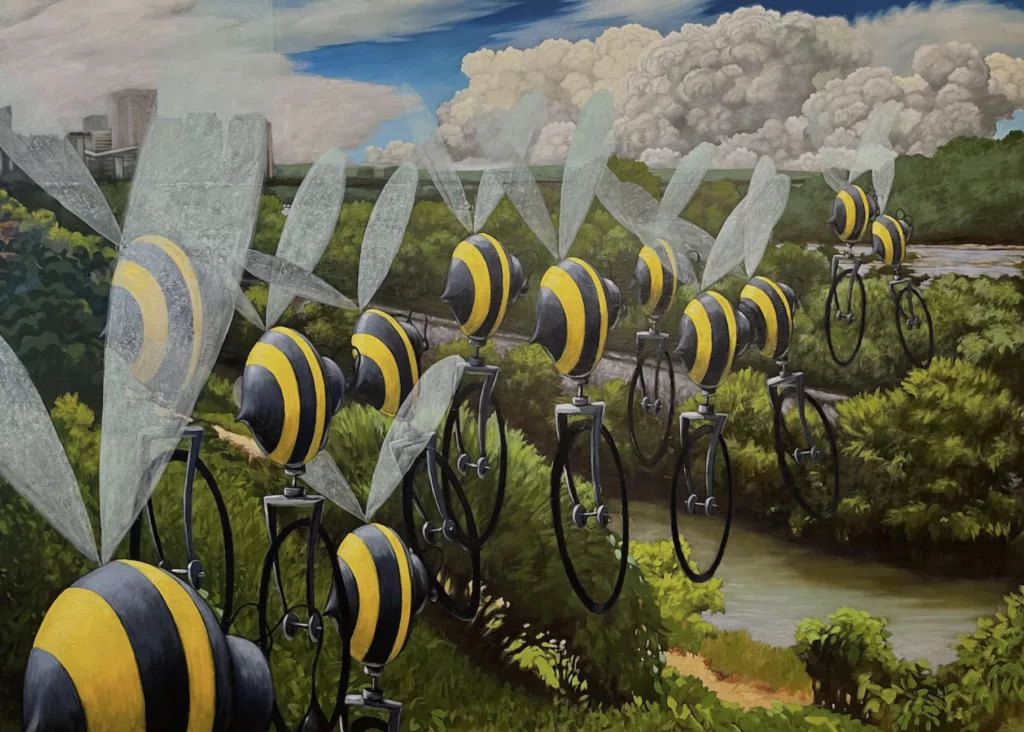
Many people tell Lively they find his art whimsical and surreal, which he mostly finds surprising and entertaining. His bees, in particular, gained a following because of the significance people attributed to them—whether that was Lively’s intention or not. Some saw them as an environmental symbol, others saw forced evolution. That “beecycle” cleverly rhymes with “recycle” was an added bonus. Clients began commissioning the charismatic honey-makers, and they became Lively’s accidental symbol.
It all started with thousands of doodles during phone calls, and when Lively didn’t quite know how to use a blank space on his paintings, the doodles found a home. The artist is fascinated with the juxtaposition of animals and man-made objects, like birds with shoes or helicopters with animal features. Many of his pieces feature vibrant colors, flora, houses, clouds, and other fun elements.
But Lively isn’t just a muralist and sculptor. He paints beautiful plein air oil paintings, like a masterfully lit piece of Hollywood Cemetery in Richmond, and a detailed panel of the Virginia Museum of Fine Arts. He offers classes in which he takes people to different spots around Richmond to learn the technique. They took off during the pandemic; the outdoor classroom had huge appeal.
The artist also participates in many art-involved fundraisers to which he’s made many donations, including Fetch-a-Cure’s Pets on Parade Benefit & Auction in May where he painted “Doug,” a papier-mäché dog sculpture. “I want to use my skill set to benefit the world somehow,” Lively says. “Not just to pay my bills. But for people’s amusement or a good cause.”
Wall Works
In the early 2010s, Lively painted a mural overlooking Richmond’s Quirk Gallery parking lot. The colorful piece attracted the attention of movie mogul Steven Spielberg, who was spotted snapping photos of the mural while he was in town filming Lincoln. His fans and audience continue to grow, with his mural portfolio including those of dogs, birds, and bees, all emblazoned on buildings on a massive scale.
Lively considers three factors when accepting a project: who’s commissioning, how open they are to collaboration and location. He visits the site before deciding on anything—analyzing the angles and the best way to approach the spot, instead of sketching something and blowing up the scale.
“I want them to be site-specific, and I want them to make the biggest impact to the most amount of people,” Lively explains. For example, for a mural by a stoplight, he’d paint something more intricate to give commuters something to ponder while they’re passing the time waiting for a green light. In contrast, a mural at a busy avenue should have a more instant impact.
Past & Future
“He’s amazing at art. He was always painting or drawing,” says Buddy Terrell, sculpture artist and Lively’s high school art teacher. “His brain is constantly going.”
Terrell advocated for Lively to attend VCU- arts, explaining that he’d be a great fit. He’s still amazed every time he sees his former student work around the state. “It’s just incredible. It gives me so much pleasure. People will talk about his art, and I say, ‘I taught him!’” Terrell says.
“It’s just so exciting how this person you knew as a 14- or 15-year-old grew up. And he still asks questions. I think he likes to keep me included,” Terrell jokes.
Lively hopes to build upon the popularity of his murals and bring it to public sculptures. He says he finds sculptures to be a welcome challenge, involving more parts of his brain. “They’re super fun,” Lively says.
His commissioned works include dog portraits, plein air paintings, and those in private and corporate collections—from Dominion Energy to Children’s Hospital of Richmond, Capital One, Facebook, and more.
Lively is tough to pigeonhole; he’s not someone who fits neatly into any one box. With his unique style, varied interests and mediums, and endless well of creativity, he breaks the mold. MattLively.com
This article originally appeared in our December 2024 issue.