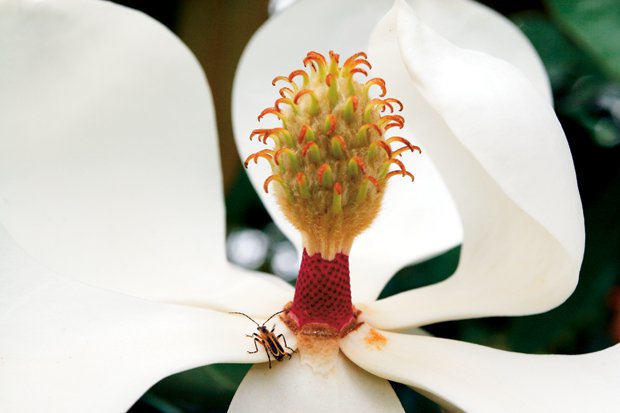

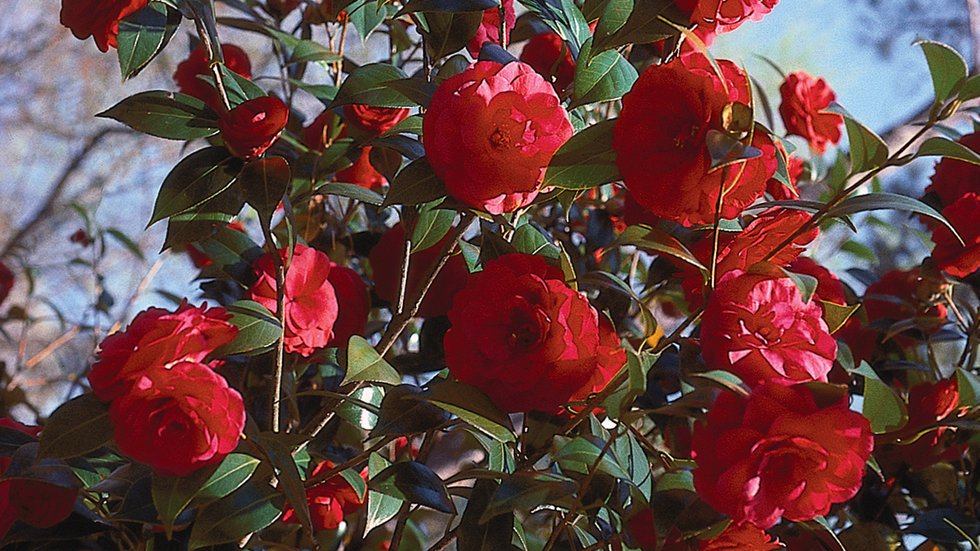
There’s no better plant for the cold months than our friends, the camellias.

Winter Bloomer
Blood of China

Winter’s Waterlilly

Betty S. Coral

White by the Gate
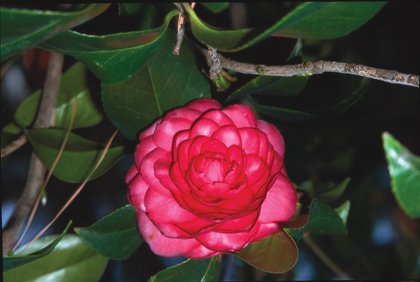
Belle Jeanette

Anticipation

A camellia workshop in the old collection
Camellias are the glory of the winter garden in Tidewater; not surprisingly, Norfolk is a hotbed of camellia enthusiasts. The Norfolk Botanical Garden, internationally recognized for its camellia collection, is also home to the Virginia Camellia Society, which celebrates its 60th birthday next year.
Virginia marks the normal northern range for camellias to thrive outdoors, although the National Arboretum has introduced several cold-tolerant varieties. Camellias are plants of subtropical regions that love the warm, humid summers and moderately cold, dry winters. Cold hardiness zones 7 to 10 define the camellia belt that stretches down the Atlantic coast to northern Florida, along the Gulf to Texas, and then jumps across the desert southwest to run the length of the Pacific coast from California to Washington.
The genus Camellia has a long and storied history. First domesticated by the Chinese thousands of years ago, it is prized for both culinary and ornamental uses. The young leaves of Camellia sinensis are dried to make green tea or fermented and dried to make black tea. Camellia oleifera is grown for its seeds, which are pressed for delicately flavored culinary oil or for use in cosmetics. (Green tea oil should not be confused with tea tree oil from the Melaleuca alternifolia, an Australian relative of the eucalyptus.)
The British East India Company not only imported tea for English devotees, but also introduced Camellia japonica in the early 18th century to the titled and wealthy. Since camellias could only survive in conservatories, they remained a status symbol through the 19th century. They were hailed by aficionados as the ‘Queen of Winter Flowers,’ according to Stirling Macoby in The Illustrated Encyclopedia of Camellias. He writes, “Their waxen symmetry and pure, shining colors epitomized the Victorian ideal of floral beauty.” Images of camellias were embroidered on textiles and painted in still lifes and in portraits of Victorian belles in ball gowns, just as thousands of years earlier Chinese artists depicted them on porcelain and scrolls.
By the 1790s, camellias were introduced to Boston, where they became an instant sensation. As in England, camellias could not survive the cold except in greenhouses. Apparently, the effort involved in keeping camellias through New England winters has not been a deterrent to fanciers. This February, the Massachusetts Camellia Society celebrates its 176th annual show.
By the 1830s, camellias had arrived in South Carolina and Georgia port cities, where they thrived in the hot, humid summers and mild winters. In the early years of the 20th century, Minton Talbot, a Norfolk lawyer and plant enthusiast, brought camellias back from Charleston. Two that he gave to the City of Norfolk were planted at the entrance to the old conservatory in Lafayette City Park and became the parents of countless offspring grown from cuttings. Once it became obvious that Camellia japonica would thrive as far north as Norfolk, ladies from the Garden Club of Norfolk held a camellia show in 1935. A transplanted Frenchman named Fred Heutte later said the show opened a new perspective for him.
As Norfolk’s superintendent of parks and forestry, Heutte made an indelible botanical mark on his adopted city. The city’s Azalea Garden, which was renamed the Norfolk Botanical Garden in 1958, was launched in 1938 with a WPA grant that paid the wages of 200 black women and 20 men. They cleared the underbrush and within a year had planted thousands of azaleas. Norfolk garden lovers donated rare camellias purchased as they became available from China, Korea, Japan and other regions of southeast Asia, where they were native plants and specially bred garden specimens.
Heutte also wrote to botanic gardens all over the world for camellia cuttings, according to Mike Andruczyk, Norfolk Botanical Garden’s curator of woody plants. “The Garden accumulated 666 varieties under his watch,” Andruczyk says with obvious admiration. “Unfortunately, the awful freezes in ’84 and ’85 killed two hundred different varieties.” Since those catastrophic winters, NBG has rebuilt its collection to 756 varieties.
One of the greatest strengths of the Norfolk Botanical Garden is its relationship with plant societies. Even horticulturists with advanced degrees can learn from ardent hobbyists. Andruczyk explains, “I maintain an active communication with the Virginia Camellia Society, which is one of the most active in the nation. They advise us on new camellias and provide funds for acquisitions and contribute to the maintenance of the Hofheimer Camellia Garden.”
Two of the most active members of the Virginia Camellia Society are Doug and Sally Simon. The retired Navy captain and school librarian became devotees in 1980 when they bought an old Victorian home in Norfolk’s Ghent neighborhood. “It was snowing when we moved in on New Year’s Day, but the camellias in the back yard were blooming,” Doug remembers. “We joined the Camellia Society just to find out how to tend our yard. We soon discovered that camellia lovers are the most congenial group of plant lovers we’ve encountered.”
The couple’s initial interest has led Doug to become an accredited camellia show judge and Sally to become president of the Fred Heutte Center, an organization dedicated to preserving Heutte’s legacy of public beautification through horticulture education.
Although she never met Fred Heutte, Sally says old-time society members instructed her in his dicta: If you could keep only one kind of shrub in your garden, it should be the camellias. They bloom when nothing else does. They are evergreen with beautiful foliage. They make an excellent landscape plant.
What gardener could ask for more?