
Falls Church is an urban village with a storied past.

Victorian Echoes
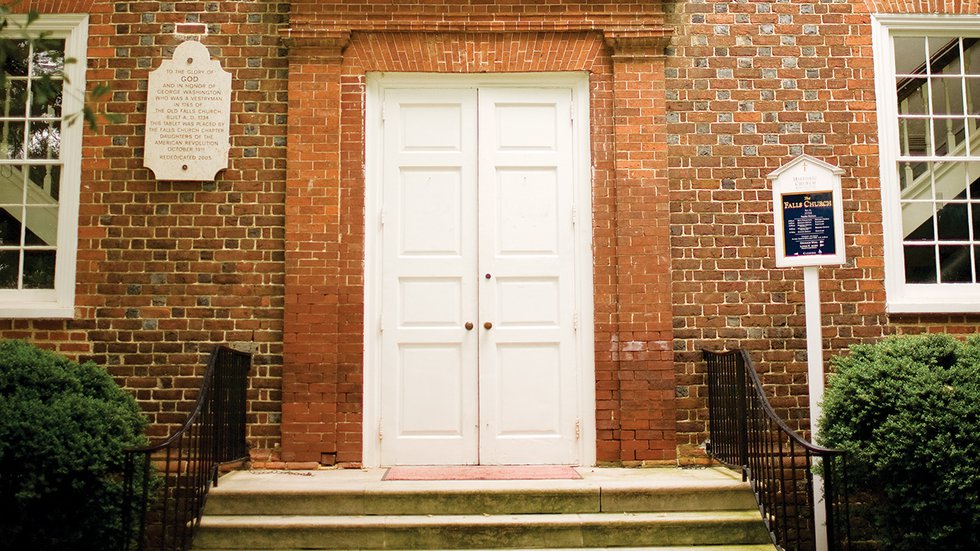
The Falls Church, the city’s namesake

Mount Hope, a Gothic Revival-style home built in 1870

Midge Wing, a longtime resident whose family owns Mount Hope

The Tinner Hill monument, a pink granite archway memorializing the founders of the Falls Church NAACP

A Tinner Hill plaque

A Victorian house in Falls Church

From Bangkok Blues, a Thai restaurant: steamed shrimp and shitake mushrooms stir-fried with aspargus in an oyster sauce

Bass player Kentucky Jim Faris, who plays at the Bangkok Blues Thai restaurant occasionally with the band Jelly Roll Mortals

Organic beef and fries at Elevation Burger

Locals chowing on the organic beef and fries at Elevation Burger

Brown’s Hardware, in business for 125 years and counting

Bedo’s Leather and other small businesses have been squeezed, literally, by larger developments.

Hugh Brown of Brown’s Hardware
There are few communities in northern Virginia that have not changed rather dramatically over the last 20 or so years. Most have acquired, at the least, a significantly faster pace, owing to population booms and the frenetic swirl of development. One of the exceptions is the City of Falls Church, a self-described “urban village” nestled between Arlington and Tysons Corner, on Route 7. It is a petite place—only 2.2 square miles in size, with 11,000 people—but one with a singular culture, thanks to its parks, world-class schools, a Victorian architectural legacy and, in general, a remarkable 300-year history. Sitting only six miles from the nation’s capital, Falls Church is a place that defies the odds, retaining the benefits of small-town life while figuring in one of the nation’s most dynamic metropolitan areas.
Falls Church began as a farming village around 1699 and was incorporated in 1875. Today, it’s an independent city, paying no homage or taxes to its broad-shouldered neighboring counties of Fairfax and Arlington. Since 1948, when Falls Church severed ties with Fairfax County, the seven-member city council has governed its own school system, police department and tax policies and has its own city manager. The city’s residents include highly educated professionals, a thriving senior population and flocks of new families who’ve recently moved into this unique place. “Living in Falls Church is great because you know so many people,” says Midge Wang, former president of the city’s Victorian Society and a resident for 36 years. “We’ve always seen ourselves as being a private, family-oriented community, and people care a great deal about the city. We are very big on volunteering, working and helping.”
Now, though, change is coming to the town that has seemed to successfully avoid it for decades. Falls Church officials say the city needs more money. Rising demands on city schools and other services have put pressure on the budget of a city that, according to Mayor Robin Gardner, has a small commercial business base. She says there was almost no development in the city over the last 25 years, and now development is needed to boost tax revenues. To accomplish that goal, says the mayor, “We started moving along a strategic plan for mixed-use development.”
Today, the talk in Falls Church revolves around the redevelopment of its City Center, which is a four-by-two-block area around Route 7 (also known as East Broad Street) and Maple Street, in addition to three other districts within the city: the West End, Broad-Penn and South Washington Street. Over the next three years, the city will build more than 500 new residential housing units (condominiums) in the City Center and add nearly 120,000 square feet of new office and retail space. “There is not a lot of commercial land in the city, so what we have really needs to be developed into higher-density [space],” says Elizabeth Friel, general manager of development services and planning director for the city. “The city has old traditions, but a fairly high turnover rate in terms of new residents coming in. We have a lot of young families, and there is a desire in the community for more services, so people don’t have to go to Tysons [Corner] but can shop right here. There are many people, loyal to the city, trying to do all their errands and shopping here. We are just increasing the variety of services. …”
City manager F. Wyatt Shields says the new development is an economic imperative. “[We need] additional density for the tax revenues and the sustainability of our city,” he says. The building plan is aimed at improving the Falls Church lifestyle, Shields adds, and the new developments will be “better” than what they’re replacing—a handful of strip malls built around the city in the 1950s. To maintain the small-town feel and preserve its treasured open spaces, the city’s building codes stipulate that new construction can be only as high as 75 feet, or 115 feet for those who obtain a special zoning permit.
When the City Center overhaul is complete, say officials, Falls Church will be the only walkable city in northern Virginia. “I think the impetus for mixed-use development is that we [all] wanted a walkable lifestyle,” says Mayor Gardner, “a place where people can work, live, play and be able to share with others who live around them in our downtown.”
And how will this redevelopment affect merchants now in the middle of town? Anthony Akis, the owner of Anthony’s Restaurant, a diner he opened 36 years ago on Broad Street, is not sure. “I don’t have a problem with changes, if changes are for the better,” he says. “Of course there is a need for tax money to support city government, city schools, city parks.” His eatery serves typical diner fare all day long, in addition to traditional Greek and Italian dishes. One day recently, he obligingly served a customer a T-bone steak at 10 a.m.
Within the Falls Church city limits, there more than a few businesses that, like Anthony’s, have been around for a long time. The German Gourmet, on the Lee Highway (or Route 29), is a grocer that has specialized in fresh German fare for nearly 40 years. Brown’s Hardware is the city’s oldest business; it’s been in the same location (the corner of Washington Boulevard and Lee Highway) for more than 125 years. Established in 1883 by James W. Brown, then run by his son Horace, the store is managed today by James’ grandson, 82-year-old Hugh Brown, who declares, “I am the last survivor.” Business, he says, is very good.
The same is true at a much younger firm—the original location of Elevation Burger, which can be found toward the center of town, on south Washington street. Known for its 100 percent organic, grass-fed, free-range beef, French fries cooked in olive oil and vegetarian options, Elevation Burger is an expanding, three-year-old restaurant company that locals assert will be challenging Five Guys and others in the casual-food market.
The Victorian Era lasted from 1837 to 1901, coinciding almost exactly with the period in which Falls Church experienced its greatest growth. After the Civil War, a large number of people dislocated by the conflict moved back to Falls Church. In 1860, the Washington and Old Dominion Railroad (originally the Alexandria, Loudoun and Hampshire Railroad) brought rail service to Falls Church, connecting it to Alexandria and Leesburg. Shortly after the Civil War, a direct rail line was built between Falls Church and Washington. This link straight into the nation’s capital attracted new residents—in particular government workers who could commute to the city and back to their tranquil homes after a day’s work. Most owned half-an-acre or more of land and built homes in the style of the time, which was Victorian. Around the turn of the century, Falls Church became even more appealing to newcomers when an electric trolley line into Washington was established.
Linda Lau, a past president of the 130-member Victorian Society at Falls Church, says the city thrived after the Civil War, and honestly embodied the principles of Victorian life, where everybody knew everyone else and the atmosphere was welcoming and familial. “Everybody worked for the greater good of the community, to beautify it, to have functions, to plant trees, and most of the construction of the homes took place during the Victorian era. That was the style of house at the time.”
Midge Wang, in her 70s, passionately embraces the Victorian history of Falls Church and says the local society chapter is extremely active with programs, reenactments and demonstrations that illustrate Victorian culture, manners and history. “It was such an elegant time,” she says wistfully, “all the gentility, all the social things. I think it was more people-oriented.” She lives with her husband, son and his wife at Mount Hope, also known as Duncan House. Purchased in the 1960s by Wang’s family, the Gothic Revival-style home was built in 1870 for Captain William Duncan, who was mayor of the town of Falls Church from 1881 to 1882.
Wang says that while the city has lost 20 Victorian homes since 1963, 90 Victorians are still around. She believes this relatively large inventory of Victorian houses defines the city’s character. The Victorian Society was started about 11 years ago, she says, “because people kept talking about Falls Church as being Colonial, and you can’t sell yourself as Colonial when you’re next to Alexandria and Georgetown. People drive through Alexandria and street after street you see Colonial houses, and what have we got? One church. But we have these homes.”
The church to which Wang is referring is The Falls Church and namesake of the city. Built in the mid-1700s, the Anglican Falls Church was the first major structure in what was otherwise a farming community with tobacco, rolling roads and some taverns. Vestry members of The Falls Church included George Washington and George Mason.
In the early 1800s, Falls Church blossomed into a prosperous farming village, attracting families from all over New England. The land’s rich soil was fertile compared to the rockier ground in New England, yielding abundant fresh fruits and vegetables, eggs, meat and firewood. The village sold this bounty to buyers from throughout the region, including Washington, D.C., which, upon being established in 1790, figured prominently in the growth of Falls Church.
Wang says she and her family are “all history buffs.” She describes in detail the tensions sparked by the Civil War, which caused a large rift within the Falls Church community. In 1861, Falls Church was just about equally divided between abolitionists (“Unionists”) and Southern sympathizers (“Secessionists”). Shortly after their victory in the First Battle of Manassas, Confederate soldiers occupied the city for two months, forcing Unionists to hurriedly pack up their wagons and go to Washington, until the village was taken by Union troops for the remainder of the war. At one point, Falls Church citizens from both sides fled the city, depleting the population by almost two-thirds. “We didn’t realize how much the city was affected because there wasn’t a major battle,” says Wang. “When the Union troops moved back in, you had to have a pass to walk down the street for five years. The whole time, you had troops everywhere. They closed every church and every school, and they all became hospitals. We didn’t have a battle, but we have these scars of war.”
In June of 1861, a civilian named Thaddeus S.C. Lowe launched an air balloon to observe the Confederate Cavalry, a mission that is believed to be the first aerial reconnaissance in American military history. Lowe launched his balloon from Taylor’s Tavern at the eastern end of Falls Church, where the area’s largest Koons Ford dealership sits today.
Not far from the historic observation balloon site, on the city’s main thoroughfare, Broad Street, is one of the city’s more grand Victorian homes. Named Tallwood, it was built in 1870 in the Colonial Revival style. The house was purchased in 1890 by Yale Rice, a descendant of Elihu Yale, for whom Yale University is named. In 1938, Dr. Milton Eisenhower purchased the home, which was frequently visited by his brother, Major Dwight Eisenhower, during the planning days at the start of World War II.
According to its 2007 annual report, Falls Church identifies environmental harmony, neighborhood preservation, community life and being a “special place” among its highest priorities. It certainly sponsors many diverse community events, most of which are free to the public and aim to highlight the city’s history and diversity. In 2007, for example, one could attend Farm Day, a Halloween Carnival, a Civil War Thanksgiving Reenactment, a Holiday Craft Show and the Black History Celebration & Celebrity Basketball Game. These are in addition to the city’s more widely known events and attractions—the monthly First Friday events showcasing local artists and art dealers, the Tinner Hill Blues Festival held every June, and sundry events at the famed State Theater. Built in 1936, State Theater operated until 1988 as a movie theater. It was restored in the late 1990s and re-opened as a performing arts and music venue, where it brings name performers to the area most nights of the week.
One Saturday morning staple is the year-round Farmers Market, held in the City Hall parking lot. The market offers products ranging from strawberry-banana preserves to buffalo meat and wine, and there is even a booth staffed by Fairfax County’s master gardeners, who proffer free advice and will happily study soil, grass and plant samples hauled in by visitors. In the warmer months, nearly 40 vendors turn out, some of whom have been selling at the popular weekly market for more than decade.
Famous for its trees and ongoing efforts to plant new ones throughout the city, Falls Church staged the first Arbor Day in Virginia, in 1892. Largely through its Village Preservation and Improvement Society, established in 1885, the city holds Arbor Day festivities and Independence Day readings every year. What’s more, it annually cosponsors, with the Falls Church Recreation and Parks Department, summer concerts in Cherry Hill Park. The city also hosts Civil War Days, a fall festival and its well-known Memorial Day Parade. “It’s one of [our] biggest events,” says Mayor Gardner, a mother of two 7-year-olds. “If you live in the city, you don’t go out of town on Memorial Day.”
Gardner is proud that the City of Falls Church has actually not changed that much over the years, thanks to its strong sense of community. “When you think of Falls Church, that is what it is,” she says. “There are so many organizations here that everyone has the opportunity to participate in designing the community, and everyone who has a point of view can express [it]. That is one of the great things—you don’t feel like you are [irrelevant].”
Wang agrees. “In the 1870s, after the war, you had a trolley ride that came from Washington out here, and you had the train line coming out, so you had people who worked in the city for the government, but they lived out here in the country. It was a bedroom community for middle-level bureaucrats back in the 1870s, [and it’s] the same thing today—except now they have Route 66 and the Metro.”
For some lucky places, even those up against the hurly-burly of big metropolitan areas, people, community and tradition still count for something. Or is it everything?