
In April 1942, 29 crew members from a German U-boat were secretly buried at night in Hampton National Cemetery. The incident that led to their deaths was the first “bright spot in a dreadful period” for America in the early days of World War II.


A picture of the burial service in 1942. Fifty-two prisoners from Fort Monroe prepared the graves of the German sailors, who were given full military honors. The burial service was read by the Catholic chaplain, followed by the Protestant chaplin. U.S. seamen fired three volleys, and Taps was sounded.

Wartime photo of the graves of U-85 sailors in Hampton National Cemetery
Last November, a small remembrance was held amid the rows of white headstones aligned at Hampton National Cemetery. A bugler from the U.S. Continental Army Band sounded taps, and several dozen Army, Navy and Air Force officers and members of their families, along with a scattering of other interested individuals, stood by respectfully, listening to Col. Reiner Schwalg eulogize the 29 sailors interred in the cemetery since the early days of World War II.
Col. Schwalg is the German National Liaison Representative at nearby Fort Monroe. The military officers are members of the Federal Government of Germany’s armed forces, serving at various U.S. installations in the Hampton Roads area. This ceremony, held annually, commemorates an unusual incident that occurred on April 14, 1942.
“The night was clear with many stars visible, the sea was very nearly calm, the water phosphorescent, a wind of force one was blowing from the southeast,” begins Capt. H.W. Howe’s report on the early morning hours of that day. The skipper of the U.S.S. Jesse Roper continues, “Bodie Island Light [on the southern end of Nags Head, at Oregon Inlet] and Bodie Island Lighted Bell Buoy #8 were [discernible] to starboard.”
The Roper, a World War I destroyer, had been on anti-submarine patrol the evening before. Howe was recounting, for the Commander of the U.S. Fleet and Chief of Naval Operations, the sea and weather conditions when his ship had first made radar contact with an unidentified craft off the North Carolina coast a few minutes after midnight. The radar contact was followed by another alert: The ship’s sonar operator had picked up the sound of turning propellers. The two contacts coincided, providing the range and direction of the vessel. Sailors aboard the American ship then spotted the wake of what appeared to be a small vessel running away at high speed.
The Roper pursued. “When the distance had been reduced to 300 yards,” Howe’s report states, “the vessel cut sharply to starboard.” At this instant, using a 24-inch searchlight, Roper officers identified the vessel as a large submarine.
According to Capt. Howe’s report, the submarine continued to turn to starboard—circling inside the turning radius of the ship in an apparent effort to make itself a difficult target. The Roper aimed its searchlight at the submarine and opened fire, first with the machine gun battery and then with the ship’s largest deck gun. It was during this early action that the vessel, a German U-boat, fired a torpedo at the Roper. It missed, passing close down the port side of the American ship.
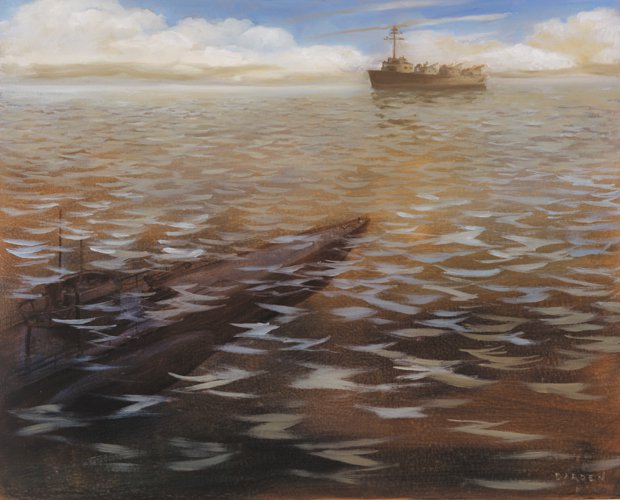
Oddly, the U-boat, later identified as a U-85, did not attempt to submerge once the Roper spotted it. (German subs had numerical designations, not names.) U.S. officials later surmised that the sub was recharging her batteries, which required the sub to be on the surface of the water. The Germans had a bigger problem: They were in shallow water. So even with a charged battery, the U-boat couldn’t submerge. That sealed its fate. With the sub taking repeated hits from the Roper and suffering a large hole in its conning tower, the commander of the U-boat, later identified as Oberleutnant (First Lieutenant) Eberhard Greger, decided to scuttle his vessel rather than see it captured. He ordered his crew to abandon ship as the submarine began to slowly settle beneath the surface of the water, stern first.
Roper crewmen spotted a number of the U-boat’s crew on deck and then later sighted them in the water. At this point, the Roper’s skipper, not knowing whether the submarine was attempting a ruse or there might be other German subs nearby, ordered a barrage of 11 depth charges (explosive devices that detonate at specific depths) to be fired. The depth-charge explosions, together with the gunfire, killed all of the U-85 crew members—between 40 and 45 men.
It was not until the early-morning hours, when a Navy patrol plane arrived on the scene, that the Roper was able to lower two lifeboats into the water to search for and recover the bodies of German sailors. Within a few minutes of this recovery operation, an airship (blimp) was observed approaching. She circled the Roper, providing protection against other submarines while the boats were in the water. According to Howe’s report, seven planes of various types appeared on the scene during the recovery phase, as well as a British trawler.
Within 48 hours of this action, the bodies of 29 Germans were moved to shore, transported to Hampton and buried in secret with full military honors in the U.S. National Cemetery. (The others were not found.) The burial service commenced at 10:00 p.m. and was read first by the Catholic and then by the Protestant chaplains from nearby Fort Monroe. Fifty-two German prisoners of war being held in the Fort Monroe stockade dug and later filled in the graves. A party of 24 U.S. seamen fired three volleys, and then a bugler sounded Taps. The official party at the funeral included a delegation of Army and Navy officers, among them eight senior and junior Army officers who acted as honorary pallbearers. Although the military authorities intended to make no public announcement of this action, word quickly got out among the local residents, many of whom observed the interment.
The facts surrounding the engagement, and why these enemy sailors were buried at night and quickly, remained secret until the Navy released all records pertaining to the incident in 1963. There are several likely explanations. Perhaps the main reason had to do with the poor state of our anti-submarine operations in the early months of World War II. In those days, German U-boats operated with near impunity along the East Coast. In fact, although the skipper of the Roper may not have known it, just five days prior to the U-85 encounter, another U-boat, the U-203, had torpedoed and sunk the tanker San Delfino in the same Atlantic waters. In the first half of 1942, the Germans sank nearly 200 U.S. merchant ships. The average during April alone was five or six per week. German submariners named the period from January through August 1942 “the happy time.”
At that time, the public was not fully aware of the threat posed by U-boats. And the U.S. Navy wanted to keep it that way, partly to protect its image. Top Navy officials felt that if people were fully informed about the threat and the Navy’s failure to deter the enemy, public morale would be greatly affected. Another consideration was the possible negative reaction of the public to authorities having treated these “Nazis” in a civil manner, after so much drumbeating about their atrocities.
As a young boy growing up in Norfolk prior to and during World War II, I felt the early impact of hostilities. I became particularly aware of the U-boat phenomenon one Sunday afternoon while crossing Hampton Roads with my dad on “Old Smokey,” a swift Chesapeake & Ohio ferry named the S.S. Virginia. It was just after Germany had marched into Denmark, on April 9, 1940. There were a number of merchant ships at anchor and possibly riding out the war. Many had flags painted on their sides to communicate their neutrality. As we approached a Danish ship, my father, who was a newspaperman, suggested that I might want to take a picture of it with my Baby Brownie camera. I did, and the resulting photo ran in the Norfolk Virginian-Pilot the next morning with the caption, “No place to go.”
The sinking of the U-boat was a signal moment. It was the first German U-boat to be destroyed by the U.S. Navy in World War II. By the end of the war, the U.S. would sink, scuttle, capture or otherwise destroy 1,100 U-boats. Six of these were sunk off the Virginia coast.
Still, there were tough days ahead. According to Marc Milner, a history professor (and head of the history department) at the University of New Brunswick, “The U.S.S. Roper’s sinking of U-85 was one bright spot in a dreadful period of the Atlantic War along the U.S. seaboard—and one that only got worse in the two months that followed that night in April 1942. Despite patrols by some 80 small vessels and 160 aircraft, fewer than a score of U-boats sank more shipping off the U.S. east coast and in the Gulf of Mexico in May and June than was lost globally in any previous year. Throughout the spring and summer, oil slicks, wreckage and bodies littered the shoreline from Cape Cod to Brownsville. Some historians have described it as a defeat worse than Pearl Harbor. They’re right, not least because the U-boat attack was hardly a surprise, and because the solution was so simple: convoys.”
Among material found on the bodies of the German crew members were two diaries and the submarine school notebook, which made it possible to reconstruct the German submarine’s history. The U-85 was a 500-ton boat of the type VII B, commissioned on June 7, 1941. After a cruise to Norway for training, she participated in three war cruises prior to leaving from Saint Nazaire on March 21, 1942, for her fourth, and final, mission.
The German diaries detailed other, earlier encounters of the sub with the U.S. military. It had had run-ins with air patrols, escaped attack by another U.S. destroyer and chased down allied shipping. According to the sub’s records, it had torpedoed three ships, the third on April 10, just four days before her encounter with the Roper.
That the U.S.S. Roper and the German U-boat circled in fairly close range of each other was an unusual circumstance. Nearly all sea battles during World War II, both in the Atlantic and Pacific theaters, took place at long range. Opposing ships were out of sight of one another. Imagining the intense emotions of the men on board the Roper and the German sub during this clash conjures up stories of the great naval engagements between British and French frigates during the Napoleonic Wars, and between British and American frigates during the War of 1812. This encounter was small, one-sided and not nearly so dramatic, but it was the start of the U.S. Navy’s counter to the German sub threat, and so was a notable event in World War II.
Once the Navy released the U-85 report, including details of where the sinking had occurred (at coordinates 35:55N, 75:13W), private divers began searching for the sub. She was found resting on her starboard side in approximately 100 feet of water.
In 2001, the famous German encoding device, Enigma, was recovered along with a hatch cover. Initially, the German government demanded that Enigma be returned, contending that because the submarine had never surrendered, it still belonged to the German Navy. Ultimately, they changed their mind and allowed the encoding device, along with the hatch cover, to be placed on loan with the Graveyard of the Atlantic Museum in Hatteras, N.C.
It’s said that one can tell a great deal about a nation by the way it honors fallen warriors. In the uncertain early days of America’s entry into World War II, the Navy took the time to give its military foes a proper burial. That speaks well of our government at that time. It is equally noteworthy that the German government annually honors her own, buried in one of our national cemeteries.
This article originally appeared in our August 2008 issue.