
After a painstaking restoration effort, a historic Albemarle County manor house has been returned to its 1920s design, when renowned architect William Lawrence Bottomley and landscape architect Charles F. Gillette imbued it with an effortless charm.

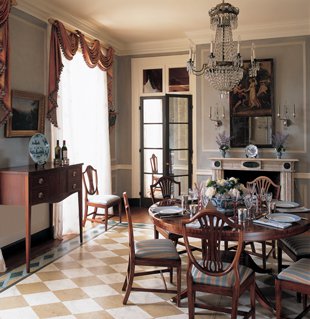
The dining room

The map room, with a Harrison Higgins table and walls covered in crimson felt

One of Blue Ridge Farm’s many tastefully decorated rooms

Charlie and Will in the pool

Sink, changing room in pool pavilion

View of the sitting room in the pool pavilion

Pavilion dining room

Annie Cory reading a book

Entrance hall

A view from the sunroom into the armillary garden
In 2002, when Chuck and Kim Cory purchased historic Blue Ridge Farm, a 150-year-old estate that traces the green-soaked hem of Afton Mountain in western Albemarle County, they had a mission: to recapture its 1920s design, when it was a gracious Georgian Revival country residence. Renowned New York architect William Lawrence Bottomley and gifted landscape architect Charles F. Gillette are credited with infusing the place with that aesthetic, but it slowly faded in subsequent decades under a succession of owners. Though Blue Ridge Farm was placed on the National Register of Historic Places in 1991, by then, says architect Madison Spencer, “it was one owner away from going in the wrong direction.” There was talk of subdividing the property and building a golf course.
Fortunately, that did not happen. The Corys partnered with Spencer, an old friend and classicist who practices from offices in Charlottesville and Newport, Rhode Island—and now, after a multi-year renovation, Blue Ridge Farm once again evinces Bottomley’s brand of good living. Indeed, the group Preservation Virginia gave the estate, which now occupies 167 acres, its 2007 Private Preservation Project of the Year Award. But it is no house museum. Though Blue Ridge Farm is sophisticated enough to house the couple’s notable collection of American art and furniture (including an 18th-century mahogany dressing table attributed to master cabinetmaker Job Townsend), it is a home with a beating heart for a busy couple with three young children. “Bottomley designed with a sense of how people lived,” says Spencer.
The same might have been true in 1906. That’s when Randolph Ortman and his wife, Blanche, purchased the estate, then known as Alton Park. They renamed it Blue Ridge Farm and developed it to raise livestock and horses. The original two-and-one-half-story brick farmhouse—built between 1852 and 1854 for a man named Smith on what was then a 600-acre tract of land—was five bays wide, with a high mansard roof covered with slate shingles, and a large porch reached by a flight of wooden steps. Around 1900, Washington, D.C. architect Waddy Wood drew up plans to remodel the house in the Colonial Revival style, but the renovation was never completed.
In 1923, the Ortmans decided to expand the house—and commissioned Bottomley for the design. It would be one of the three he would complete in Albemarle County. Bottomley retained the home’s original center block and added two asymmetrical brick wings, one room deep, to maximize the views of the gardens and the mountains. He replaced the window sashes on the first floor with French doors and added a balustrade and cornice to the roofline. In addition, the interior was completely redesigned, including nearly all of the mantels, paneling, woodwork, trim and stairs. Characteristic of Bottomley’s work is the progression of light to dark rooms, the open staircase and the high-quality brick and woodwork. Gillette, whose involvement in Blue Ridge Farm actually preceded Bottomley’s, designed an expansive English-style landscape, enlarged and redesigned brick terraces, and created formal boxwood and flower gardens.
Blue Ridge Farm passed out of the Ortman family in the 1970s, and subsequently through a handful of owners. A gradual accretion of modern elements—including what Chuck Cory describes as a “Vegas-style” farm office with shag carpet, an awkwardly placed pool, and a brown marble his-and-hers bathroom and sterile all-white kitchen—combined to obscure Bottomley’s aesthetic.
When the Corys first saw Blue Ridge Farm in 2001, they were living in a home they had restored in Hillsborough, California. It had been built in 1915 and had a garden designed by another distinguished landscape architect—Thomas Church. Chuck Cory, a Morgan Stanley executive and a native Virginian who earned law and business degrees at the University of Virginia, says he had always wanted to move back to the Piedmont area, and, for a couple with a keen interest in historic properties, this proved the opportunity. They previously had restored historic homes in Litchfield County and Darien, both in Connecticut, as well as an apartment in New York City, and were knowledgeable collectors of American furnishings and art.
Chuck and Kim, who is from California, say it was important to them to find a house that was on the National Register. “Somebody has to come and take care of these places or they’ll disappear,” explains Chuck. The couple hired Spencer, who has worked on numerous historic properties, making him what Kim calls the “quarterback” for what would be a serious restoration project done long-distance at first, from the Corys’ home in California. “Madison loves to envision how people are going to use their house,” says Kim Cory. “We knew, with his help, we could bring Blue Ridge Farm back.”
They succeeded in doing that. The restoration pace was slow, says Spencer, because the Corys had a specific, even lofty goal in mind. “Rather than sweating what they could turn the house into,” he says, “Chuck and Kim always wanted to do what was appropriate to what Bottomley had already achieved.”
Kim laughs and says their mantra throughout the restoration was, “What would Bottomley do?”
The couple spent six months combing through Bottomley’s archives, visiting other Bottomley buildings and digging into Blue Ridge’s history. Among other things, their investigative work revealed that several upstairs fireplaces had been bricked over, and that two columns that Bottomley had installed in the double-sitting room, off the center hall, were gone. “There was character in the house that had been lost,” explains Spencer.
Kim says the layout of the formal gardens was still evident, but the plants had been let go. The couple also discovered that the infrastructure of the house—plumbing, electrical and HVAC—needed a complete overhaul. The next 18 months were spent breaking down sections of the house and resolving numerous mechanical issues.
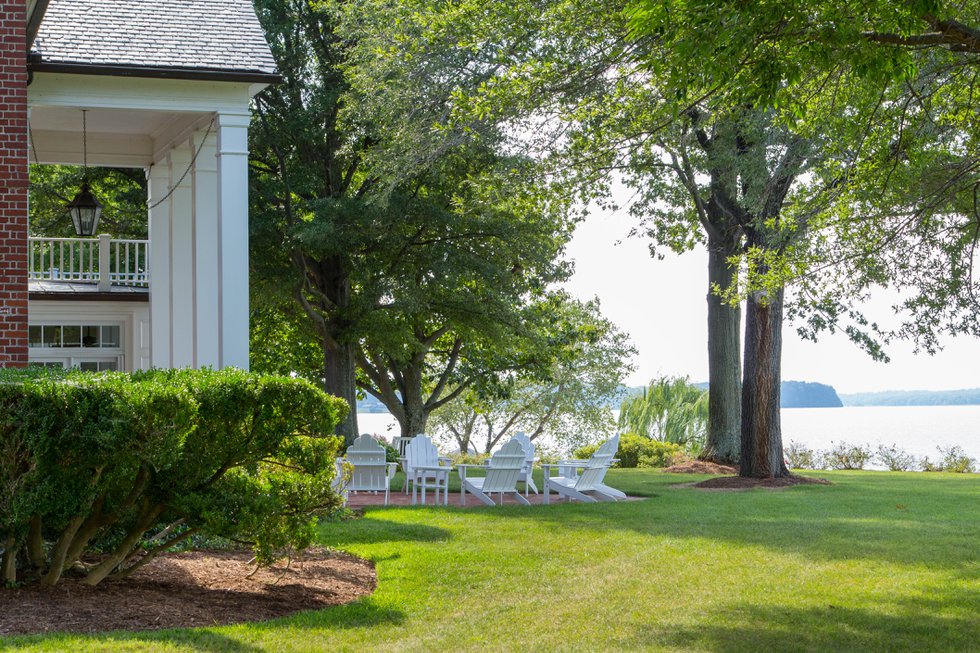
The ensuing restoration encompassed the home’s 12,000 square feet and 33 public rooms as well as many of its 17 outbuildings. The offending farm office was demolished, and the original pool was relocated. The drive to the main house was reengineered to create a lower deck so that cars parked in front wouldn’t obscure the mountain view. The front terrace was rebuilt with tiers of bluestone leading to Gillette’s original boxwood garden on the south side of the house.
Inside, the Corys removed bookcases that had been added to the double sitting room to reveal Bottomley’s detailed woodwork, including an inscription carved into the molding that reads, “Love and contentment abide here within these four walls.” They replaced the missing columns separating the two rooms and painted the walls Farrow and Ball’s Cooking Apple Green. Says interior designer Ralph Harvard, a fellow Virginian practicing in New York whom the Corys commissioned to help them arrange their collection of antiques and adapt the home to their lifestyle, “We used a lot of strong colors throughout the house, and we painted all the ceilings in warm colors to make the rooms glow.”
To restore Bottomley’s flow of light to dark rooms, a progression intended to exaggerate the effects of each, the Corys enclosed the sun porch off the dark paneled library adjacent to the double sitting room. To complement a flagstone floor already in place, the couple added large windows, a plaster ceiling and cornices—and heat. The brick was whitewashed to create an airy year-round space.
A Bottomley trait that did not have to be reclaimed is the perfect dimensionality of many of the rooms, perhaps most evident in what is now the map room. To accentuate this, the ceiling’s geometry is purposefully reflected in the painted floor cloth and in the details on the custom-built, reading-height Harrison Higgins table in the center of the room. The walls are covered in crimson felt and display Chuck’s collection of maps focused on Virginia and the Age of Discovery. Chuck had a folding wall installed to expand his display space, and it opens to reveal the 1775 edition of A Map of the Most Inhabited Part of Virginia, by Joshua Fry and Peter Jefferson.
Many of the materials used in the restoration were salvaged from the property. A pair of screen doors monogrammed with the Ortmans’ initials was found in the barn and returned to the rear door of the main entrance hall, and a stair-riser in the kitchen was made from a board with “Claiborne & Taylor, Ortman Job” scrawled on the back that was found in one of the outbuildings. Herbert Claiborne was often Bottomley’s contractor in Virginia and was himself a skilled craftsman who had worked on the reconstruction of Stratford Hall. Kim Cory describes that find as exciting for everyone.
“Chuck and Kim have always been interested in the adventure” of the restoration, says Spencer, “and that can be infectious on a job site.”
The two upper floors of the house, which contain bedrooms and additional sitting rooms, did not receive short shrift in this process, nor did the basement, formerly a storage space. Spencer rebuilt a staircase to the lower level from the center hall, and he and the Corys reimagined the space. It’s now a wine cellar that can hold 5,000 bottles and has been the site of intimate wine dinners and tastings. A card room leads to an outdoor arcade with views of rolling hills—the site of a birthday dinner for 50 guests on an evening not long ago. Next to the former walk-in silver vault (now storage for canned goods from the farm’s ample gardens) is what Spencer playfully refers to as the gentleman’s pissoir. Urinals retrieved from a defunct New York hotel are mounted on a wall of dark soapstone near a gleaming white double-pedestal sink surrounded by exposed natural brick and whimsical light fixtures. The remainder of the basement contains utility rooms and children’s art and game rooms.
According to Spencer, Bottomley had a penchant for “pulling details and weaving them into the fabric of the house.” In homage to this trick, Spencer used a fretwork motif from the library molding in the new pool house. The blue-hued space—with a bell-jar roof inspired by a Gillette pool pavilion in Richmond—was designed so that a 400-year-old white oak on the property would always be in view, as would many of the original Gillette gardens, painstakingly restored by Kim, an accomplished gardener, with the help of landscape architect and Gillette scholar Rusty Lilly.
All of the work meant “a slow migration into the house,” says Kim Cory. The family spent several summers living in one of the farm’s guest houses while the restoration progressed. During the rest of the year, they flew in every six weeks to spend a day on-site. Good, authentic work can’t be rushed—and today Blue Ridge Farm conveys an effortless charm.
But don’t be fooled. “We didn’t wave a wand and say, ‘Here is your house,’” explains Spencer. “Blue Ridge Farm is the way it is now because of Chuck and Kim’s stewardship.”
For the Corys, reclaiming Bottomley’s legacy isn’t just about bricks and mortar, it’s about living well. “A house should be gracious enough to host the president of UVA for dinner,” says Chuck, “but family-centered enough to play Crazy 8s in any room.” Blue Ridge Farm is both.