
Some one million people visit Shenandoah National Park annually, so clearly its creation in the 1930s has had a lasting impact. But it’s not as well known that some 500 families were forced to move off their land to make way for the park.
Time to Leave
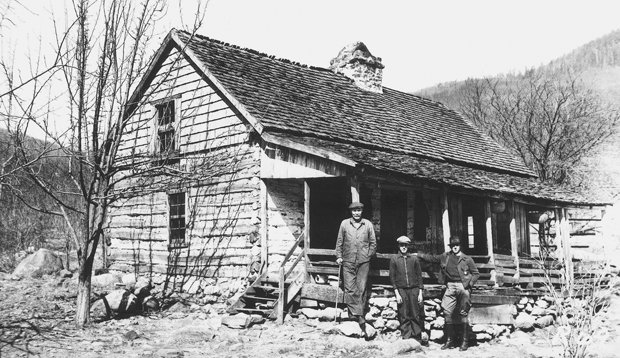
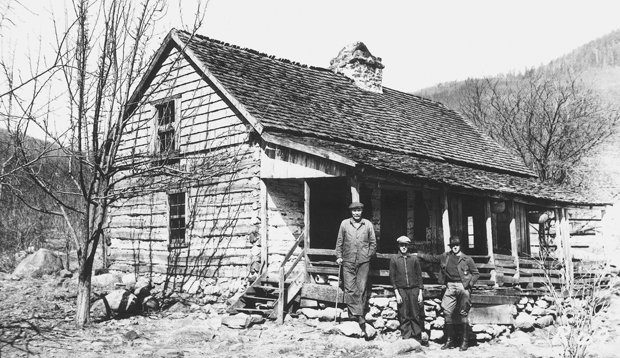
A typical mountain home that was razed by the Civilian Conservation Corp. Pictured are William Erastus Nicholson, his son Robert and a Park Ranger. Nicholson owned 37 acres and was paid $615 by the state after the property was condemned.

A Time to Leave
Teeny Florence Corbin Nicholson, wife of George Bailey Nicholson

A Time to Leave
George W. and Lucy E. Hurt at their home in Madison County. George Hurt owned 16 acres and was paid $420 by the state. The couple was later granted “life tenure” so that they could live out their lives without having to move.

A Time to Leave
Matilda Breeden, a Greene County resident, writing on the front porch of her mountain home. She was one of about 40 elderly people who were granted “life tenure” and allowed to stay in their homes. She moved in 1946, the year this picture was taken.

A Time to Leave
A letter written by one of the people displaced from their home in the Blue Ridge Mountains.

A Time to Leave
“Answer at Once: Letters of Mountain Families in Shenandoah National Park, 1934-1938,” edited by Katrina M. Powell (left); A letter referenced in the book (right)
When Virginia’s General Assembly passed the Public Park Condemnation Act in 1928, the fate of some 500 families was sealed. Those families lived on 3,000 land tracts, comprising nearly 200,000 acres, in Virginia’s Blue Ridge Mountains. The Condemnation Act took that property from landowners and tenant farmers and donated it to the federal government to establish Shenandoah National Park.
The mountain families got the dire news from Virginia’s State Commission on Conservation and Development, which sent the landowners a “Notice to Vacate” letter. It effectively ordered them to sell their property at a “fair market price” (ranging from $2 to $25 an acre) and move elsewhere. Those who did not own property, who were tenant farmers or who wished to remain in their homes as long as they could, were given some leeway: The state allowed them to stay on their property until alternative housing was found—a process that in many cases took three or four years.
While the decision to create Shenandoah National Park (SNP) was a government initiative, it was facilitated by Virginia businessmen. In the 1920s, the National Park Service announced that it wanted to establish a park in the eastern part of America, and prominent Virginia landowners, led by Skyland Resort owner George Pollock, seized on the opportunity. Pollock proposed Virginia’s Blue Ridge Mountains—with their panoramic views, waterfalls and proximity to Washington, D.C.—as an ideal location for a park. In 1924, Pollock and other businessmen formed a group named Shenandoah Valley Inc. to lobby for the idea and successfully persuaded the Southern Appalachian National Park Committee (part of the Department of the Interior) that the mountains of central Virginia could be a major draw for tourists in cars. That was the genesis of SNP, which would come to encompass land owned by Pollock.
Not surprisingly, many of the mountain residents were completely unaware of the goings-on in Washington that led to their displacement. Indeed, they didn’t get the news until the Condemnation Act was passed and the state began surveying their land. At first, the residents were led to believe that they could stay on their property with conservation easements—but that proved not to be the case. Many of the homes on the 200,000 acres would be destroyed—and all the families in that area would have to move. Needless to say, the mountain families were shocked by the development, but resistance was futile: The state and federal government had already begun to move forward with the building of Skyline Drive and the development of the park.
Of the 500 families who lost their homes, many left willingly and found other housing on their own. However, about 350 families remained within park boundaries during an interim period between 1934 and 1938. During this period, several state and federal programs determined whether those families were eligible for resettlement housing or government assistance. It was during this time that many residents wrote letters to the state and park officials who then effectively managed their property. Some 300 of the original letters were carefully preserved. They are housed at the Shenandoah National Park Archives in Luray, Virginia and were recently made public. They reveal a unique communication between families and the government—so unique, in fact, that I compiled them into a book, titled “Answer at Once”: Letters of Mountain Families in Shenandoah National Park, 1934-1938, published in 2009 by University of Virginia Press.
Scanning the 300 letters, most are practical, poignant and, in most cases, polite. In some, residents express their sadness, uncertainty and confusion about the displacement situation. A few of the missives are quite emotional, as residents try to reconcile the demands of daily life with the reality that they will soon lose their homes—and with them, perhaps, their livelihoods.
Life became bureaucratic. Families who remained in the park during the interim period were required to sign “Special Use Permits,” which outlined the rules and regulations about living on what was to become federal property (the transfer from Virginia to the National Park Service took several years). So while they lived in their homes, their homes and land belonged first to the state and then to the federal government.
Hence, there were many practical questions related to the disposition of their property prior to their departure. And so they wrote letters to state officials, requesting help with problems large and small, and to seek clarification about what they could or could not do. Many needed to have their homes repaired while they waited for word on whether the state would be offering them a new place to live, or money, or nothing. Others needed lumber or apples or fencing.
Matilda Breeden’s 1938 letter was emblematic of the anxiety felt by residents. (Note: All letters have been re-printed exactly as they appear in the book.)
Dear Sir I am asking a favor of you i have a hog to kill and hav no plac to salt my meat I would aful glad if ou would put me up just a small bilden to put my meat in. My house is so small I have no room…
Teeny Florence Corbin Nicholson wrote to Park Ranger Taylor Hoskins:
“Please have my house fixed as soon as you can for it is in sorely bad shape. Remember me to your wife. Respt. Mrs. Bailey Nicholson.
With its note of familiarity, this letter highlights the almost symbiotic relationship that developed between park officials and families who had not yet found a new place to live. As a resident living under federal policies, Ms. Nicholson had to write for assistance, and then wait for the government to make the repairs. To repair the house on her own, without permission, would have been against regulation. Still, the park was obligated to help her, and Mrs. Nicholson and others made sure to remind officials of that obligation.
Likewise, Dennis Corbin’s March 10, 1937 letter to James Lassiter, the first Superintendent of the Park, illustrates the very real sense of urgency facing families living with the specter of displacement.
Writes Corbin on March 10, 1937:
Dear Mr. lassiter
i rite to you Sealrul [several] Weeks ago and Mr taylor Hoskins did promisss to see me to talk with me a Bout waat i writen to you and i hant seen hime yeat Mr lassiter you no i did Sine a Special use permit to live at my home untill the home Steades ar redy fore occupancy and you no the time has come to go to work and to have Somthing to Eat fore this winter i am going now to prune the apples treeas and to ceep the Bushines cut frome around thime this year and to Farme the land i did 1935 i ben a looking to heare frome you long a go what i rite to you look like it Shold wold Be Satisfaction with you
i am going to obay the rules I aint going on no one place to git nothing and no one aint coming on my place to git nothing and that is Fair a man should have what he work fore”
yours truly
Mr Dennis Corbin
nethers Va
ancer soon
Corbin’s letter requests that he be able to prune the apple trees, as he did every spring, and to work the land as usual. However, since his land was under the auspices of the federal government, he was compelled that year to write for permission to do so. When he did not receive a response to his first letter to Lassiter (written on February 9, 1937), Corbin wrote this one to assure Lassiter that he was obeying the new rules.
Why the urgency? Because, as Corbin implied, pruning was needed to maximize the apple yield from the trees, and as a consequence to provide more food for the winter. (Many families dried apples for the winter). One can imagine the duress for these people who suddenly needed a special permit to do things that had been part of their daily lives for years.
And all issues seemed to require written permission, no matter how trivial. Stanley Corbin, son of Dennis, wrote to Superintendent Lassiter on February 28, 1938 with a request related to his father’s former property in the mountains.
dear Mr. lassiter I am asking you to do me a favor. Now I want you to give me the wire around George T Corbin garden whear he left. he is my father I am a poor man and Need the wire to go around my garden it ant doing No one No good whear it is at I moved out of the park and caused you all No truble so plese give it to me as I would bee thankful for it so plese let me hear from you at once.
As Stanley Corbin asserted, the fencing wire was unused, and like many residents in their letters, he appealed to Lassiter’s sense of logic and good sense: Better that he take it and use it at his new home, where he had already moved, than allow it to be lost amid the destruction of property. Likewise, resident Rebecca Baugher asked Lassiter if she could keep her “building materials” rather than let the Civilian Conservation Corps boys “burn it up.”
The socioeconomic status of the mountain families varied greatly. A few were wealthy orchard operators, others were tenant farmers, widows, ministers, teachers and maids, and some were not formally educated.
Writes John T. Nicholson of Luray on January 28, 1937:
Please excuse poor writing and all mistakes as I never had the opportunity of going to school as much as one day in all my life so far to learn to read and write. What little education I have, I picked it up here and there.
An absence of formal education did not preclude some from writing rhetorically powerful letters and asserting themselves. In fact, it is clear that residents saw their concerns as worthy of quick attention. Several, such as Stanley Corbin’s above, beseeched Lassiter to “answer at once”; another implored: “Let me hear from you at once.”
Many families were promised homesteads if they sold their land to the park. Later, after doing that, they were assessed by the Resettlement Administration and often did not qualify for the government loan needed in order to purchase the homestead. This kind of bureaucracy frustrated many residents because they felt they weren’t given adequate information. That was the case with Gird Cave of Stanley who wrote Mr. Lasiter on December 1, 1937:
the welfare woman was just hear and Says they Cant buy us a place but wants us to go and rent for our Selves but you Know as for our Contract that I had Signed up for a homestead at ada and now bin turned down…So you know that this is not fair as there is people lots younger than I that they have bought homes for and we have had no work for a good while and we don’t feel able to go out to rent. So we are ready at any time to now to move iff they will furnish us a place…So ii am willing to do any thing that is any ways right but I cant see that this deal is any ways right So I amnot willing to accept it. So use your influence iff you please as we would like to moved or Setteled Soon as we Could as you Know how it would be to be always on a dread not Knowing what to do….
Some residents, when they unwittingly breached a regulation, were quick to defend their honor. Before moving, Mr. John T. Nicholson apparently took the windows from his father’s mountain home. When the state discovered the problem, Nicholson wrote a long letter to Ranger Taylor Hoskins on January 28, 1937, to apologize and reaffirm his moral standing:
…I certainly do regret that I took those windows…but I needed [them] bad in my house…I had no thought as to stealing, I abhor, and shrink from the thought of such a thing small or great in value…Dear Chief, since I have learned that this displeased you, I have been hurt and troubled over it for more than you may imagine…To prove to you that I am in reality, and are trying hard to lieve as a real Christian should live before God and man, if you say so, I will buy you as many windows as I took from that house and will put them where ever you say. I sincerely mean this because I am grived and hurt very much over it since I saw that you were displeased because I did so, but I hope you will gladly pardon me for doing so, as I humbly assure you that I will be very careful from now on in obeying the rules and regulations of you Park officials. Indeed I have obeyed the special use permitt to the very letter and have nothing to regret as to this, and shall continue to do so as long as it please you Park officials to permitt me to remain in the Park.
Letters like Nicholson’s directly counter the written and photographed stereotypes of mountain families as illiterate, immoral and poor. While some families were not educated formally and did need assistance, those issues could not be linked to an absence of values. Quite the opposite was true, in fact.
Every community has its share of disputes among neighbors, and certainly in this respect the mountain residents were no different. Indeed, the displacement issue may have exacerbated a few disagreements. In one letter to park officials, Robert Matthews of Bentonville writes that he needs to cut hay on his erstwhile property, but his neighbor has “about 30 head of cattle pasturing on the place now.” He asks officials to move his neighbor’s cattle off the land.
Matthews’ letter was typical of the many conflicts that arose, all of which state and park officials had to resolve. In a March 24, 1937 letter, Walter Lee Cave writes to Mr. Lassiter:
dear Sir I want to no who gave fread Meadows Permission to tear down Walker Jenkins building and move it off of the Park land Mr. Hoskins told me that no one living out of the Park was not alawed to take Eny thaing out & so I want to no whear Meadows gets his athoritie from.
And where did the lost residents of what became Shenandoah National Park go? Of the 500 families who lost their homes, some moved across the state, some moved just outside the park’s boundaries, and some moved to one of seven government resettlement areas in Page, Madison and Greene counties. While the mountain families were almost uniformly cooperative during the displacement process, it’s also true that many harbored a deep sense of bitterness and regret for the rest of their lives, and in some cases the impact was felt by subsequent generations. “My daddy grieved himself to death over it,” said Florence Morgan, granddaughter of Teeny Nicholson and daughter of Richard Nicholson. “He never got over it.”
Indeed, Richard Nicholson’s 1945 letter to Senator Harry Byrd reflects the deep frustration felt by many families. In it he asks to reclaim his old home, and he speaks for others. He writes:
Mr. Byrd, a number of mountain people have asked me to write and ask you if it would do any good or be a chance whatever of the people getting their homes back to have petitions wrote out and lay these petitions before Congress on the grounds that the mountain people was badly misled when they sold their land for a Park believing that they could stay there and not be forced to move. Almost every man or woman who moved from the Park would sign such a petition.
While Nicholson may have had a persuasive argument, few families were able to return to their homes. (About 40 individuals, nearly all elderly, were given “life tenure” permits to remain in the park). The unique “blanket condemnation” of such a large tract of land remains a controversial eminent domain law issue in Virginia, and continues to inhabit the stories of families whose ancestors lost their homes in the 1930s.
Today, Shenandoah National Park is one of Virginia’s greatest attractions. Nearly one million visitors either drive or hike through the park annually, yet many tourists are unaware of the fact that people lost their homes so it could be built. It is worth keeping in mind the price they paid.