
Remembering architect Lewis A. Rightmier

Tidewater Classic
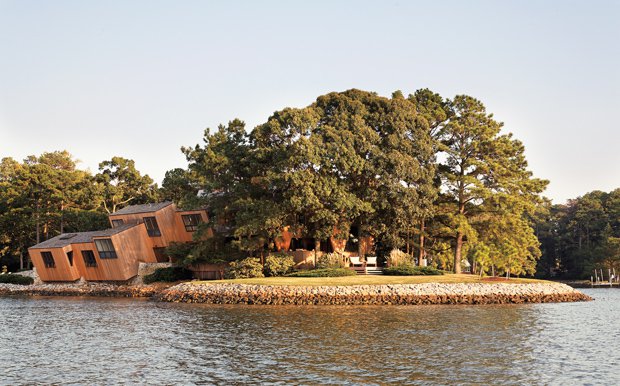
The Shibui house from the water
Although Lewis A. Rightmier (1922-89) is remembered as an extraordinarily creative architect, he was basically a simple guy, according to son Lonnie, who followed his father into the profession. “Dad was an indifferent student but an avid reader. He joined the Navy at 17, met my mom while he was stationed in Norfolk, married her and went back to Kansas State University on the GI bill and earned a degree in architecture,” Lonnie says.
“Dad grew up Mancato, Kansas, [less than] 50 miles from the marker erected at the geographic center of the U.S. Like most midwestern architects, he was heavily influenced by Frank Lloyd Wright,” Lonnie continues. Wright visited Kansas State while Rightmier was in school there.
After a stint working in Manhattan, Lew and wife Joan moved to Norfolk, her hometown. He designed Pembroke Mall while working in Harry Dudley’s office and collaborated with Bill Walsh on St. Pius X Cathedral in Norfolk and St. Gregory’s in Virginia Beach. Cove Point in Virginia Beach, a condominium built on pilings in Linkhorn Bay, is one of the most unusual designs among his numerous multi-family and hotel projects.
After 30 years in commercial practice, Rightmier decided in 1967 that he’d rather design houses. His widow, Joan Rightmier Talke, says, simply, “Lew found his niche doing residential.” Their Virginia Beach residence, which she still occupies, was built partly as a demonstration to clients, but mainly as his personal definition of hearth and home.
Rightmier created open, flowing floor plans that included intimate spaces on varying levels. He always included the flexibility of places for the family to gather and places to be alone. He eschewed doors except on bedrooms and bathrooms. He was a nature lover who used windows as a connection to the world outside. He also brought the outdoors in, by using exterior materials such as cedar siding on the interiors. His houses were sited to take advantage of the winter sun, but large overhangs sheltered them from the summer heat. He’d cut a hole in a deck to keep from taking out a tree.
Like his idol Frank Lloyd Wright, Rightmier favored indigenous materials. Riprap slid into that category because of its ubiquitous use for stabilizing shorelines and ditch banks throughout the coastal plain. He liked its rough-textured honesty, and the lowly material no one had ever thought to use in residential construction covered foundations, chimneys, fireplaces and garden walls in his designs. Frequently, his trademark riprap fireplace was a double-sided room divider.
Lonnie witnessed firsthand the deliberative way he worked. “Dad would sit down with clients and listen to them. Once they left, he’d go to his chair and sit and think. He might sit for a day, or for two days. Then he’d disappear into his office and come out a couple of days later with a set of preliminary plans and elevations to present to his clients.”
Friends remember him as a quiet, introspective man with a terrific sense of humor and indisputable talent. Pamela Turner, who lived in Shibui until moving to another Rightmier-designed home, remembers, “He was a big huggy boy, a farm boy, yet you could feel the art in him.”
Al Abiouness, president of the structural engineering firm Abiouness, Cross & Bradshaw, worked with Rightmier on numerous projects, including his own office. “Lew was a really fun guy and one of the most creative people I’ve ever known. Sometimes his designs were so innovative that contractors were scratching their heads.”
Jim Sykes, owner of J. M. Sykes Inc., never had a problem with Rightmier’s plans. “Everything was right there. All you had to do was follow them.
“Lew was a futuristic guy, always on the cutting edge,” Sykes concludes. “He didn’t want to do what had already been done.”