
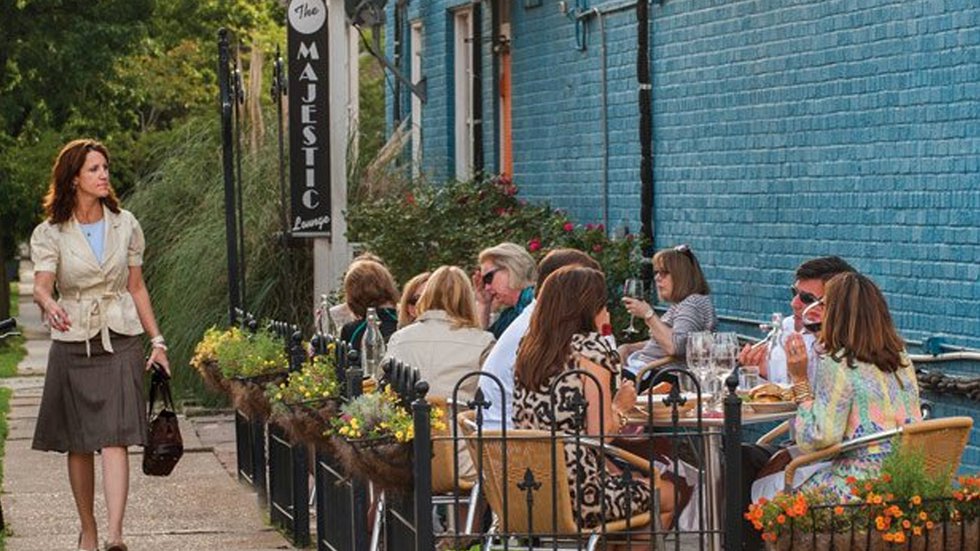
Staunton is not a high profile town, but it’s got a wonderful weekend scene

The Valley Vibe
Downtown Staunton

Mockingbird, a restaurant and roots music Hall

Staunton Grocery restaurant

Zynodoa restaurant
I’m coming clean! Up till now, in my three-plus years as editor of Virginia Living, I have been a tiny bit indifferent toward Staunton. I didn’t have a negative impression of the Shenandoah Valley city—not at all; I simply knew so little about it that I never had a sense of urgency about visiting the place.
Well, now that I have visited Staunton, I feel humbled, awful—suffused with Piedmont guilt—because it is a pretty cool town, as anyone who lives in or has visited the place well knows. Staunton should not be compared with Charlottesville—its larger, more prosperous, more urbane neighboring city—but it doesn’t need to be: It’s got plenty of good qualities of its own.
For starters, Staunton is a very manageable place. You can easily walk around downtown Staunton and do a lot—and indeed, that arguably is the best thing about the place. Most of the action is in the five- or six-block downtown area—which means that you can park your car and start strolling its somewhat hilly streets and not climb back in your vehicle until you are ready to return home a day or two later. That is a very good thing.
Staunton, like most places in Virginia, has a lot of history. Scots-Irish settler John Lewis (with family) was the first European to settle in the area, in 1732, and more Scots Irish followed. Surveyor Thomas Lewis, son of John, laid out Staunton’s streets in 1747. The city was named for Lady Rebecca Staunton, who was the wife of Colonial Governor of Virginia William Gooch. The city’s name, of course, is pronounced STAN-ton, with no ‘u’ sound—and yet apparently nobody knows why, which is all the more perplexing because descendants of Lady Staunton pronounce the ‘u.’
No matter. Partly because it was not damaged during the Civil War, Staunton has still got a lot of charming historic architecture—old red-brick buildings built during the city’s boom period of 1860 to 1920—and more than a few charming Victorian houses. Downtown Staunton looks and feels charmingly old, yet it’s very much alive, with its own distinct Valley vibe. “I would describe the vibe as both local and fun,” says Sheryl Wagner, Staunton’s director of tourism. “I grew up in Lexington and years ago, you didn’t go to downtown Staunton sometimes—it was kind of scary. But they revitalized the downtown and it has become a vibrant place.”
Quite true—and the merchants are all independent, all local—which is the buzzword in Staunton. There are no chain stories of any kind, that I could see, and yet plenty of restaurants, shops, galleries, coffee houses, two movie theaters and a few places to hear live music. The shops downtown are mixed and eclectic, but there is quality. The Michael B. Tusing Gallery offers art, furniture, and jewelry—very fine things with a slightly contemporary aesthetic. Vintage Wedding Gifts sells furniture, fine art, china and silver. Once Upon a Time, which just opened in the past year, sells European and domestic clocks. Duke & Fitzpenn sells English and American antique furniture and decorative accessories, and is located in the Marquis Building at the corner of Beverly Street and North Augusta. It is a distinctive Romanesque-Revival structure that Wagner says, “features an unusual corner entrance supported by stone columns with carved capitals.” Built in 1895, the Marquis Building housed the offices of architect T. J. Collins, who was responsible for the design or remodel of more than 200 buildings in downtown Staunton. The building is also sometimes referred to as the “umbrella building,” as it has a large tin umbrella attached to the turret in front. It was installed as a trade sign by a man who used to own a men’s clothing store in the building.
Otherwise, says Stephen Fitzpenn, who moved from New Orleans to run the store and whose sister Tommie Duke owns the building, the structure is completely original—“untouched.” Adds Fitzpenn: “For a town of 23,000, the architecture in Staunton is amazing.” He says that some of the buildings across Beverly Street must have been spectacular 75 or 80 years ago, but many have since lost their original street-level storefronts.
Tourists with a historical bent will enjoy the Woodrow Wilson Presidential Library and Museum, which is adjacent to Wilson’s birthplace home in Staunton. Wilson was the son of the local Presbyterian preacher and later the president of Princeton University and our 28th president. He was America’s leader during an epochal period—World War I—and was a key negotiator and one of the signers of the Treaty of Versailles that ended the Great War, so digging into his life and presidency is a worthwhile experience. There are numerous papers and letters in the museum, as one might expect, along with the (restored) Pierce-Arrow limousine that meant so much to him.
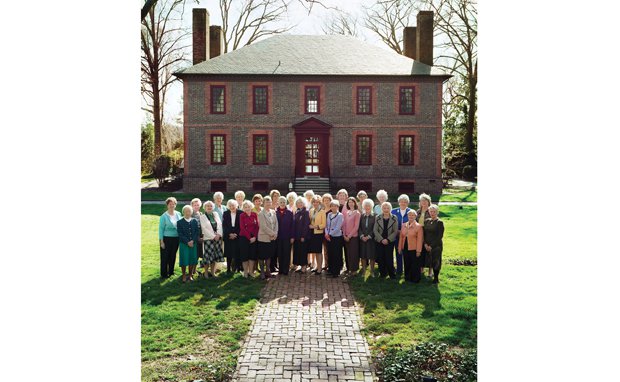
Staunton is also home to Mary Baldwin College, a private “women-centered” university founded in 1842 as the Augusta Women’s Seminary. Painted white and hunkered down on a big hill, Mary Baldwin is a rather majestic sight—and not surprisingly, some of its nearly 800 undergrads can be seen downtown on a weekend night—opting apparently to eschew the library. Kids!
I had two excellent meals in Staunton—a Saturday night dinner at Zynodoa and a Sunday brunch at the Staunton Grocery. Both take the “farm to table” concept very seriously, and rely heavily on the large number of farms in the valley for their food. Zynodoa, owned by Jeff and Susan Goode, is a little more than four years old. It’s got a contemporary motif, a small bar (with a trellis and blown glass) and, most important, excellent food—much of it procured from local suppliers identified on the menu. Waiter Bill Broach greeted me and said, “This is the first restaurant where I’ve worked that I can sincerely recommend everything.”
I soon understand what he meant. I had a house-made chive biscuit with honey butter to open the meal, followed by three starters—a Honey Hill Farm (Locust Hill) Bibb and Charred Beet Salad (with feta cheese, candied pumpkin seeds and pumpkin vinaigrette), a grilled flatbread pizza (with eggplant confit and Legend Brown Ale onions and housemade mozzarella), and some braised Buffalo Creek Beef (Lexington) short ribs (with caramelized turnips and red wine onion pan sauce). Oh, my: they were each outstanding—charring the beets nicely minimizes their pungency, while the pizza practically melted in my mouth and the ribs were indescribable. All paired nicely with some sparkling cru from Kluge Estates.
My main course was tough call between North Mountain Eggplant “Marinara,” Butternut Squash Agnolotti (with lima beans—very tempting) or a Polyface (Farm) Chicken Cassoulet, with local market cannellini and October beans and Polyface sausage. Hungry, I went with classic dish from southern France and found it as exquisite and it was hearty. I was impressed by the way Chef James Harrris leans on beans and vegetables—and gets them into various dishes in creative and tasty ways. “I like simple things,” he told me. After a dessert of caramelized apples with crème fraiche ice cream, Chef Harris raved about his Shenandoah Valley suppliers, including Harvest Thyme Herbs, and we have just published a story on that little farm’s delectable vegetables in the January/February issue of Virginia Living.
The next morning, after a night at the charmingly rambling Frederick Inn, I ambled down the Staunton Grocery for Sunday brunch. It is a cozy restaurant that Ian Boden started four years ago after working as executive chef at Home Restaurant in New York City, where he was included as a “critic’s pick” in the first NYC addition of the Michelin Guide. Though modest in appearance, the Grocery has received quite a bit of acclaim from travel websites and guides for what’s important—the food, and it was easy to see why. I sat at a counter overlooking the kitchen and was treated to some delicious country ham and Gruyere croquettes, house-made charcuterie, and I finished with a plate that was southern and strong—fried chicken with buckwheat pancakes (with raspberry syrup and braised spring greens). Or should I say that it finished me?
Boden, like Harris, is totally committed to local farmers—and buys from about 40 of them, many listed on the menu. “In a nutshell, we work with the best products the valley has to offer and try to do as little as possible to them,” says Boden. “We want each item to shine through.” The brunch only whetted my appetite for a Grocery dinner, the more so after I glanced at a few of the recent offerings. Boden’s pasta dishes include carrot agnolotti and sea scallops, pumpkin tortellini and house-made fettuccini. Other dishes include “hot to share” starters such as Boer goat meatballs and grilled king trumpet mushrooms and, among the main courses, heritage pork loin and wild striped bass.
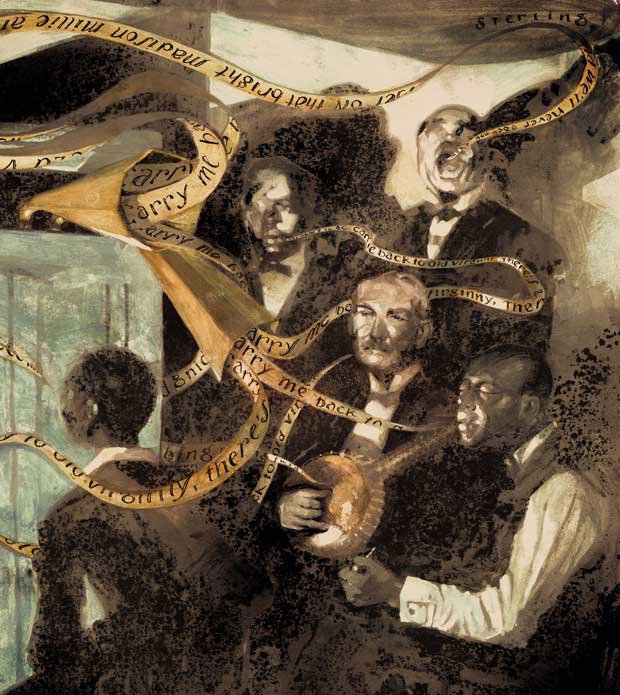
Staunton has plenty of places to listen to live music. Most are fairly casual, including Baja Bean, Darjeeling Café, and Mill Street Grill). On Saturday night I took in a roots-music show at the one-year old Mockingbird, a combination artisan restaurant and music hall opened a little more than a year ago by Wade Luhn. Like the Grocery, Mockingbird is located on Beverly Street. I was curious about Mockingbird having heard ads about the place on radio station WNRN (the best radio station in Virginia, in my opinion) and it did not disappoint. The music hall is adjacent to the restaurant but acoustically separate—meaning you don’t hear diners in the music hall or music while eating. The hall, which seats 160, is intimate and warm—an ideal size for a venue focused on showcasing local and regional talent, and there is a lot of it in valley.
For all the good things I’ve mentioned, the highlight of my Staunton visit was seeing a performance of The Taming of the Shrew at the Blackfriars Playhouse, which is part of the American Shakespeare Center. The ASC dates back to 1988 when Jim Warren and Ralph Cohen started a touring company called the Shenandoah Shakespeare Express. The playhouse, built 10 years ago, is a recreation of Shakespeare’s original indoor theater—and the performances hew to Shakespearean tradition: the lights are kept on and there are few if any stage props.
The ASC is not about stodgy Shakespeare—quite the opposite. It is dedicated to “recovering the joy and accessibility of Shakespeare’s theatre, language and humanity” through its performances and education efforts—and though I only saw one show, it is clear that the troupe holds that mission statement dear. Their zeal, and talent, was infectious. Taming of the Shrew was thoroughly entertaining, highly professional and very high in energy. I loved it—and so did everyone else in the audience. It was easy to see why the ASC troupe regularly receives acclaim from prestigious newspaper critics and academics—including an endorsement from Dame Judi Dench. The performers were palpably enjoying themselves on the stage, on which a few audience members sit as well. Select members of the troupe sing songs up on a balcony behind the stage before every show—and again during intermission.
If you have not been to the Blackfriars Playhouse, go. And the same holds true for Staunton—a valley town that is not just an ideal spot for a one- or two-day visit, but also one that celebrates all things local, and what can be better for that?