
A private-public partnership is working to protect the enigmatic swamp that has captured Virginians’ imaginations for centuries.

Great Dismal Swamp
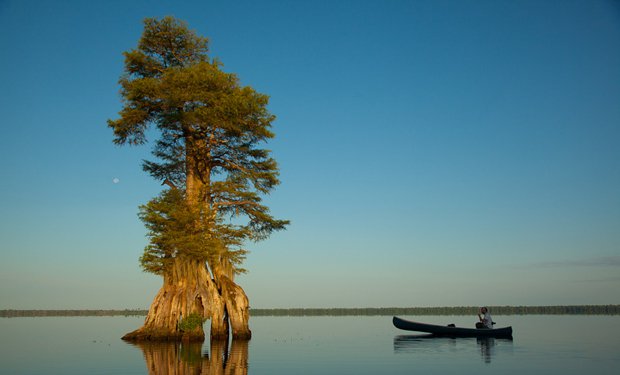
Bald cypress tree on Lake Drummond

Bald cypress on Lake Drummond

Near east entrance to Lake Drummond

James Remuzzi (left) and Dave Urban at Dover Farm

Great Egret

Bear, left, a 3-year-old white shepherd and Abby, an 8-year-old chocolate lab, resting on a dock on the intercoastal waterway.

Dave Urban at Dover Farm

Cypress tree on west side of Lake Drummond

Reeds

Walkway

Opening between trees

Roots reflected in water


Sky reflected in the water on Lake Drummond


Great Dismal Swamp
Bald cypress tree on Lake Drummond
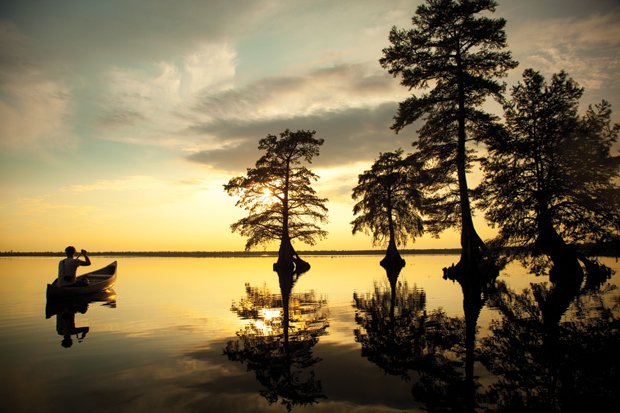
Sunset on Lake Drummond

Dave Urban scans the horizon for the enemy that lurks within the 112,000 acres of the Great Dismal Swamp National Wildlife Refuge on the southern Virginia border. Quiet and skilled, the killer attacks by day and night, and nothing is immune to its wrath. Enemy number one, at least as far as Urban is concerned, is the phragmite, better known by its street name: the reed. As Urban undertakes transforming the 750 acres of Dover Farm that is located within the swamp and which his company, the Towson, Maryland-based Ecosystem Investment Partners, purchased in 2007 to turn from agricultural land back to swampland, reeds are only the most prominent of myriad problems to be overcome.
The Great Dismal Swamp has long captured the public’s imagination; its siren call issued to all walks of life. The swamp was given its evocative name by William Byrd II as he first surveyed the area in 1728. There are the stories of escaped slave communities well hidden in the lush growth of the bog. Harriet Beecher Stowe set her sequel to Uncle Tom’s Cabin here, entitled Dred: A Tale of the Great Dismal Swamp. In 1894, a young lovelorn poet named Robert Frost decided the swamp’s romantic name and enigmatic aura would be the perfect setting for his own death, and wandered in hoping to perish there. He didn’t succeed.
The northernmost swamp along the Atlantic Ocean, the Great Dismal Swamp is located between two eco-regions, and everything from the black bear to the otter, barred owl and alligator call it home. The swamp has been recognized for its unique properties since the days of George Washington. “George Washington became enamored with the idea of draining to make a vast corn plantation of farmland. It failed, and various efforts later failed as well,” explains Brian van Eerden of the Arlington-based Nature Conservancy, one of the conservation groups active in the swamp. Today, 50,000 human beings pass through the refuge annually, and this intermingling of development and nature has not been without its downsides. Flat coastal plains are prime real estate spots, and housing developments dot the boundaries. Loss of habitat, changes in water patterns and forest devastation have all taken their toll, and the Great Dismal Swamp is no longer the uncharted expanse of the East Coast it once was. Enter public efforts and private groups such as Ecosystem Investment Partners, acting together to protect one of the most unique regions in North America.
Early 19th-century settlers removed the swamp’s juniper trees, which provided lightweight, rot-resistant wood. “For decades, people felled trees and cut them into shingles, and those would be exported. White cedar was virtually eliminated,” says van Eerden. Later came farmers, who drained out the swampland to grow corn and soybeans. By the mid-19th century, the composition of the forest had changed; the swamp was one-third of its original 2,000 square miles, and many animal and plant species were threatened or had disappeared altogether. But there were more problems. Large plots of land within the swamp remained in the hands of farmers, and substantial development was still occuring as late as the mid-20th century. (A plan to sell large tracts to a logging company was thwarted in the 1970s.) And though there have been other successes—logging was halted, and the white cedar and bald cypress, thought to be on the path to extinction within the swamp during the mid-20th century, were saved—invasive species such as phragmites continue to be a thorn in the sides of conservationists, biologists and park authorities.
By 1974, lawmakers and activists realized something needed to be done. That year, Congress passed the Dismal Swamp Act, which in part created the Great Dismal Swamp National Wildlife Refuge: 112,000 acres of protected, forested wetlands. The refuge’s work has been relatively successful, removing several animals from endangered lists and restoring the original hydrology and water flow of the swamp. But foreign species like the reed are posing one of the greatest threats to the stability of the swamp by crowding out the more delicate, native species.
Reeds are foremost on Urban’s checklist during his regular visits to Dover Farm. It’s the first item he asks his environmental specialist about. “It grows in thick stands and in areas that are really disturbed. Only thing to do is herbicide it. You can’t pull it out,” Urban explains. Since phragmites have horizontal roots, the plant seems to follow the same growth pattern as gray hair: pull out one, and two seemingly grow up in its place.
As the swamp authorities begin to turn the clock back on the swampland, from the deterioration, foreign species and development which have propagated in the last half century, they will have more to deal with than just reeds. Though the 1974 act helped direct attention and resources to the area, the protected zone was still more like a quilt than a blanket, with spaces of agriculture and housing breaking up blocks of preserved space. And while humans may have respected these arbitrary boundaries, animals and plants do not. Patchwork preservation limited animals and plants that needed extended spaces to flourish.
Through purchases like those by Ecosystem Investment Partners (EIP), that patchwork is becoming what Don Schwab, wildlife biologist at the Great Dismal Swamp National Wildlife Refuge, calls a “green island.” EIP purchases threatened land and recoups its expenses (Dover Farm was purchased for $5 million) by selling easements in the form of Payments for Ecosystems (PES) to companies which are required by the government to purchase and protect the same amount of land they develop; it is currently working on similar wetlands purchases in Delaware, Montana and Louisiana. Motivated by financial as well as environmental interests, EIP targets areas like the Great Dismal Swamp, which contain conservation gaps. “Our purchase is going to add 1,000 more acres to the National Wildlife Refuge. Bear and bird species need a lot of room to be successful. To defrag an area allows them to breed and spread out,” Urban says of the beneficial effects.
In 2007, EIP’s partner, Nick Dilks, heard of a farmer who was thinking of selling his landholding within the protected area. Dilks managed to find a way to come up with the capital for the 1,000-acre Dover Farm, and Urban was off. Now Urban, acting as director of operations, spends his time trying to turn land that for 20 years grew soybeans and corn into marshy wetlands that will foster native species development. It took a year to get permits and then, in spring of 2008, the ground site changes began. Nature is on Urban’s side, but habit is not.
Farmland in the Great Dismal Swamp is, by definition, exhausted. There is also the problem of past pesticide use. “Residual herbicides and pesticides in the soil affect growth…Luckily, most herbicides they use now degrade quickly,” Urban explains. There are also weeds specific to agricultural areas, which Urban’s team may need to spray off with pesticides of their own.
First on Urban’s and the team’s agenda is planting trees. Soon after the purchase, the field was covered in neon orange strips marking where trees had been planted. “Oaks, cedars, pines. We’re farming here, too, tree farming,” the site’s senior environmental specialist, Mark Eversole, says of the now eye-level-height saplings. Restoring forest cover is a goal for all groups working within the swamp. (In addition to the Nature Conservancy and EIP, groups including the Trust for Public Land, the Great Dismal Swamp Coalition and the Conservation Corps are also working to restore the swamp.) Van Eerden sees the trees as not only important within themselves but also integral to conservation: “An abundance of forested wetlands provide tremendous benefit to wildlife.”
Urban looks over the saplings, which spread out as far as the horizon, “We’ve planted over 800,000 trees on the site,” he says. “We want at least 400 trees per acre in 10 years.” The site isn’t much to see now, because to get the kind of trees that Urban and Eversole want, they will need to first fill the land back up with water, and take a yearly inventory of arboreal growth. Urban says that in the late 1930s and early ’40s, the area was made into a military airfield. “It was never paved, but they filled up the holes.” Now his group is working to make sure all of the land is returned to its original state.
And then, of course, there’s the Sisyphean task of annihilating the reed. Despite popular belief, the most widespread reed along ponds and marshy ditches is not native to Virginia or North America. “With phrag, no one knows where it came from. It was used as fill material and packaging material as far back as Colonial times,” explains Schwab. Now, one of the largest efforts on behalf of the park service, and the assortment of conservation groups that work in the swamp, is to prevent the reeds from pushing out other less hardy, but rarer and indigenous species.
“When there are too many reeds, they inhibit growth of other species. We want sedges, et cetera, in open water and forested areas. It’s a management tool,” Urban explains. Biologists like Schwab worry about the larger impact of the reed. “Phragmites become a monoculture. They change overall habitat, though the acidic soil of the swamp here limits it somewhat.”
Private groups like EIP have a flexibility not seen in government and can raise funds that the cash-strapped state and federal government departments cannot. For years, refuge officials had their eyes on Dover Farm for conservation, but EIP had ready cash on hand, which gave them the freedom to act faster to make it happen. The Great Dismal Swamp Refuge is completely supported by federal appropriations from Congress. But with an 18 percent reduction proposed in the 2012 U.S. Fish and Wildlife Service’s budget, including $48 million in cuts for national wildlife refuges, park authorities will have to rely even more heavily on partnerships with advocacy groups such as the Nature Conservancy and smaller firms like EIP to make things happen.
Private ownership allows for more conservation and the government departments are glad for the help. Schwab has worked closely with Urban and EIP throughout the restoration process of Dover Farm. “I’m glad they found it. I’m glad they’re going to change it back to wetlands. It can only help in the long run. It was probably the only big inholdings left inside; everything else is within our hands.”
But the ubiquitous reed is not the only species that is out of sync within the swamp. Animals great and small have their own set of problems. “Fire ants have few natural predators here and can affect all ground-living critters, lizards, insects and mammals,” explains Schwab. “There are lots of threatened species. Some plants are just rare, like the Virginia liste trillium. It’s not impacted by invasives; it’s just rare.”
There are also several native animals that have landed themselves on the state endangered list: “The Great Dismal Swamp shrew, timber rattlesnake, the big-eared bat. All warm fuzzies; things you want to wrap your arms around,” Schwab laughs. But the refuge has had its successes. The swamp is the only place where populations are steady or increasing. Despite changes, van Eerden believes much of the romance of the swamp remains. “The refuge has true forest habitat conditions. There are no edge effects or edge impacts affecting species. The size of the refuge allows it to be a tremendous storehouse of biodiversity. Not only great diversity, but abundant population.”
Urban hopes his Dover Farm will become another one of the swamp’s success stories. He and his colleagues have already seen some black bears, hawks and snakes on the site. “All of the animals are already here,” he says. “We just want them to reproduce and expand. Eventually, there will be woodpeckers when trees die and rot out. Pretty soon this place will be overrun with deer and bear.
“We have big plans to replicate this 10 more times in the next two years. It’s going to take a few more years to recoup our investment here,” Urban adds as he proudly surveys the land. The highest distinction Urban and EIP want for the land is for it to not be distinct at all, but a seamless, reed-less addition to the green island.
“In 10 or 15 years,” says Urban, “we want it to look like the rest of the refuge, so you can’t tell where one stops and the other begins.” •