

Mindful gardening yields a serene retreat in Hanover. Walk slowly, and contemplate.

The Art of Zen
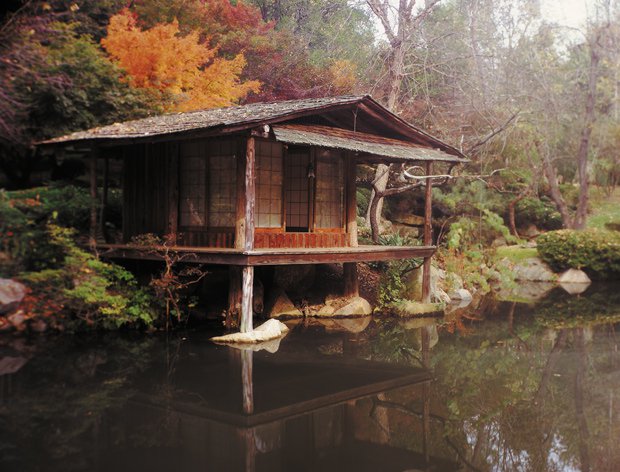
The teahouse—or azumaya—is made from American cedar, for durability.

Looking from the teahouse onto the pond

Junko Liesfeld

The path meanders up the hill into a stand of colorful maples. Note the bamboo water spout at the top of the stairs.

A waterfall tucked around a bend in the path.

Fern, moss and stone at the water’s edge

Bright nandina berries
Along the South Anna River in Hanover County, you can find many serene spots where fortunate Virginians have situated rural retreats. They’ve come for the view. Only one home on the river, however, can offer a vantage point from a teahouse (azumaya)—a garden feature offering tranquil sanctuary in a setting that’s a constant source of inspiration.
Junko Liesfeld, a gardening consultant, celebrates nature from dawn to dusk in the expansive Japanese garden she has built over the last 18 years. Liesfeld grew up in Osaka, and she has re-created the spirit of her homeland—and her country’s reverence for nature—in the Rockville home she shares with her husband. She designed the main house so that she could see the river from every room. She wanted it all to “sit on the ground,” connected to the earth, so it is a long structure, running parallel to the river, with floor-to-ceiling windows in some rooms. The roof overhang is at least three feet—constructed, to the Japanese way of thinking, to provide a sense of enclosure and to create, along with the trees, a counterpoint to the openness of the sky.
Japanese have a special appreciation for “harmony” in all aspects of life, and Liesfeld has an innate sense of the concept. Her aim, when designing the house, was to blend American practicality with Japanese style. That’s why her Japanese home has an American fireplace. As she acknowledges, “I don’t like rules.”
Liesfeld’s garden begins to unfold from the moment the shaded drive along the river forks into a cobblestone lane. The first thing a visitor notices is the rocks—sizeable rocks, artfully placed along the drive, around the edges of the property. They function as a buffer between a large pond on the property and green spaces—the lawn, banks of ferns, swatches of moss. The scene is meant to imitate the coastline of Japan, where striking rock forms rise abruptly just off shore.
There are five styles of Zen garden: hill-and-pond, dry landscape, tea garden, strolling garden and courtyard. All are meant to capture nature’s essence, and they typically attempt to evoke the natural effects of wind and water over time. Liesfeld essentially has created a strolling garden, applying the techniques of a Japanese garden to her Virginia property. Her garden mixes the best of verdant Virginia topography with the contemplative spirit of Japan. It helps that many of the backbones of the Japanese garden—dogwood, redbud and cherry—are also basic Virginia plants.
In Japan, wind blowing across the island shapes trees and bushes, often creating horizontal planes of foliage, spaced widely apart on sturdy branches. Liesfeld, like many Japanese gardeners, seeks to capture this look through artful pruning. She has a scrub huckleberry—a very ordinary native tree few would want—growing along a walk by the pond, and she’s pruned it to have a windblown look that mirrors the horizontal lines of the rippling pond, thus turning the tree into a soothing asset.
Just as there are five Japanese garden styles, a Japanese garden has five main elements—stone, water, plants, ornament and structures. Liesfeld uses them all. Stones and evergreens connote permanence and endurance. A massive stone, more than six feet high, is positioned vertically in the garden and functions essentially as a sculpture. It’s a special object because it’s natural—and therefore a point of contemplation. For the plants, green is preferred over bright colors, so ferns and mosses are abundant. The palette is restricted, explains the gardener, so that the senses are soothed rather than stimulated. Liesfeld uses stone lanterns and basins as ornaments. And, finally, her structure is the azumaya. To build it, carpenters used interlocking pegs instead of nails, a sacred building technique used in Japanese shrines, temples and old teahouses. The frame is Virginia cedar, with the bark stripped, used because of its durability.
In the Japanese culture, people are part of nature and must stay in touch with it in their daily lives. The best way to do that is to create a garden where man’s role is not that of conqueror or observer, but rather participant. The idea of anticipating and then discovering beauty, detail by detail, is central to the strolling garden. Says Liesfeld, “In Japan, we don’t want to show off everything at one time.” So she incorporated surprises—a waterfall around a bend in the path, for example.
Unlike in Western gardens, you don’t see the entire garden in one glance; rather, it gradually unfolds as you meander along. The turning slows the pace, allows time for contemplation. Stepping stones and bridges are symbolic crossings—they encourage the traveler to linger, to become mindful, to focus on the journey rather than the destination. “Zen teaches us everything about a people—how to behave, how to look closely,” says Liesfeld. “Don’t rush. Keep things simple. The meditation is inside of you. You learn from the experience of working on moss, or weeding, or grooming off leaves from the garden.”
In Japanese design, the placement of plants, trees and ornaments, and their relationship to each other, is paramount. It’s all about creating a special gestalt from a combination of elements. Liesfeld likes to place a shrub or tree next to a rock, so that they complement one another. “It must be a whole view, connected,” she says. Before deciding where to place a rock, and how to place it, she examines it closely—its contour, color, texture. There is a face, a best side. And Liesfeld can be quite exacting about the placement of her rocks, as crane operators have learned over the years. “An American worker will say I am crazy—what’s the difference? A stone is a stone. But I have to feel, after placing it, that the stone has been there for a long time.”
Liesfeld has a deep appreciation for what Americans might consider “imperfect” plants or trees. In her eyes, nothing is more sacred than nature itself—there is no perfect shape. She often speaks reverently of unique branches on trees or bushes, as if they were objets d’art. A massive, gnarled wild grapevine serves as the top rail of the garden’s fence, mortised with bamboo vertical slats. She has a wonderful nurseryman who saves unusually shaped specimens for her.
Japanese also respect old things—in life and nature. It is not a sad thing when a gorgeous bloom drops to the ground. In fact, there is more beauty in such a scene because it represents merely another stage of life. Try to enjoy “the sorrow process,” says Liesfeld, for it is a natural part of existence—something every gardener has felt. Natural life is fleeting. Hence, the fast-fading cherry blossom holds a special place in Japanese hearts. A plant in full bloom is not the Japanese ideal. Liesfeld explains that Japanese consider a whole shrub with only one or two blooms extraordinary for its “condensed beauty” against a green background.
Ironically, achieving the simplified, natural look that characterizes a Japanese garden is a complex and time-consuming design challenge. Indeed, Liesfeld’s own garden has been a work in progress for nearly two decades. She is constantly “walking around and looking [at space] from every angle.” For her design work (her business is named Zoen Garden Creations), she avoids computerized mockups in favor of hand-sketched vistas for each of her clients—most of whom live in central Virginia. She finds clients are often in a hurry to have their gardens mature, “but I say give it five years.”
One of Liesfeld’s most gratifying moments came recently, when she peeked in on some clients, who could well afford to have their garden tended professionally, and found them gloriously dirty, with holes in the knees of their jeans. They “never knew what a pleasure the manual care of a garden could be,” says Liesfeld. “This is what I want for all my clients. If a garden becomes your own, you have to grow together.”
In the end, every season is special. Green ferns and mosses are cooling in the summer. Japanese maples and burning bush give a lovely red glow to the autumn garden. In winter, the sun hits the bare trees, casting wonderful shadows on the ground—especially nice if contrasted against a pure, bright snow. And then, in spring, buds start opening and, once again, it is time to rejoice in the renewal of life.
Five elements of the Japanese garden—a sampling
PLANTS Japanese red maple, dogwood, cherry (weeping is very graceful); evergreens—some form of pine (red, Japanese black or Japanese umbrella); shrubs such as azalea, camellia, Japanese holly, aucuba, nandina; bamboo—common or pygmy; perennials such as peony, Japanese anemone, astilbe, ferns; mosses or ground-hugging alternatives such as pearlwort or Corsican mint; water plants such as lotus, sweet flag or Japanese water iris
ORNAMENTS These might include a traditional stone lantern or a bamboo pipe dripping water into a basin. Likewise, any ornament can be adapted with natural elements of personal spiritual meaning, sited carefully and treated with reverence to foster contemplation.
STRUCTURE Bamboo can be worked into fences or gates.
WATER Pond, fountain—any kind of water feature will do.
STONES Look for form, color and texture.