
Truly an island out of time, legendary Tangier is only 12 miles away from the Eastern Shore, but decades apart. At times quaint, underneath the island’s Bible Belt exterior is a colorful past, and a (mostly) idyllic present.

Wooden boats are still common on Tangier Island.

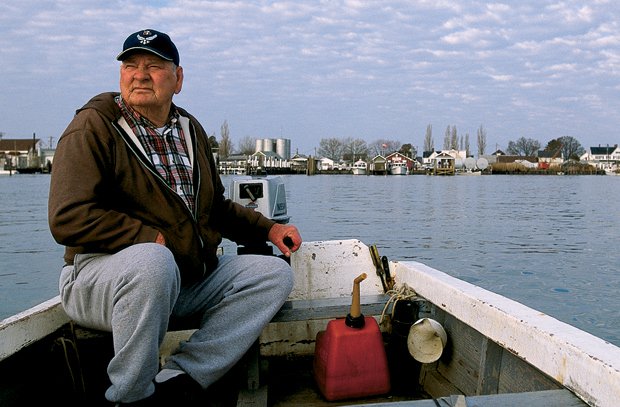
A crabber

Pier and water

Barbara Thomas at Bay View Inn

A boy and his Labrador

Juke Marshall on the cover of National Geographic magazine in 1973

Juke Marshall

Acres of crab pots

Ubiquitous chain link fences

A wooden bridge

A preacher

Bikes are primary transportation

Fishing nets

Milton Parks

Tangier sunset

Waiting for the mailboat

An island graveyard

Islander Strickland Crockett

Tangier Island map

Clam shells at a seafood house

While many enjoy their youth, they often go to the mainland after graduation.

Crab floats

Crab pots are in many a backyard

Wallace Pruitt of Shirley’s Bay Inn
It started out a simple sleuth’s errand: Find the young Tangier Island boy who in 1973 was immortalized for getting his finger nipped by a blue crab on the cover of National Geographic. The search was similar to the one that National Geographic launched for the “Afghan girl” with sea-green eyes whose 1985 cover shot became a symbol of the plight of refugees. Admittedly, finding a boy from an island fishing community was a little less ambitious. National Geographic’s investigators had spent several weeks afoot in Afghanistan, peddling the nameless girl’s picture from refugee camp to refugee camp before finally finding someone who recognized her. I had sent an e-mail to island native Bill Pruitt.
“Sure, that’s Juke Marshall,” he said. “Lives in Crisfield. Want his number?”
When John Woodland Crisfield brought the railroad to the sleepy Maryland village of Somers Cove in 1867, it sparked an economic boom so massive that the town simply had to change its name. Situated on the bay side of Maryland’s Eastern Shore, roughly two hours north of Norfolk, Crisfield occupies an enviable perch: nestled between two of the richest oyster and blue crab grounds in the Chesapeake Bay — the Tangier and Pocomoke sounds. It is for this reason that the town of 2,800 souls still receives little challenge to its boast as the “Crab Capital of the World.” But after decades of declining bay health and lackluster harvests, the town is a shadow of its former self.
Crisfield’s other, perhaps less glamorous, claim to fame is being the port of call to the historic fishing village of Tangier Island, which lies just 12 miles off its harbor, across the Tangier Sound. From Crisfield, Tangier receives its mail, its groceries, its prescriptions, its lumber and the bulk of its summer-season tourists. With no industry, no crops, no cattle and no timber to speak of, only what it can wrest from the unpredictable bay, Tangier and its 604 inhabitants depend on Crisfield for just about everything. And for some, that includes a little nip.
“Don’t let ’em tell you they don’t drink,” said Trish, the bartender at the Waterman’s Inn, a local restaurant and watering hole on Crisfield’s main drag. “Yeah, I’ve served most of ‘em.” Tangier, it should be noted, has been dry since its much-storied conversion to Methodism in the early 1800s. This fact, Trish pointed out, only means that the men have to hide their liquor on their boats or slip over to Crisfield undetected.
“They’ll come in off the boat with no bags and drink all weekend. Wearing the same clothes every night,” Trish laughed. “Ah, but they’re really good people. Very religious, though.” Religion is unavoidable when reading about or discussing Tangier. In fact, a number of the island histories I’d read consisted of little more than “had a revival,” “built new church,” “new preacher didn’t suit,” “had a revival,” “added on to church,” “new preacher didn’t suit.” But faith and the island’s religious journey are so integral to an understanding of life on Tangier that to marginalize the importance is to miss the very essence of Tangier. More than their tiny island confines, more than the water on which they eek out a living, the church defines a Tangierman. And yet, it’s what has given this community the bulk of its controversy.
Go as far back as the Civil War when the otherwise proudly Southern islanders sided with the Union, strictly over their religious objection to slavery. Or look more recently to when the island, out of step with the entire Eastern Shore, voted rather convincingly (264 to 71, by the way) against the Virginia Lottery. Faith, very simply, comes first.
In 1998, Tangier town council voted unanimously to reject Warner Brothers’ offer to film the movie Message in a Bottle on the island. The council had held a public hearing to address the matter but reasoned by majority that the “drinking and blasphemy” in the script were simply inconsistent with the image they wanted to portray. “It’s like Children of the Corn over there,” one Warner Brothers location scout commented to a newspaper at the time. “There’s no separation of church and state. It’s grass roots fundamentalism gone totally out of control.”
“There was a lot of bitterness over that,” Trish said. The town of Crisfield lost out as well on what would have been greatly appreciated construction contracts, not to mention the anticipated tourist revenue that generally follows in the wake of being touched by Hollywood. “Five councilmen had no right to decide the fate of all of us.”
The producers of the PG-13 movie eventually settled on New Harbor, Maine, where, according to the governor’s office, it has since brought no less than $15 million to the state’s economy. Tangier received both applause and ridicule for its principled stance, yet it remained unwavering and unapologetic.
“Some people feel hard about it,” said then-mayor Dewey Crockett. “But all of us on the Town Council were voted back in, so I guess most of the islanders agree with us. We would have been glad to have the movie people if they had made the changes in the script we asked. …We didn’t even consider what money we might make from it.”
Juke was late.
“Hey pal, you didn’t tell Juke he had to buy, did ya?” joked a man from across the room. “He’ll never show up!”
The only view I had through the bay window of Joanne’s Country Kitchen was of Route 413 and opposite it the Kingston Construction Company, builders of quality pre-fab poultry houses. I kept an eye out for Juke. Luckily I’d brought along some reading material, articles with titles like “Island Community Desperately Seeks Doctor,” “Dead Body Trapped on Iced-in Island,” “Tangier: Brine-soaked Tradition,” and my favorite, “Church, Crabs, and Television: Three Forces Dominate Life on Tangier.”
I read that Tangier has only a handful of cars and depends primarily on golf carts and bicycles to move about its half square mile of high ground. Children all attend the same school, K through 12, and twice a week a doctor and a dentist visit from the mainland. Most of the women are homemakers, and most of the men crab and/or oyster for a living. Nearly everyone is related and shares one of a handful of surnames that trace back to the island’s settlement in 1778 — names like Crockett, Pruitt, Parks, Thomas, Dise, Shores, Wheatley and Marshall.
Though certainly beset with a unique set of circumstances, Tangier otherwise sounded like the quintessential small town, where everyone knows each other, where the idea of dating is first a matter of ruling out cousins, and where one full-time policeman is more than enough.
Juke eventually emerged from one of the Kingston Construction Co. buildings and came sprinting across the road. A clean-cut stocky man of about 6’2″ with short brown hair and a waggish demeanor, Juke apologized for being late.
“I weren’t supposed to have nothing going on,” he said in that lyrical Tangier brogue, “but a guy come over there and I couldn’t get away from him. Time I start walking off ….”
This sort of thing happens when you own the company. “Yeah, I been off the water ’bout eight year now,” he told me. “Come to work up here and I worked up here six years then I bought it … bought the business.”
I looked at the company’s lot through the bay window. If the open warehouse chock full of palleted pre-fab walls was any indication, business was good. It was Saturday and Juke’s morning had started with a business trip to Salisbury at 5 a.m. I asked if six-day workweeks and pre-dawn wakeup calls were the norm.
“Well, I’d always worked on the water, so that’s the way it is on the water.”
There’s something about a waterman’s work ethic that makes you think he’d log 100-hour weeks even if he worked in a bank. Now 42, Juke quite obviously enjoys life as a mainlander, business owner and father of three — he and his wife have two daughters and a son. But he admits there’s something a little strange about it all. “We just bought a farm down the road. I ended up living on the water my whole life and now I’m out in the country. You don’t even see water.”
But could he move back to the island? I asked.
“It’s real nice over there. I tell my wife I could move back if she would,” he said. “But I don’t know if I could. I say I could.”
Juke Marshall moved off the island at 26 to marry his Crisfield sweetheart, and for another nine years he continued to crab, and even did a little conching (fishing for conch shells) in the ocean. But licensing and catch restrictions, coupled with long periods away from home, forced Marshall to reconsider his lifestyle.
“I had kids,” he explained, “and I didn’t want to be away all of the time. When I worked on the water I was away six months of the year, home on weekends. Usually go away in December and come back in May or June. Live right on the boat. It was hard. It’s a hard life. But I loved it. People who do it — they really love it.”
It wasn’t long before Juke sold his gear and accepted a job at his father-in-law’s company, Kingston Construction.
But giving up the water has been hard. Juke and his family still manage to get out on their boat for pleasure, and, not surprisingly, Juke still holds onto a crab shanty in Crisfield, which he leases out. He makes it back to the island about five or six times a year to visit his mother Ruth and his aunts, uncles, cousins and friends. “I’d like to go more,” he regretted, “spend more time, but if you buy a business you gotta be there every day.”
It was nearing noon and I had to catch the 12:30 mail boat to Tangier, so I quickly pulled out my copy of the 1973 National Geographic, just to verify that the boy was in fact Juke. “Yeah, that’s me,” he said somewhat bashfully. “I was 12 years old.” I asked if he remembered NG’s photographer, David Harvey, taking the shot. “Yeah, I was crabbing up on the bridge, catching a crab for him. And I was getting it out of the net … and, you know, that’s what you do as a child over there. My children don’t do it. And I’d like for them to grow up like I grew up but … well, and he got hold of me and bit me right when I was takin’ it out the net.”
It seemed an idyllic image: growing up Tom Sawyer-like, running unleashed with your buddies, progging in the neighborhood streams. You couldn’t help but envy Juke’s memory, and, in my case, wonder if it was still that way on the island. A few of Joanne’s patrons stepped up to the table to have a look at the picture of Juke. A bit chagrined but noticeably proud, he quipped, “All right, it’s a free breakfast if you’re gonna be lookin’.”
On a map, the tiny island of Tangier dangles in the Chesapeake Bay like a fishhook. That’s how the Geographic article described it — though I’d argue it looks like more like a seahorse. Situated mid-bay, about an hour’s boat ride southwest from Crisfield and just eight miles south of the Maryland line, Tangier falls next to last in a diminishing chain of islands that stretches some 30 miles to Maryland’s Bloodsworth Island.
Divided principally into three segments — the Uppards (the seahorse’s head), Tangier proper (the seahorse’s body), and Port Isobel (a piece of food the seahorse is chasing), the island measures at its farthest points roughly two miles long by one mile wide and rises no higher than five feet above mean low tide. The landscape is an amalgam of marsh grass and six habitable “ridges,” crosscut throughout with guts and canals. The roughly 600 souls who call Tangier home live exclusively on the three parallel ridges that occupy Tangier proper, totaling about half a square mile. The Chesapeake Bay Foundation owns and operates a small facility on Port Isobel; and the Uppards, which once supported the community of Canaan, has been uninhabited since 1928.
A quick history of the island is as follows. Though used as a Native American hunting and fishing ground for perhaps 9,000 years, the island, as they say, wasn’t “discovered” until 1608 when Captain John Smith sailed by on a scouting mission from Jamestown and dubbed her (and the 30-mile island chain) the “Russell Iles” — the name “Tangier” wouldn’t appear on maps until 1685. The first settlers, Joseph Crockett and his family, found their way to the island in 1778 — legend (and the state historical marker) says “1686” but it’s just that, legend.
During the American Revolution the island became over-run with Gypsy-like marauders (a.k.a. pirates or “picaroons”), who, as opportunists are want to do, took advantage of the war-time laxity in public policing to pillage the wealthy estates of mainlanders and raid passing ships. Those first settlers, who by 1800 numbered 79, simply endured the occupation and went about their business of farming and raising cattle.
It was in 1805 that, at least for most Tangiermen, the island’s most significant historical event occurred: the Christian conversion of island native Joshua Thomas, the so-called “Parson of the Islands.” By 1808 he had turned the island toward Methodism, which was then a fledgling denomination in America, and in that same year Tangier had its first religious camp meeting.
The War of 1812 brought another occupying force, the British navy. For nearly a year the Brits, who at one point numbered more than 6,000, camped on the island’s southern sand spit, using the strategic mid-bay location as a staging ground for attacks on Washington and later Baltimore’s Fort McHenry. It was on the eve of this last attack that local lay Rev. Joshua Thomas was asked to say a few words to the troops. Thomas took the opportunity to harangue the crowd of armed soldiers, insisting that the Almighty had revealed to him that the British effort to take Baltimore was doomed — a bold statement considering they’d just burned Washington. Nevertheless, he was proven right. From aboard a vessel in the Baltimore harbor, Francis Scott Key recorded the American victory in what became “The Star-Spangled Banner.” Four months later the British withdrew from Tangier, and Joshua Thomas was a celebrity.
Up until the Civil War the islanders had subsisted primarily as farmers but, with Northern seafood stocks greatly depleted and demand still high, the Chesapeake Bay became a hotbed of activity. Islanders soon realized that watering was their future. The oyster industry dominated the scene until the turn of the century, when harvest counts began to drop precipitously. With the sudden decline came a greater interest in fish and crabs. By 1938, with the invention of the crabpot, Tangiermen had found their niche.
The years that followed brought more settlement (by 1930 the population peaked at 1,190), as well as a series of great storms and freezes, and a cholera epidemic that caused a near total evacuation of the island. The “August Storm” of 1933 struck a particularly hard blow, forcing flooded islanders to the top floors of their houses. And, as if to add insult to injury, three years later the “Big Freeze” locked the tiny island in a foot of ice, calling on the Army Air Corps to air-drop food and supplies. By 1928 limited electricity had reached most homes, but island-wide telephones wouldn’t arrive until 1966. Since then the island has gotten an airstrip (1969) and a much needed seawall along the western shore (1990). Today you’d be hard-pressed to find an amenity islanders don’t enjoy. Computers, satellite TV, Internet access, they’ve got ‘em all.
It was getting ridiculous now. The Tangier watermen had just marched down Janders Road, armed with a ridiculous assortment of weapons — wooden oars and oyster tongs — intent on taking the visiting dentist hostage. The plan was to force the governor to remove the speed-check lines he’d ordered painted on the town’s cart-width streets. And while they were at it, there was talk of seceding from Virginia.
I hadn’t even made it off the mailboat to Tangier and already my book, Patricia Cornwell’s Isle of Dogs, had put me at risk of getting pummeled by a local. I quickly hid it. Poor Tangier. The island’s insularity seems to invite crazed flights of fancy from landlubbers. Cornwell’s treatment, though absurd and at times downright insulting, is something Tangiermen have had to live with for years: visitors mocking their “peculiar” accent and their intense faith, as well as their habit (by no means unique to Tangier) of burying relatives in the front yard.
My seatmate, eager to author another rumor, had this to say: “I hear Tangierians [his word] have the highest rate of cholesterol of any community in the United States.” And, whispering, “I understand it’s because of the inbreeding.”
A common attack on Tangiermen. And flatly unjustified. It’s true that in the 1950s researchers from around the world came to investigate Tangier as a case study in “closed communities.” In fact, their research yielded a disease known as “Tangier Disease,” an inherited blood disorder. The disease, it’s believed, is the result of genetic isolation, or the Founder’s effect — where in an isolated community an early ancestor passes a particular gene down the bloodline. It’s not meant to suggest that anyone’s marrying his sister. Admittedly, and quite unavoidably, cousins do marry on Tangier, but rarely if ever does it get closer than a second cousin.
As the boat approached the island, I expected somewhat of an island mound. Instead, it looked like a giant sandbar. The cluster of white buildings seemed to float atop the surface of the water like a village of ice-fishing huts. A closer inspection revealed that some, in fact, do sit atop the water — lining the harbor are the watermen’s stilted crab shanties, used during the crab molting season to cull out ready-for-market peelers. Still, looking to the shore, the island’s mere five feet of water clearance seemed apparent. Only the church steeple and the water tower appeared safe.
I had come to Tangier in the off-season, that silent and welcomed gap from October to April — the on-season being the rest of the year, when some 20,000 tourists descend on the island. The pleasures of the off-season are obvious: less crowded streets and less edgy locals. (You’d be edgy too if over-anxious, map-clutching tourists wanted to photograph you taking out the trash.)
At the dock standing next to his impressive six-seater golf cart was my host, Wallace Pruitt, the wonderfully gregarious operator of Shirley’s Bay View Inn.
“Welcome to d’aye-land,” Wallace said, in an accent that immediately sounded foreign. Some say that due to years of isolation the Tangier accent remains a vestige of the original West Country dialect spoken by the island’s original Cornish settlers — and perhaps the closest example we have to how Shakespeare would have spoken. Not so, says linguist David Shores, author of Tangier Island: Place, People, and Talk. “It’s simply one of the many American regional dialects. It’s rather distinctive, but it’s definitely not Elizabethan.”
With Wallace’s directions, I first headed toward the sand spit at the southern end of the island, where Joshua Thomas gave his famous speech to the occupying British soldiers, and where for years the island had its camp meetings, bringing in sometimes as many as 10,000 faithful from the mainland and neighboring islands. Just after the bridge that accesses the beach, and only feet from the bay, were the remains of an old house: a few brick pillars and some charred wood amidst sand and sea grass. I’d come to learn this home once belonged to the Jander family. While on vacation here in the 1930s, Henry and Anne Jander fell in love with the island and its inhabitants. In short order they settled their affairs back home in Connecticut and moved their family to the then-vacant and dilapidated house at the remote southwest end of the island. The family’s delightful story of assimilation is recounted in Anne Jander’s memoir, Crab’s Hole, written during her 10-year stay and only recently published by her children.
Leaving the island’s “West Ridge,” I headed across the “Big Gut” to the “Main Ridge,” where the church, the school, the fire station, the few stores and the majority of the homes are found. The houses on Tangier are rather non-descript, generally white and unadorned. Some are more weathered than others, but the community is largely classless. There’s an obvious progression to remodeling, starting with the original clapboards and moving on to asbestos shingles and more recently vinyl. The picket fences that once lined all of the town’s streets, giving it that Mayberry RFD-feel, are gradually coming back, replacing the chainlink fence craze of the last 30 years. The yards are small and often backed with rows of ready-to-toss crabpots. Fewer houses than I’d imagined had tombstones in their yards. Most graves were relegated to the cemeteries scattered about the island.
I followed closely the walking tour in Kirk Mariner’s book, God’s Island, which provides some juicy trivia — the Methodist parsonage apparently started the chain link craze — as well as some surprising sites, like the building where Tangier’s only unsolved murder occurred.
Seventeen-year-old Roland Parks was out one Sunday morning in the 1930s getting some ice cream for his invalid mother from his family’s store. The store, of course, was closed, it being Sunday. Deputy sheriff “Bud” Connorton approached and insisted that Parks turn around and go home, seeing as the town ordinance forbade “loafing on store porches and streets on Sunday.” Not persuaded, Parks retrieved his ice cream and went home. Connorton followed. Standing at his front door, Parks turned to face Connorton — some say taunting him — and the deputy sheriff summarily unloaded a round in his chest. Parks, it turns out, survived the gunshot wound. But a year later, after having returned from jail and resumed his post as deputy sheriff, Connorton was shot through a window by an unknown assailant. Curiously, the site is now an ice cream shop.
After touring the island a few dozen times, I headed to Lorraine’s for dinner — Lorraine’s, by the way, is your only dining option in the off-season. Expecting it to be crowded, I found only the Erickson family, a lovely couple from Nebraska who, with their twin daughters, were staying at the Bay View Inn with me. I soon learned that everyone on the island was at the volleyball tournament in the recreation center. After eating, I’d head over to watch.
The two ladies working the counter at Lorraine’s took a break to sit and talk with us. Their appreciation for the island’s pace in the off-season was apparent. The tourist season, they said, tends to run them ragged, but they enjoy the visitors. They admitted that the island life isn’t entirely idyllic, that Tangier has problems (drugs, drinking, etc.) like anyplace, but on the whole the people are all good and loving and watch out for each other.
“I’m just contented here,” one woman said. “Which I don’t guess I’m normal — a lot of people from here likes to go away. They like to go to Wal-Mart and shoppin’, you know, to the grocery store. But I’m just contented.” They explained how the scarcity of crabbing permits has driven a number of the young people off the island, either to college or in search of work. Those intent on staying on the island have found an option in running tugboats, mostly out of Norfolk. While the job security and benefits are attractive, the time away from home can be hard on the family. For some, though, it’s better than leaving for good.
As I paid my bill, two teenagers walked in, mid-conversation. They looked like they could have been from any town in America: she in a college sweatshirt, he in a Dale Earnhart jersey.
“You gonna go to the revival tomorrow night?” he asked, averting his eyes to the floor.
“Yeah, probably,” she replied matter-of-factly.
“Wanna go with me?”
I wondered if any TV viewer would have bought this piece of dialogue.
The charge for the volleyball match was $2, not bad for an evening’s entertainment, I thought. Inside it was packed. The interior, just like the exterior, was no-frills, with blank walls and a vinyl-tiled floor with five-row bleacher seating to one side and a single line of folding chairs along the other. A card table sat in the corner with napkins and condiments for your hot dogs — occasionally it was hit by an errant volleyball. There seemed to be no order to the games; a mismatched group would step up and play and then fade back into the crowd. A lady sat at the net keeping score with flip cards. Though a few watched intently, most talked amongst themselves, strangely as if relishing a rare opportunity to see one another. Dangerously beautiful young girls primped and giggled on the bleachers, and younger kids ran wild. The tiniest of children crawled about the floors unattended, mothers and daughters sharing the responsibility of watching over whoever’s child crawled by. It felt like a family reunion.
Back at the Bay View Inn, I relaxed awhile on Wallace’s backyard observation deck, listening to the bay in the distance as it gnawed away at the shore. Looking west, I could see the distant lights of Reedville and east, the yellow squares of the town. A skim of water blanketed Wallace’s yard and glistened in the moonlight.
The island seemed so vulnerable, battling tides and youth migration and television and tourists. Still, something seemed immutable, something anchored in the community’s tremendous sense of faith and family. Tangier, I thought, may go the way of islands like Shanks and Fox and Little Watts, sinking beneath the always moving bay. But my mind’s eye also saw a dozen old watermen and their sons, boats encircled atop Tangier’s ghostly outline, sharing a story or two about the old days of progging in her marsh streams and courting at the revivals. And, sure, they were complaining about the catch.
This article originally appeared in our June 2003 issue.