
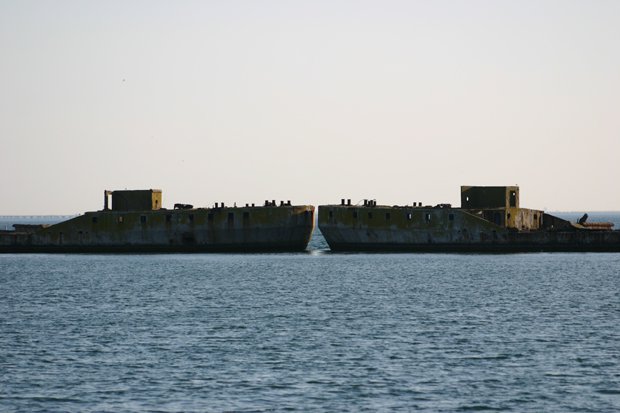
70-year-old ships made out of concrete (no, really) now form a breakwater off the Eastern Shore’s Kiptopeke Beach.

Sunken Ships

Sunken Ships

Sunken Ships
The wind is biting, the water bitter cold. There’s a small group gathered on the bayside beach, and each man is wrapped tightly in neoprene. They’re enthusiastic, expectant. Not all of them will succeed, but a few will, and it’s the anticipation that draws them out, calls to them, despite the less-than-ideal conditions.
Virginia’s Eastern Shore sometimes seems like a forgotten cousin. It’s rural and agricultural, lightly populated, a thin finger of land that points southward toward the much larger metropolitan area of Hampton Roads. But this time of year, when the weather can be numbing at times, the Eastern Shore is a Mecca of sorts, as a handful of hardy souls converge on Kiptopeke State Park, a sanctuary just a couple miles from the peninsula’s southernmost point.
Kiptopeke is known for bird watching—it happens to be along a major thoroughfare for migratory birds—and for the network of trails through its preserved coastal habitat. But that’s not why these folks are here. No, they’re interested in what lies just offshore: a breakwater, nine mammoth concrete ships, partially sunk, arranged in two neat lines. Or more accurately, they’re drawn by the creatures that inhabit these hulking remains.
Wait…concrete ships?
That’s right. Ships made out of concrete. More on that later.
Kiptopeke’s iconic concrete ships once housed seamen, but now, seven decades later, they’re home instead to a thriving ecosystem. It’s a food chain that folks in the tiniest of watercraft seek to engage. At any given point of the day or night, the concrete ships are rimmed by kayakers, fishermen trolling eels at the watery base of the ships’ ghostly ruins. Most hope to land a striped bass, icon of the Chesapeake Bay. For those who happen to hook up, the payoff is magnificent. 30-pound stripers are common, a 40-pounds-plus not unheard of.
The prosperous ecosystem at Kiptopeke’s concrete ships is a product of structure, moving water and salinity, according to Lewis Gillingham, director of the Virginia Saltwater Fishing Tournament. Most adult stripers are on their way out of the bay, or have popped in briefly from the ocean for a meal or two before heading offshore to deeper, warmer water. Gillingham says that stripers’ happiness index is best in water below 70 degrees. When the temperature falls to 50 degrees, they seek comfort elsewhere.
This scene likewise provides ideal conditions for another species that kayak anglers target this time of year. The tautog, gun metal-gray and almost clownish looking with its big lips, is excellent table fare, much like the striper. Gillingham describes the tautog, or tog as it’s known in angling circles, as a lurker, a torpid fish that’s quite at home in the shadows of the biofouling community of underwater structure, popping out to pluck a tasty morsel that floats past its hiding place. Tautogs don’t get as big as stripers—a large one is nine pounds—but the concrete ships are no doubt home to some of the species’ healthiest.
Still, the absolute biggest of each species seem not to make the few miles’ journey up the bay to the concrete ships. In fact, the Chesapeake Bay Bridge-Tunnel, 17.6 miles of pilings, islands and tunnels located several miles south of the concrete ships, produces stripers larger than 50 pounds and togs that approach 14.
But the concrete ships remain popular among anglers whose craft is “powered by peanut butter” as Gillingham puts it. The ships are merely a few hundred yards offshore, less than a five minute paddle. The kayakers are happy to leave the Chesapeake Bay Bridge-Tunnel to those willing to burn the gas to get there.
So why are these ships sunk so close to the shore? Function, not failure. Their placement was intentional. Before Kiptopeke State Park existed in its current incarnation, the land belonged to the Virginia Ferry Corporation. It was the northern terminus for a vehicle ferry that linked the Eastern Shore and Hampton Roads in the days before the bridge-tunnel connected the two. The concrete ships were placed there as a buffer from the incessant thrumming of the waves against the ferry terminal.
Certainly the breakwater is a boon for anglers and marine life alike, but the ships themselves are now a sad ruin of their former glory. To the layman, it admittedly seems a bit counterintuitive that boats made of concrete once floated. But the math works. And shipbuilders knew this by the time the United States became embroiled in World War II, and wartime metal shortages compelled them to consider other materials. Concrete ships had already proven their seaworthiness for more than half a century. A 1944 article in Popular Science even envisioned a concrete passenger liner.
24 ships, built in Tampa by McClosky and Company, were named in honor of men who’d made contributions to the field of (what else?) concrete: S.S. William Foster Cowham and S.S. Willis A. Slater, for instance. The ships measured an impressive 120 yards long and weighed nearly 5,000 tons. They were necessary for the greater war effort, hauling products that kept families and fighting men functioning, like sugar from Cuba.
But now, seventy years later, the concrete ships are a tangled mess, a jumble of cracked cement and rebar. Gaping holes punctuate the sides. Signs warn of the danger of floating inside the weather-beaten hulls.
Concrete’s popularity as a shipbuilding material took a nosedive in waning years of the 1940s. Steel, which was stronger and less labor intensive, became more readily available and seamen simply couldn’t get over their apprehensions about the concrete between their feet and the briny deep. So when the Virginia Ferry Corporation moved its terminal to Kiptopeke in the late 1940s, sinking nine idle concrete ships there for a breakwater seemed as good a second use as any.
The ferry ceased operations decades ago, but the concrete ships have become useful a third time. Just ask those tenacious anglers who return to shore on a cold winter day, having teased a striper from the vestiges of the once-great ships sunk just offshore.