
The beach is not the only way to beat the heat. Lots of people enjoy the freshwater aura at Virginia’s three biggest lakes-all created, ironically, by power companies.

Buggs Island Lake
Photography by Robb Scharetg. scharetgpictures.com

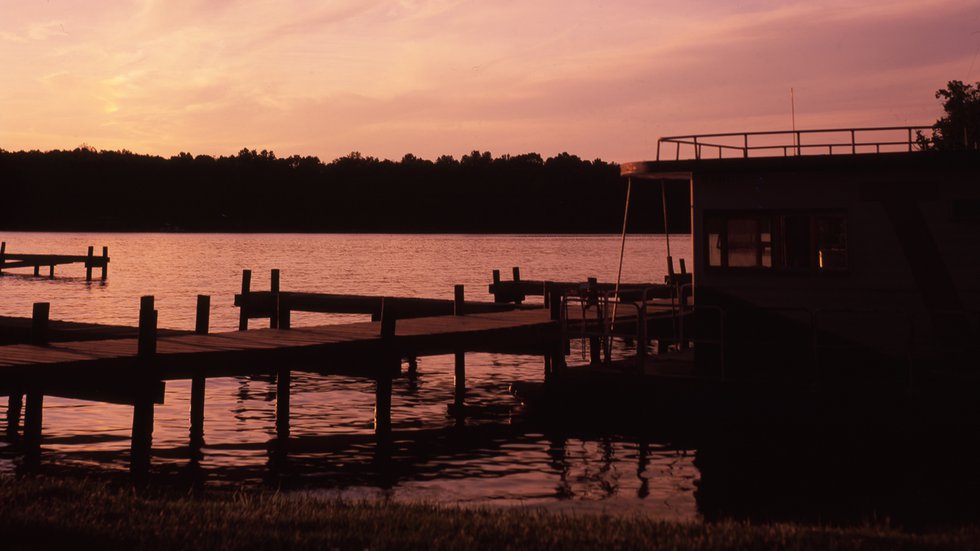
Summer sunset at Buggs Island Lake.

Families and pets alike enjoy Buggs Island Lake.

Families and pets alike enjoy Buggs Island Lake.

Families and pets alike enjoy Buggs Island Lake.

Lake Anna

Bill and Ann Heidig started Lake Anna Winery, which is now run by their sons Eric and Jeff.

Lake Anna

Lake Anna

John H. Kerr Dam and Reservoir
Nearly all of us know the summer beach routine: Early in the morning, you pile the kids and the stuff in the car, rev the engine and head east, toward the Atlantic. It’s a sedate trip, typically, until you rumble into Tidewater, where the stress level tends to increase with the traffic volume. You then inch over the last few miles before the interstate ends. You unload, mark your patch of sand and plop down on your blanket. Don’t forget to lather up with the SPF 50. It’s all sunny, sandy and good.
But what if you packed in the same way and then drove in the opposite direction—inland, away from the coast? Your quiet drive stays that way. Farmlands induce a hypnotic trance as you cruise by. Somewhere in the middle of the state, you might encounter a dealership selling brand new boats, miles from shore. Your final destination is beyond a few tight bends in roads with no painted lines. There is water and a beach—but, oddly (since you’re in the country), they are man-made and not the majestic work of Mother Nature. Paddleboats powered by giggling adolescents meander by. Close to the shore, a fisherman cuts his engine and casts a line. Homes peek through the trees, and boat docks replace garages. You come for the day and a swim. Or you aim to fish in a cove, or tow your children behind your boat on a round inflatable. If the kids are older, maybe they go roaring around on personal water craft (PWCs), which are much louder than anything you encountered on the road trip. This is lake living—and, in Virginia, as in many other states, it seems to get more popular every year.
According to the Virginia Department of Game and Inland Fisheries, there are 112 lakes in the state. Amazingly, only two—Mountain Lake, in Giles County, and Lake Drummond, in the Great Dismal Swamp, southwest of Chesapeake—are natural. The rest are man-made. Many are so-called electric lakes—created by power companies damming up rivers. There are dozens of electric lakes in Virginia, but three stand out for reasons of size, popularity and history. They are Lake Anna, spread across three counties—Louisa, Orange and Spotsylvania; Smith Mountain Lake, a boater’s paradise near Lynchburg and Roanoke; and Buggs Island Lake, in Mecklenburg County on the North Carolina border, a magnet for freshwater fishermen and one of the few places in the country where one can fish at night. They are the three biggest lakes in Virginia—big, blue ink stains on a Commonwealth map.
While all three came into existence over the last half-century, one has to look farther back to understand how these lakes came to be. In 1926, seven years before President Franklin D. Roosevelt created the Civilian Conservation Corps, Virginia established the State Commission on Conservation, now called the Department of Conservation and Recreation. Its first chairman was William E. Carson, who helped establish Richmond Battlefield Park and the Shenandoah National Park. His vision was for the people to “spend a pleasant outing and find pleasure and recreation close to nature.”
Mission accomplished: In 1936, with the help of the CCC, Carson’s agency opened Virginia’s first “state parks.” There were six initially, and the daily admission fee at the time was 10 cents. Today, the DCR operates 34 state parks, and they are still relatively inexpensive—usually less than $5 for a day’s play. Many are adjacent to electric lakes. For years, the parks were a principal attraction, but today both the woods and the water draw people eager for a weekend getaway or more. Marinas, condominiums, retirement communities, restaurants, triathlons, fishing tournaments, water skiing, boating, golfing and barbecuing: It’s all doable on or near the major electric lakes. Or you can do what many “lakers” prefer—absolutely nothing at all.
ake Anna enthusiasts predict that it will be a resort town one day. That seems possible—the lake is close to two major transportation arteries (interstates 95 and 64), and the area’s first major golf course is on the drawing board—but for now Lake Anna remains a pleasingly remote place. Though the lake is huge—17 miles long, with 200 miles of shoreline—there is only one motel, the Lighthouse Inn, along with rental properties and campgrounds, including cabins at the Lake Anna State Park, which itself covers more than 2,300 acres. The nearest supermarket is 14 miles away. There are a handful of restaurants and some marinas available to both vacationers and locals. Here is a place that hasn’t been compromised by rampant commercial development, and credit for that goes to the surrounding counties of Louisa, Spotsylvania and Orange and to the area’s residential communities, which have their own building restrictions and covenants.
Virginia Power built Lake Anna in 1971 to provide cooling water for the North Anna Nuclear Power Plant. As result, the lake has a unique character: It’s got both a “warm” and a “cool” side, separated by dikes. The warm side is considered a “cooling lagoon” for the power plant, which means the water is run through the plant to cool the two reactors and then returned to the lake. Not surprisingly, the warm side is not ideal for swimming, unless one likes to sweat while doing the freestyle. The water temperature in mid-summer has been known to top 100 degrees, and it’s still in the upper 70s, low 80s as late as September. But the warm water is a boon for fishermen, who can be seen casting the lake year-round. In fact, the peak season for largemouth bass is said to be in February and March.
The cool side of the lake is stocked with fish and attracts more fishermen than the warm side. (Trace amounts of mercury have been found in the cool side—and officials at Game & Inland Fisheries recommend either catch-and-release or eating fish from that side no more than once per month.) That the cool side is fished more than the warm one may be merely a matter of accessibility. There is no public boat access to the warm side, so one must be a friend of a resident to get on those waters. In fact, the Coast Guard Auxiliary was not allowed to patrol the warm side until two years ago. And while the thought of water coming from a nuclear power plant may seem unsettling, experts say the warm side of Lake Anna is actually cleaner than the cool side.
The Lake Anna Beach Marina is, as one might expect, a natural gathering spot. Situated on the lake’s southeastern corner, near the main dam, the marina is the place to unload and gas up the boat. Those with a more active nature can rent paddleboats. A small swath of white sand and a grassy point adjacent to the marina are popular with sunbathers. On a recent Saturday, a girl in an orange bikini lolled on the grass near a neon-green 4×4 truck. (Now there’s a contrast.) Nearby, young men tossed a football. Out on the water, a pair of PWCs ran wild. Confederate flags and NASCAR signs were prevalent.
The marina used to be called Pleasant’s Landing, named for Frank Pleasant, whose farmland became lakefront property as Lake Anna’s water rose in 1972. It’s now owned by former high school teacher Mike Averett and his wife, Robin—the two have owned the beach marina since 1990. A new lakefront restaurant is in the marina’s near future, along with a boathouse and even more beach.
Pleasant wasn’t the only person to prosper from the creation of the lake. Another is retired airline pilot Hunter Perkinson, who bought land close to where Lake Anna would be created. Perkinson used to fly from Washington to Tokyo, sometimes cruising over Virginia’s lakes. After he retired, Perkinson decided to buy farmland along his former flight path. Smart move: Just after he closed on the property, plans for Lake Anna’s creation became public. Although he sold a substantial amount of his property to real estate developers, one location, Hunter’s Landing, still bears his name. On it now sits a small grocery store, selling boating supplies, bait, fishing equipment and boat rentals. There’s also the Lakeview Restaurant, featuring the “Bluddy Merry” breakfast buffet on Sundays.
Like a lot of places, Lake Anna has changed from a spot that appealed mostly to seasonal renters and weekenders to a place where more than 75,000 people live year-round. Nellie Fuller and her husband, Steve, are two of them. They live in nearby Mineral, which is a Lake Anna community, though not on the water. For years, the couple visited Lake Anna every weekend from their home in Annapolis. They eventually tired of packing every Thursday and unpacking every Monday, and moved to Lake Anna for good 11 years ago. Their sons, Douglas and Travis, grew up on the water, first swimming, then kneeboarding and wakeboarding.
While the population swells each weekend, especially on the water, Fuller has no complaints. “Lake Anna is long, so it’s never overflowing with people,” she says. “It gets crowded around the marinas and gas stations, but I don’t think I’ve ever been on the lake where there hasn’t been enough room to go out and play. It gets worse as the years go on, but I was a weekender too. So many of our friends here first camped here and eventually moved here themselves.”
Fuller’s only concern about life on Lake Anna is its remote location. “In Annapolis, I was used to having the grocery store down the street. Here, everything’s a day trip. I try to do some local shopping in Louisa, but to do major shopping, I go to Fredericksburg,” she says. “When I leave the house to go shopping for groceries, pretty much the day’s gone.” Before she and her family started coming to the lake, they were regulars at Ocean City, Maryland. But nowadays, the lake’s the thing. “I much prefer the fresh water to the salt water. With our small boat, we didn’t go out on the ocean as much as we do on the lake. And the crowds are smaller.”
There are also non-boating diversions. The Lake Anna Winery, on the north side, sells wines with names like Spotsylvania Claret, Lake Side Red and Lake Side Sunset. In May and June each year, the vineyard hosts the Virginia Renaissance Faire on its grounds. You can taste and buy at reasonable prices.
An ideal stop for weekenders and day-trippers is Lake Anna State Park, which offers hiking, boating, camping and cabin rentals and a 400-foot swimming beach. Sunny days are delightful, and as the afternoon wears on, there is the classic sight of parents dragging coolers, Day-Glo floats and, of course, their reluctant children to the gravel parking lot. There, they shake sand off their feet and replace their sandals, all more than 150 miles from Virginia Beach.
The Coast Guard Auxiliary, a volunteer group, patrols Lake Anna. Jim and Mary Griffes are two members of the corps. The couple moved to a home on the lake in 1993. Jim Griffes, 79, a retired Presbyterian minister, makes two four-hour patrols every month. Just before a recent patrol, he shows remarkably agility on his son-in-law’s dock as he prepares his pontoon boat. Mary usually accompanies him on the trips. The two test the boat’s lights and equipment, and, after several pulls, the seven-horsepower engine rumbles to life.
Looking at the shoreline, Griffes points to a road that approaches the lake and then slips beneath the surface. He explains that a house on the disappearing road was relocated before the lake filled in, but its foundation is now 40 feet beneath us. Further on, we spot duck-hunting blinds. Save for two or three other craft, we have the lake to ourselves. We stop to fish a lost baseball cap out of the water and continue our loop back in case the drizzle builds into a storm.
Being a member of the Coast Guard Auxiliary has been a learning experience. Before Griffes bought global-positioning (navigation) equipment for his boat, he’d occasionally get lost in the lake’s early-morning fog. One time, while laying buoys for the swimming leg of the Lake Anna triathlon, he lost his bearings. When the fog cleared, the swimming course he’d laid out was shaped like an “S.” No matter: the competitors followed his snaky route. Griffes has also learned, the hard way, that you cannot tow a PWC without a rider, because the engine is mounted so far forward that they begin to submerge as you tow them. “If you don’t go slow enough, you’ve got a submarine,” he laughs.
Lake Anna has no speeding regulations for boaters, and while it had no on-water fatalities in 2005 or 2006, safety is a concern. Some permanent residents are rankled by fast-moving weekend boaters. Powerful “cigarette” boats occasionally race across the lake at speeds of up to 125 miles per hour. Despite the potential for a major accident, Griffes sees the weekenders as “good citizens out for a good time.” He adds, “I have no objection to the weekenders, but there are people who don’t like them. What happens is that the farmers and other people here have been slow to change, and that creates a tension between them and the new residents and weekenders.”
While Lake Anna’s population is gradually growing, the numbers remain relatively small. Griffes says the number of permanent residents in his community has nearly tripled since he moved there—from five to 14. Development is limited mostly by the fact that there is little infrastructure or services in the area. Many newer inhabitants complain about the lack of garbage pickup and the fact that there is no local government to speak of. Old-timers don’t mind because they’re farmers, used to the isolation and doing things for themselves.
Real estate speculators keep an eye on prices. This spring, there were more than 1,700 properties for sale in and around Lake Anna. While many year-round residents are retirees, some work. In fact, daily commutes to Washington, D.C., via train are not uncommon—a roughly 80-minute trip. (The nearest train station is Fredericksburg, a half-hour drive from the lake.) News Corporation Chairman Rupert Murdoch, who spends time in D.C., owns a vacation home on the Spotsylvania side of the lake.