
Naval Air Station Oceana is one of America’s largest and most important military installations. Half of the U.S. Navy’s tactical aircraft are located at Oceana, where scores of pilots daily take to the sky to maintain a state of “combat readiness.”


Preparing to land after air exercises.

Amie Dukes; to her right, a row of Hornets from VFA-106, the Gladiators.

A team of Navy firemen, from left: Ronnie Pierce, Michael Neverson, Lt. Barry Gentry, Josh Rathke, Michael Rorie. Right: Capt. Mark Rich, commanding officer of NAS Oceana.

Physical training, rain or shine.

A Super Hornet after landing.

An instructional session in the Center for Naval Aviation Technical Training.

A team of mechanics in a hangar.

Capt. Craig Yager, Commodore of the strike fighter wing.
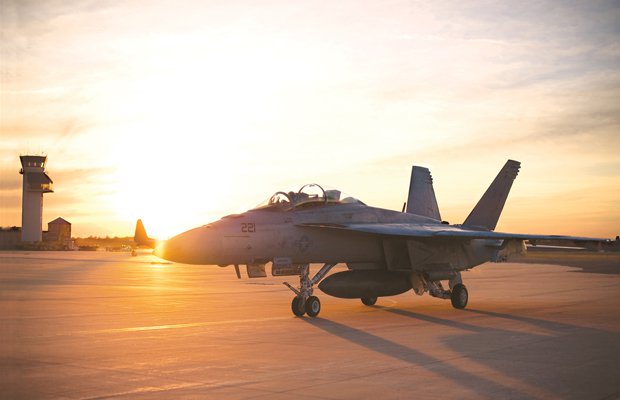
An F/A-18 Super Hornet.

Post-flight operations.
The observation deck of the air traffic control tower is the best seat in the house. From this vantage, 107 feet above seven miles of intersecting runways, one gets an acute feel for Naval Air Station Oceana. With its noise and frenetic activity on a late-winter day, the place rouses the senses. Top Gun-style pilots and ground crews ready multi-million-dollar machines for an afternoon of flying practice—at speeds up to 1,000 miles per hour. Trucks ferry fuel and inert practice ordnance—which smokes on impact so pilots can be graded on their accuracy—around the tarmac. Aircraft taxi forward and queue up at one end of center stage: runway 14R/32L. It’s from here that a half-dozen F/A-18 Super Hornets, the Navy’s sleek, gray strike fighters—each worth about $60 million—will rocket forward with a blast of jarring sound and staggering thrust. Each is airborne in seconds, banking hard left, clearing the runway for the next plane in line, which follows suit within a minute.
Even from this aerie, it’s impossible to take in all of Oceana, a sprawling naval complex that is one of America’s largest and most important military installations. Located on more than 5,000 acres of land in Virginia Beach, Oceana is the Navy’s East Coast Master Jet Base, one of two installations in the United States (the other is NAS Lemoore in California) devoted exclusively to housing, servicing and deploying the Navy’s combat-ready, or tactical, jets. Its westerly neighbor, Naval Station Norfolk, might be better known—it’s the largest Navy base in the world—but Oceana is equally vital to national security. “Fifty percent of the Navy’s tactical aircraft, give or take a few, are located here at Oceana,” explains Capt. MarkRich, the 49-year-old commanding officer of the base, sitting in his tidy ground-floor office on Oceana’s main street, named Tomcat Boulevard. Dressed in his black naval officer’s uniform, Rich is an unassuming and mannerly officer who appreciates the gravity of his command. In the event of an international crisis, it’s possible that pilots and aircraft from Oceana would be the first physical U.S. military presence on the scene, the so-called “tip of the spear.”
A former F-14 Tomcat pilot with combat experience in Iraq and the former Yugoslavia, Rich is effectively the mayor of a small, aviation-oriented city. He is certainly well suited for the challenges, but acknowledges they are far different from anything he’s done before in his 27-year military career. For example, he must manage civilian and military contractors and labor unions, in addition to the dozens of military commands and facilities he oversees. “When all you do is go to your squadron, fly your airplanes and work in the field,” he says, “you have no awareness of the complexities and breadth of issues [at a major military base].”
Maintaining a state of what the military calls “combat readiness,” which is the basic function of this base, requires a lot of manpower. Some 15,000 employees work at NAS Oceana, one-third of them civilians, the rest naval personnel. They hold jobs ranging from intelligence officer and fighter pilot to aircraft maintenance technician and weapons expert. Nearly everyone at the base has advanced technical skills or is in some stage of acquiring them. The employees work in such key units as the Strike Fighter Wing, providing all the shore-based training and support for the Atlantic Fleet’s tactical aircraft; the Navy Munitions Command Detachment Oceana, which secures and accounts for all ammunition and explosives at the base; and Naval Aviation Forecast Center, Oceana Component, which provides the weather data and warnings that are critical at a base focused continuously on pilot training.
Oceana has two companion facilities, located a few miles from the main base. One is NAS Oceana Dam Neck Annex, home to combat support units such as intelligence, and the other is Naval Auxiliary Landing Field Fentress, Oceana’s outlying landing field that offers another set of nearby runways where pilots can practice. Together, these two sites comprise thousands of additional acres where aviators and support personnel ply their trade. “Every time an East Coast [aircraft] carrier deploys, the striking power of the aircraft they’re taking with it is coming from Oceana,” says Rich. “It’s our job, when [pilots are] shore-based, to enable their training so they can maintain the level of readiness they need.”
Oceana’s aircraft—almost 300 F/A-18 Hornets and Super Hornets—make up the Strike Fighter Wing, U.S. Atlantic Fleet (“wing” is the term the Navy uses for a large group of aircraft, pilots and support personnel). According to the commodore of the Strike Fighter Wing, Capt. Craig Yager, Hornets are quick and versatile jets that can carry a variety of air-to-air and air-to-ground weapons and complete unique missions in a broad range of locations and situations. He says that upgrades in software—and occasionally hardware—render Hornets and Super Hornets among the most advanced weapons in the Navy’s arsenal.
A seasoned aviator, Yager works in an olive drab flight suit and has an office adjoining imposing hangars. He trained at Naval Air Station Fallon in Nevada, better known by its less formal name, Top Gun, and still takes to the sky occasionally with his subordinates (but not as often as he’d like). Yager’s job, like Rich’s, is decidedly managerial: He must ensure that the wing’s 17 operational F/A-18 squadrons (a smaller division of a wing, consisting of about 12 jets) are properly manned, trained and equipped.
That is a massive undertaking. Oceana’s aviators conduct more than 300,000 “flight ops”—meaning takeoffs, flybys and landings—per year. This despite the fact that at any given time, as many as two-thirds of Oceana’s aircraft may be deployed or practicing on aircraft carriers off the coast. Yager says that constant training, even by experienced aviators, is necessary to maintain razor-sharp flying skills. After takeoff, Oceana’s planes typically head east toward training ranges over the Atlantic Ocean. There, they practice air-to-air operations. Alternatively, they may head south to a bombing range in Dare County, N.C., for air-to-ground work.
Navy pilots must have one essential skill, and that’s the ability to take off from, and land on, an aircraft carrier. Oddly enough, because aircraft landings have almost no room for error, Oceana’s pilots do much of their training on land, supplementing that with practice aboard the ships themselves. “Landing aboard a carrier as it’s moving and the deck is pitching can be very difficult,” says Yager. “As you see airplanes going around and around [at Oceana and Fentress], that’s what we’re doing—coming back here and getting proficient in that landing pattern.”
Lieutenant Trent Arnold, a 35-year-old Marietta, Ohio native, knows this routine well. He’s a student pilot assigned to VFA-106, also known as the “Gladiators,” which serves as the East Coast’s fleet replacement squadron, responsible for training newly winged Navy and Marine Corps pilots or those switching the type of aircraft they fly. Pilots train with VFA-106 for about eight months before being assigned to one of the Navy’s 37 tactical F/A-18 squadrons around the world. A new class of eight to 12 student pilots joins VFA-106 every six weeks.
Arnold seems very much at home in an aircraft hangar full of a dozen Super Hornets. He likes to point out that Navy jets are different from all other military jets in one key respect, and that is the size and composition of their landing gear. Unlike Air Force pilots, who can coast in for a landing on long runways, Navy pilots must come down out of the sky like a rock—hard and at a steep angle so that their tail hook can catch a wire stretched across the deck of a carrier. The wire stops the jet. Such landings put a tremendous amount of force on the landing gear, which is why it is an intricate mass of thick steel with substantial shocks.
As Arnold says, “There is no trying to make [our landings] nice and pretty.” Even on long, shore-based runways, Navy pilots tend to land hard and short, as if they were landing on a carrier. It’s force of habit. The Hornet’s landing gear, specifically its “launch bar,” also allows them to be hurled off the deck by a powerful catapult. “It’s zero to 130 in three seconds and change,” Arnold says.
According to Arnold, 10-hour workdays, some of which start in the evening, are routine. While flying the aircraft may only last an hour or so, pilots must sit through a pre-flight brief and a post-flight debrief (better known as “finding out how bad you did,” he quips), and spend time preparing themselves and the plane to fly, which includes practice time in a flight simulator. Much of Arnold’s coursework and aerial training is conducted by instructors of Oceana’s Strike Fighter Weapons School, Atlantic. These experienced pilots, who have trained at Top Gun, teach students how to properly employ the tremendous weaponry F/A-18s are capable of carrying.
Student pilots are all officers who, in addition to expressing an interest in flying, have completed a battery of tests demonstrating their competence and physical suitability for the training and for the aircraft they hope to fly. Some Oceana pilots have flown other military aircraft before, but most—known as a “Category I”—are in aviation training for the first time. The work is demanding and stressful, but pilots like Arnold, who tend to be highly motivated 20- and 30-somethings, would have it no other way. Arnold says that there have been days during his flight training when, on the way to work, he’s driven past people mowing golf course fairways and thought, “What a stress-free job, I wish I did that. But it would be nowhere near as rewarding to me as flying planes.”
Of course, pilots are not the only Navy personnel being schooled at Oceana. Many of the sailors who staff the state-of-the-art Fleet Readiness Center, where jet components are serviced, have received their training a few streets over, at Oceana’s Center for Naval Aviation Technical Training. There, sailors learn to repair the hundreds of intricate systems that are part of the F/A-18. Students receive classroom, computer and hands-on instruction. Dozens of doors line the center’s dark corridors, and behind many of them are sizable laboratories, each containing jet systems—engines, wings and cockpits, for instance. These labs are spotless and orderly, with an aircraft component in the center of the room, typically, and mobile red tool chests lining the walls. Students apply their computer learning in these workshops. Just when they begin to feel comfortable with a particular part, the instructor taps a few keys on a PC and—bam—something goes awry. It’s the students’ job to diagnose and repair the problem. Chief Warrant Officer 3 Tom Thomas, a training unit officer, underscores the importance of the lessons he and his colleagues teach. “Many of the parts are electronic parts,” Thomas says. “You’d think, looking at one, ‘It’s just a little box.’ Well, that little box might cost 80 grand.”
Navy brass know that they demand a lot from employees and their families—especially during those periods when personnel are on routine six-month deployments—and try to reward them in return. Besides the scores of military buildings on the base, Oceana has dozens of Navy Exchange shops that provide low-cost goods and services to sailors, their families and retirees, all tax-free. They include clothing stores, restaurants and gas stations. What’s more, the Navy’s Morale, Welfare and Recreation (MWR) division offers 31 different recreational activities ranging from bowling to golf to horseback riding. There are three gyms at the base, along with a child development center and a two-dollar movie theater. “We recognize that relaxation is an integral part of the fighting force,” says Robin Joseph, general manager of the Oceana Navy Exchange, which is the fifth-largest U.S. Navy Exchange in the world.
According to Joseph, the exchange and MWR division help boost morale and play a big role in personnel retention. Sailors who are surveyed when reenlisting, he says, often cite the Navy Exchange and MWR among the reasons for their return. Vinny Spagnuolo, one of Oceana’s MWR directors, explains that the division also helps sailors cope with anxieties related to long deployments—one of the military’s most challenging responsibilities. “We’re here to put the sailors at ease while they’re deployed,” he says. “With all these diversified programs and youth centers, they know their families are taken care of while they’re gone.” MWR also serves a public relations function of sorts, helping to coordinate Oceana’s renowned air show, attended by more than 200,000 citizens annually. According to Lieutenant Arnold, Oceana is considered a choice military assignment—he calls it the “crown jewel” of Naval Air Stations.
The U.S. Congress approved the construction of NAS Oceana in 1943. The base was originally an outlying landing field for aircraft training at Norfolk. In those wartime days, Oceana was far from any population center, located on marshy and nearly inaccessible land. That’s not the case today. Like the Hampton Roads region around it, Oceana has grown significantly over the years.
Owing to its size and large number of employees, Oceana is a key component of Virginia’s economy, injecting more than a billion dollars annually into state coffers. Partly for that reason, says Rich, Oceana and the communities that surround it are inseparable. “A huge part of this community has some association with the military,” he says. “We’re in the churches, our folks are coaching soccer teams—a large number of the people we’re flying over are people who work here.”
Still, both the Navy and Virginia Beach officials are aware of how complex the relationship between a city and a major military base can be. Simply put, municipal priorities and military priorities are not always the same. Certainly, encroaching development in areas adjacent to Oceana, where an airplane crash could occur, has created some tension and been a source of concern for Navy officials for years. Meanwhile, the persistent jet noise at the base (which can exceed 110 decibels when jets are taking off, equivalent to the volume in the front row of a rock concert) alarms many citizens around Oceana.
One big issue now is space. Oceana and Fentress don’t have quite enough of it for all the demands of training. That’s especially the case before major deployments, when the Navy’s high command might order that five squadrons must get ready to ship out. All those pilots must use the same time and airspace to prepare. As a result, Navy officials (largely from the base in Norfolk) want to build another outlying landing field, or OLF, on the rural outskirts of Hampton Roads. The Navy is currently studying five potential OLF sites in Virginia and two in North Carolina. While the proposal has garnered both criticism and support, a final decision on where—and if—an OLF will be built is years away.
Five years ago, the military’s Defense Base Realignment and Closure Commission proposed moving the East Coast Master Jet Base from Oceana to Florida. The idea was eventually quashed, but not before it unnerved both city and state officials and prompted renewed attention to Oceana’s needs. Navy officials and community leaders are now charting a new, more cooperative path. To address encroachment concerns, for example, Virginia Beach and the state have purchased conservation easements and have limited development around Oceana. For their part, Navy officials have restricted flying times and set up a phone line for complaints about jet noise.
Will Sessoms, mayor of Virginia Beach, is well aware that the loss of Oceana would have had a devastating effect on the local economy, but he prefers not to dwell on the past. In fact, Sessoms and other Beach politicians are working to make sure that Oceana remains the home for the next generation of Navy strike fighters, the F-35, slated to join the fleet in 2014. “I see the Navy and the city working well together in the future,” says Sessoms, citing the shared interests of the two sides.
He emphasizes the importance of Oceana’s economic contribution to the city in terms of jobs created, money spent and hours volunteered. More than 30 percent of schoolchildren in Virginia Beach come from military families. Civilian federal employees and military personnel continue to have among the highest average salaries in the region. What’s more, ongoing construction at Oceana, including a $40 million energy efficiency project, provides work for local contractors. And then there’s the fact that Oceana produces some of the best pilots in the world. “Oceana is a tremendous asset to the city,” says Sessoms, “but the impact on Virginia and the nation is the [larger] issue, and it is very substantial.”
That is true. Last February, F/A-18 aircraft conducted missions in Afghanistan, driving Taliban fighters from hostile positions and clearing the way for U.S. and coalition forces on the ground. NAS Oceana, like all military bases in America, is fulfilling U.S. security needs every day, along with providing economic ballast to the region and, more generally, injecting can-do spirit into its community—all in a manner that might be described as large, proud and, yes, loud. •