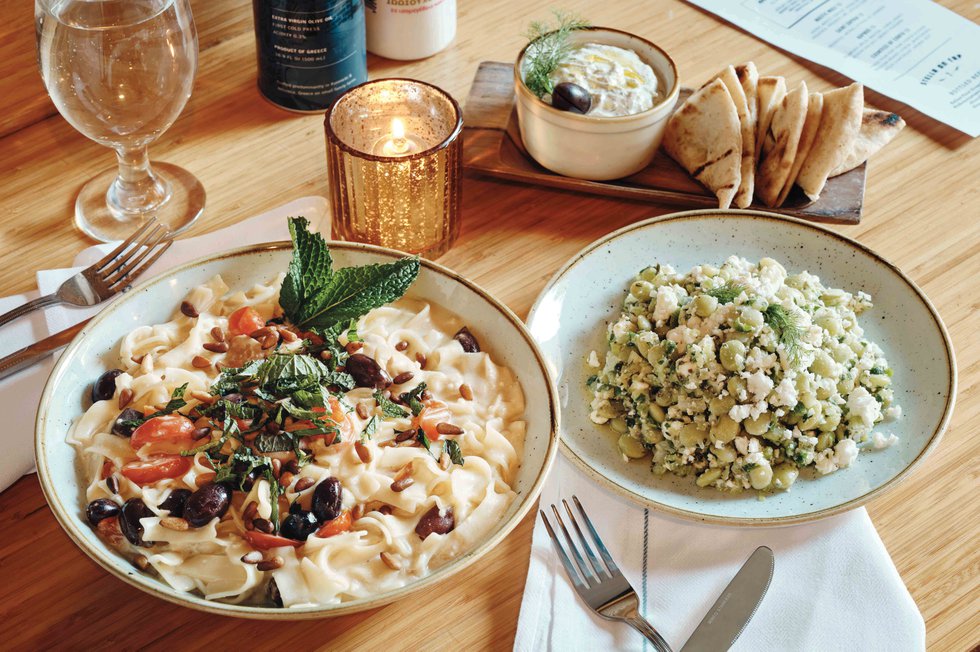

Now is the time to stalk the many possibilities of asparagus.
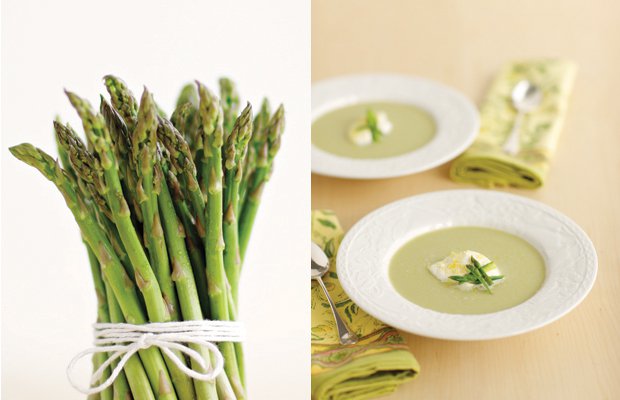
Asparagus feature
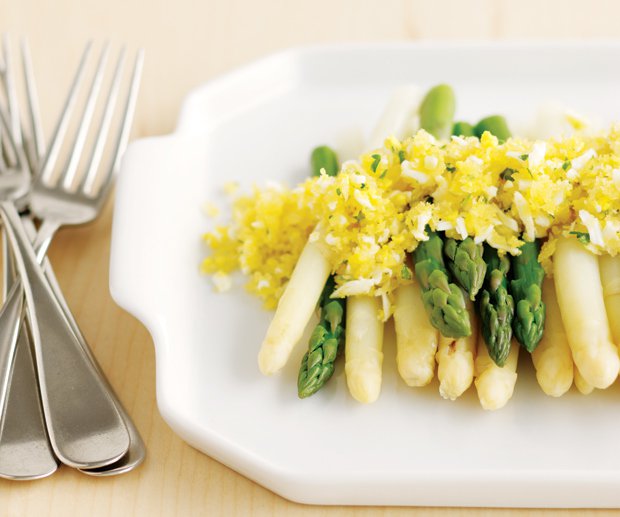
Asparagus polonaise.
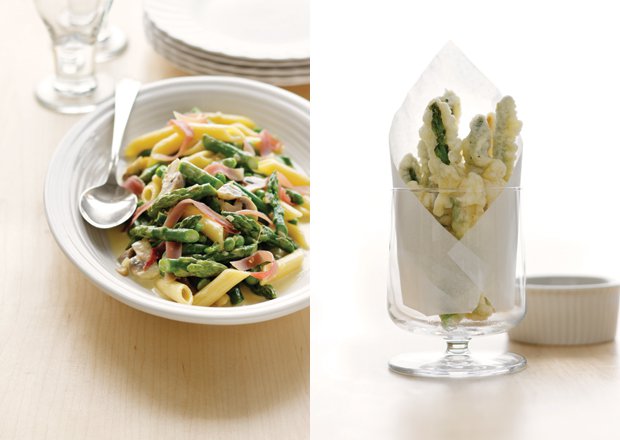
Asparagus, pasta and peas; right, tempura asparagus.
Asparagus wants to be anthropomorphized. According to food writers far and wide, it “loves” mayonnaise (or Hollandaise or Bearnaise or any other –aise), and lemon is its “old comrade.” It “knows” where its juicy part begins and ends—most recipes instruct cooks to snap off the woody ends rather than cutting them, because the spears will break exactly where they need to. Animal, Vegetable, Miracle author Barbara Kingsolver has described the spears as having the “tight, shiny sex appeal of dressed-up matrons on the dance floor of a Latin social club.”
And it does look very grown-up and elegant amid the messy lushness of the produce section, where most of us find it rubber-banded in orderly, green bundles standing at attention in their water bath. Whether or not you’re inclined to endow it with human qualities, there’s no doubt that hidden inside those buttoned-up stems is the power to bring about some interesting phenomena.
One of them is asparagus’ odd and very well known side effect, which Marcel Proust once described as transforming his chamber pot into “a vase of aromatic perfume.” (Think he was being perverse about a urinary byproduct that’s chemically akin to skunk spray? No—food science guru Harold McGee, who cites Proust’s quote in his book On Food and Cooking, notes that some people are genetically disposed to find the odor pleasant.) Another effect, which you’d think would be at odds with the first, is the mania asparagus can induce, even to the point of sweeping an entire nation: Each year throughout Germany, for a few springtime weeks known as Spargelzeit—“asparagus time”—the country is rife with asparagus-centered menus, contests, festivals, asparagus routes (much like Virginia’s wine tours). There’s even an asparagus museum.
But why get so excited about asparagus in spring when it’s available year-round? Because, hands down, spring is when asparagus is at its best, whether or not you’re drawn to the idea of buying locally. Dale Reitzer, chef and co-owner of Acacia Midtown restaurant in Richmond, talks about breaking off a stalk at the ground in an asparagus patch. “You pop one in your mouth and you go, ‘Wow, that’s just great,’” he says. “It’s night and day, the sweetness of it, the crispness of the stalk. Any time you get something that’s right out of the ground, it’s so much sweeter than something that’s well-traveled. Especially with asparagus, which is more on the bitter side.”
Indeed, the moment it’s cut, asparagus, which is about 4 percent sugar, begins to change—“more rapidly,” writes McGee, “than any other common vegetable. Its flavor flattens out; it loses its juiciness, and it becomes increasingly fibrous from the base up.” McGee suggests soaking the spears in a 5 to 10 percent sugar water solution to slow the loss somewhat. Reitzer points out this change as another reason to choose the freshest asparagus: “More of it is usable, because the breaking point is much lower on the stalk.”
Asparagus’ flash-in-the-pan flavor belies the long life cycle of the plant, which can extend up to a couple decades. The cultivation requirements are backbreaking and may demand a little mania on the part of the gardener. After double-digging a trench, enriching the soil and sowing, the reward is a three-year wait before the first stalk can even be cut, which allows plants to adequately establish themselves. (Perhaps this is why asparagus was once considered the royal vegetable—what peasant could afford to invest that kind of labor and then wait for three years? Luckily, three-year-old rhizomes, called crowns or mops, are available for purchase.) Because asparagus grows as fast as six inches a day, the gardener must cut it at the ground by hand within 24 hours after it erupts, before its pointed scales start to become branches, before its tip unfurls into blowzy disarray and the plant grows into the ferny little tree it wants to be. Harvest should run only a few weeks lest the plant gets … frustrated.
For fun (in an even more labor-intensive sort of way), gardeners can alternate green and white asparagus years with the same plants by keeping soil mounded around the stem, preventing photosynthesis and, thus, greening. White asparagus’ flavor is variously described as milder, more buttery or more bitter than the green, without the grassy flavor of chlorophyll. It’s also more fibrous and usually requires peeling. “It’s a vegetable that can be cooked easily,” says Reitzer, “but to truly make it great takes a little finesse.” One of his favorite preparations is a white asparagus salad with a mayonnaise made with blood oranges, to highlight white asparagus’ citrus tinge. “When I eat that, I feel like I’m eating grapefruit—the balance of the bitter, the acids ….”
By the end of asparagus’ brief season, other bounty is coming in, so it’s not so hard to let asparagus finally kick up its heels and grow, grow, grow, laying in reserves for next year. In the meantime, you’ll have steamed, roasted, fried or grilled it. You’ll have enjoyed it in risotto, au gratin, or with a vinaigrette. Reitzer, who used to serve asparagus year-round (grilled, with crab cakes), now offers it only in season. When the farmer he gets it from has it, he says, “I get it and try to find 30 ways to put it on the menu.”
But most of us don’t need 30 ways to make asparagus. Perhaps a simple asparagus tip omelet is the place to start. In his 1947 tome, The Gold Cook Book, Master Chef Louis P. De Gouy instructs us to first blanch the tips, then sauté them with a diced artichoke heart in butter: “Nothing else, no parsley, chervil or chives. The asparagus and artichoke singing in the butter make a harmonious duet, to which no other voice should be added unless it be that of a truffle cut in thin blades, but then this would be a dream rather than an omelet.”
Sounds more than worth waiting for, doesn’t it?
ASPARAGUS, PASTA AND PEAS
1⁄2 shallot
1 tablespoon olive oil
1 tablespoon butter
4 mushrooms, quartered
1⁄4 cup peas
1 1⁄2 cups asparagus, woody ends snapped off and spears cut
into 1-inch lengths
1 cup cooked penne pasta
3⁄4 cup cream
2 slices Surryano ham (or proscuitto), julienned
Blanch the asparagus in boiling salted water, until bright green, and then shock briefly in an ice water bath to stop cooking. Sauté the shallot in olive oil and butter until soft. Add the mushrooms, and sauté until golden. Add the peas and asparagus, and stir until heated through. Add the cream and, over medium-high heat, bring it to a boil and allow it to thicken and reduce, about 5 minutes. Add the pasta and ham, toss until heated through, and serve.
ASPARAGUS SOUP
8 cups water
3 bunches asparagus
1 ounce unsalted butter
1 tablespoon olive oil
1⁄2 of one small onion, diced
1 medium shallot, diced
3 tablespoons all-purpose flour
salt and pepper to taste
for garnish, unsweetened whipped cream, lemon zest and
juice, salt, sugar
Snap the woody ends off the asparagus, reserving the ends (about 1 1⁄2 inches each). Salt the water and bring it to a boil. Add the asparagus ends and blanch for 8 to 10 minutes, and then fish out and discard them. Meanwhile, cut the rest of the asparagus into 2- to 3-inch lengths. Blanch them in the rapidly boiling water for 4 to 5 minutes, then scoop them out with a strainer and immediately shock them in an ice water bath, to stop the cooking and retain the color.
In a pot, melt the butter with the olive oil, and sauté the onion and shallot until soft but not brown. Add the flour, and cook slowly for 3 to 4 minutes, until it makes a light roux. Slowly add 3 cups of the asparagus stock and bring to a boil; add in another 3 cups; add 1⁄2 teaspoon salt and fresh ground pepper to taste. Bring once more to a boil, and then cool it enough to puree it with the blanched asparagus. (Discard the remaining liquid, or use it for another dish.)
Garnish with a drizzle of lemon juice, a pinch of salt and a pinch of sugar, and finish with a dollop of whipped cream seasoned with grated lemon zest.
ASPARAGUS POLONAISE
1 bunch each green & white asparagus, woody ends snapped off
2 tablespoons butter
2 hard-boiled eggs, chopped
1 cup bread crumbs (Japanese panko works nicely)
1⁄4 cup parsley, chopped
salt and pepper to taste
Brown the butter, warm the bread crumbs in the butter, then add the eggs and toss in the pan until heated through. Remove from heat, add parsley and toss. Salt and pepper to taste. Meanwhile, blanch asparagus in rapidly boiling water for 4 to 5 minutes. Arrange on a serving platter. Sprinkle the egg mixture over the asparagus, and serve warm.
TEMPURA ASPARAGUS
1 bunch asparagus
batter
1 egg yolk
1 cup flour, sifted
1 cup ice water
2 tablespoons sesame seeds, toasted
vegetable or peanut oil for deep-frying
dipping sauce
1 cup dashi (Japanese fish stock)
1⁄3 cup soy sauce
1⁄3 cup mirin
1⁄2 cup daikon radish, grated
3 tablespoons fresh ginger, grated
Snap the ends from the asparagus stalks, and make sure that the asparagus is completely dry. Heat oil. While oil heats, make batter: Beat the egg yolk, add the ice water and mix, then add the seeds and the flour all at once. Stir gently until just barely combined—you want the batter very lumpy. When a bit of batter dropped into the oil sizzles, the oil is hot enough. Piece by piece, dip the asparagus in the batter and carefully lay it into the oil. Cook each spear until the batter is golden. Drain briefly on paper towels, and serve immediately with dipping sauce (combine dipping sauce ingredients in a saucepan over medium heat; serve warm).