
Welcome to Rappahannock County—a tranquil island in a sea of development. Residents and visitors laud its rural charm and sophisticated culture. The question is, can it stay this way?

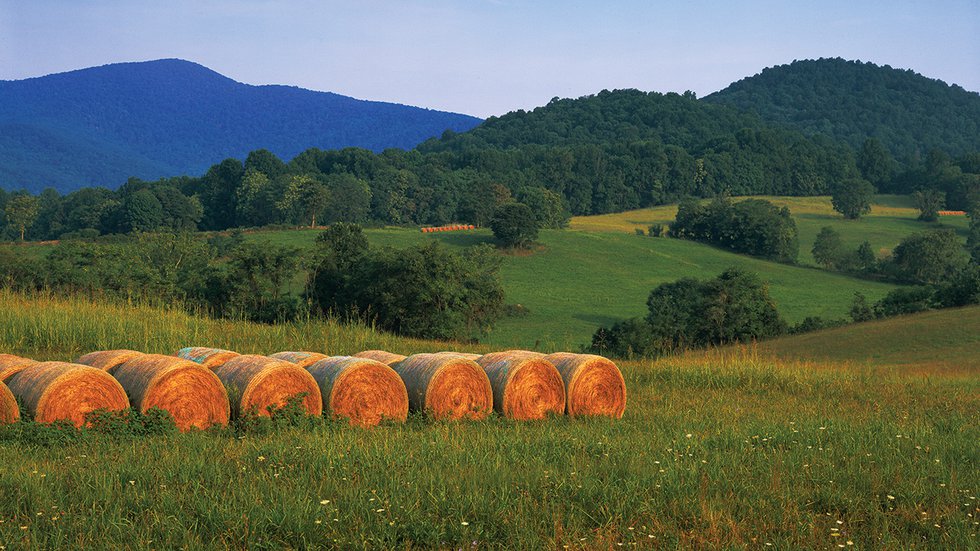
Rappahannock view


Middleton Inn, in Washington


Alan Zuschlag with Phoebe

Blackberry cobbler from Rae’s, in Sperryville


Salad from Epicurious Cow, in Amissville


Sunset from Skyline Drive

Sherri Fickel and Kevin Kraditor, owners of Hopkins Ordinary, in Sperryville; right, the headwaters of the Rappahannock
Photography by John Henley
Rappahannock’s village of Washington hasn’t grown much since George Washington laid out the place as the county seat in 1749. The future president was a surveyor then, age 17. The village then had a five-by-two-block grid, and it remains precisely the same today—small and, in many ways, unchanged.
With about 200 official residents, Washington is a bustling hub by Rappahannock standards. One can stop at the family-run Country Café on Main Street and, for a few bucks, enjoy some simple country cooking. That’s not surprising in this rural county. What is unusual is that visitors can also stroll across the street and, assuming a reservation has been made, dine on classic French cuisine at the Inn at Little Washington—the first five-star, five diamond restaurant/inn in America. Bring your Louis Quatorze wallet. Poke around R.H. Ballard for Georgetown-quality linens, rugs and gifts. Enjoy chamber music or a Shakespearean play at the Ki Theatre, or visit one of the village’s six art galleries. Here is a tiny town with some big-city amenities.
This mix of simplicity and gentility defines not just Washington but all of Rappahannock. Tucked against the northern neck of the Blue Ridge Mountains, Rappahannock is a place stuck in time—a fact many of the residents are proud to point out. The late U.S. Senator Eugene McCarthy, who had a home in Rappahannock, famously noted that the county was “75 miles and 75 years away from Washington, D.C.” For Col. John Bourgeois, longtime Rappahannock resident and Director Emeritus of the Marine Corps Band, those are conservative numbers. Asked if it takes about an hour-and-a-half to drive from Washington, Virginia, to Dupont Circle, he quips, “No, a century-and-a-half.”
Truth be told, those may be only slight exaggerations. Rappahannock, with a population of 7,000, is one of the smallest of Virginia’s 95 counties—and it wants to stay that way. Its residents hold tight to a big idea: No growth, or, more precisely, very limited growth. While development proceeds at a breakneck pace across many rural areas in America, Rappahannock’s landscape remains largely as it was 200 years ago.
That’s a good thing, because the scenery is sweet, starting with the Shenandoah National Park, which occupies the western third of the county. In addition to the mountains, Rappahannock also offers an 18th-century network of villages and (working) farms—and, in the spring, a stunning collection of flowers, including fiddleheads and exotic lady slippers, not to mention ginseng and, growing in the wild, tantalizing morel mushrooms, which often find their way into local dishes.
“I think it’s one of the most pristine and unspoiled landscapes on the eastern seaboard,” says Alan Zuschlag, a Rappahannock Realtor, farmer and county enthusiast, who moved there 11 years ago. As he and others point out, there is not a single subdivision in the county—and there never will be. There are no fast-food restaurants, no McMansions squatting on former apple orchards, no strip malls occupying erstwhile pasture land.
Cruising through the county on winding, two-lane roads like Route 211 or Route 522, one sees Rappahannock for what it is: a redoubt, or retreat, from the steamrolling suburban machine. This is not to say that the place is Eden. The county offers few services, and many residents are getting antsy for improved cell phone service (too many hills and hollows) and high-speed Internet.
Often, the word “rural” is a synonym for economically depressed. That’s decidedly not the case in Rappahannock. It is, in a word, prosperous—with low taxes, gentlemen farmers and few of the development pressures found in neighboring counties (Madison, Fauquier, Culpeper and Warren), thanks to aggressive use of conservation and scenic easements as well as progressive zoning laws. The minimum lot size outside the villages is 25 acres. In neighboring Culpeper, by contrast, the agriculture zoning minimum is 10 acres.
With so much open space and so few people, Rappahannock might be dismissed as being a backwater. It is just the opposite. The pace of life may be relaxed and the buildings old, but here is a place that is forward in its thinking. Rappahannock has more culture than many large suburban centers. Art studios are scattered around the county. Sperryville, a village with roughly 500 residents, boasts numerous Victorian houses, two fine restaurants (Thornton River Grille and Rae’s), a good coffee company (Central Coffee Roasters) and a superb art venue (the Long View Gallery), along with impressive antique shops. In the even smaller village of Amissville, Terry Lehman has turned a former gas station into The Epicurious Cow—a country market, at first glance. But step inside and find a fabulous array of quality meat, seafood and produce that rivals Balducci’s or D.C.’s Sutton Place Gourmet, with greater emphasis on organic and natural food. Lehman worked as a manager and buyer at Sutton Place before opening Ecow, as the locals know it. It’s the go-to place for quality food—including Niman Ranch meat (all-natural feed, pork from heirloom hogs), for example, as well as fresh vegetables in season, wine and cheese.
What is Rappahannock’s secret? How has it managed to blend rural with refined? The answer, really, is that the county has attracted successful people. Not just the tourists who visit Shenandoah National Park, but wealthy transplants, mostly from Washington and, recently, Europe. Some are well-educated professionals, others retirees. All buy land, many start new businesses, and, as Washington Post writer Joel Garreau noted, speaking at a recent conference on sundry issues pertinent to Rappahannock’s future, all bring their appetites for good art, theater, food and coffee. As he said, the place has been gentrified—it’s “urbane but not urban.” The Washington Post recently described the county as Sonoma East. According to U.S. Census Data, the median family income in Rappahannock more than doubled between 1990 (just below $24,000) and 2000 (just below $52,000).
Zuschlag now sells real estate and owns a sheep farm, but he used to be a diplomat with the State Department. Lorin Maazel, the conductor of the New York Philharmonic, owns an estate in Rappahannock. He and his wife have built a private theater on the property, where outstanding musicians perform, and they’ve started a foundation dedicated to nurturing young artists. (See following story.) As Zuschlag says, “I can kick the mud off my boots and go see Itzhak Perlman play a few doors down.” Mary Ann Kuhn, a retired CBS News producer and Washington Post reporter, owns Middleton Inn, a regal 1850 Federal Manor house turned four-star inn.
Tourism and farming together form the economic backbone of the county. Many tourists visit Shenandoah National Park, though the numbers have been falling in recent years, as well as the county’s numerous first-rate bed-and-breakfasts. In addition to the Middleton Inn, Fairlea Farm, Foster Harris House, Gay Street Inn and Heritage House all offer a mix of historic architecture and creature comforts. John and Diane MacPherson, who own the Foster Harris House, are two young Californians with a passion for cycling; their upscale Tour d’Epicure lets you burn off calories accumulated at winery lunches and gourmet dinners.
There is no industry in Rappahannock. Farming defines the county—that and the idea of protecting the land. Cliff Miller does both. He is the fifth generation of his family to live at Mount Vernon Farm, whose 825 acres wrap around the village of Sperryville. After retiring as Upper School head of Richmond’s Collegiate School, followed by a stint with Davenport & Co. as an investment manager, Miller moved back to Rappahannock full time in 2000. He built a striking contemporary house near the top of a steep hill, a glass-and-stone aerie with stunning views across the valley and the long, gentle line of the Blue Ridge. The historic family home, built in 1827, remains on a lower slope.
Miller runs a burgeoning meat and egg business, but he is also a proponent of small-production farms that can supply a wide variety of food to their communities. That means making farming profitable for the farmers—a challenge in a county where land has gotten pricey. While the real estate market in most parts of America has been soft, that is not the case in the upper end of Rappahannock, meaning large estates and weekend homes. “We’re slightly below Middleburg in terms of prices,” says Zuschlag, “but I think Rappahannock will be more expensive in five years. People on the Loudoun County side of Middleburg are selling out to developers and getting out of Dodge. They’re driving up prices here, where there is never a lot on the market at any one time.”
Miller leased 30 acres of his property to Eric Plaksin and Rachel Bynum under a long-term arrangement, and gave them two years of free rent so that they could put their money into improving their spread, Waterpenny Farm, rather than simply making interest payments. “I’m thinking this could be a model for enabling outstanding young farmers to work land that probably would be [too expensive] otherwise. My goal is to have the land get better every year,” he says.
County administrator John McCarthy, sitting in his office in a historic two-room building in Washington, says that locals and newcomers alike are committed to the concept of land conservation. “There is a broad-based consensus to protect the landscape by zoning, and the political will [to do so] has been very constant since the 1960s,” he says, which was when county officials first started reviewing zoning laws in reaction to developers buying land close to Shenandoah National Park and breaking it into small lots.
Rappahannock’s Board of Supervisors “watched very carefully the development in Fairfax County, then Manassas,” says McCarthy. In 1973, when Route 11 widened to four lanes, the reaction in Rappahannock County was to boost the minimum lot size for a house—to five acres outside the villages. Then in the mid-1980s, he adds, “a density of one house per 25 acres was established to protect the farmland.”
According to Jim Gannon, editor of the Rappahannock Voice, an online newspaper, “The overriding issue is the pressure all around us for rapid growth. Rappahannock is an island in a sea of development. The kind of zoning laws we have here, and the public support for maintaining Rappahannock, have kept us successful so far. But economic pressure is all around us.”
The zoning in Washington and Sperryville, allowing up to 10 houses per acre, assures that clusters of houses and businesses stay in the villages rather than tumbling out along rural roads. The policy protects the agricultural landscape, which in turn reinforces tourism. “We want to promote businesses that support the landscape,” McCarthy says.
One tool is the use of so-called value taxation, which offers landowners a lower tax rate for farming. The county also encourages niche agriculture. “Maybe it’s not so easy to make money with a winery, but growing grapes is a very good way to make money,” McCarthy says. “Niche agriculture is returning dividends to those in this county. It’s not easy, but they’re making it.”
Indeed, Zuschlag, who’s 47 and a bachelor, claims that Rappahannock is Nirvana for foodies. “All the trendy restaurants in D.C. would love to source in Rappahannock. We’ve been successful in branding the county as a source of natural and organic food products.”
Patrick O’Connell, who with Reinhardt Lynch started the Inn at Little Washington in 1978, has done much to promote local farming—not to mention the county as a whole. O’Connell meets with farmers every spring to map out what food he’d like to buy for his restaurant. The Inn’s popularity has been an economic boon for Washington and the county: new restaurants, gift shops and antique galleries have sprouted to cater to the Inn’s well-heeled visitors. And the Inn now has its own group of shops, across the street, with its signature Dalmatian-themed items. Says O’Connell, “What needed to be proved here is that something could be done extremely well and that people would support it. You can create a market, a destination.”
Amazingly, nearly 40 percent of Rappahannock is completely off-limits to developers. About 18 percent of the county’s acreage comprises the majestic mountains of Shenandoah National Park, and another 18 percent is protected via conservation easements on private land. The first conservation easement was donated in 1974, and, as Don Loock, land conservation officer for the Piedmont Environmental Council, says, “they’ve been building momentum ever since.”
That’s partly because there are a lot of groups dedicated to the cause. The Krebser Fund, named after Werner Krebser, a former doctor in the county, is a private organization that raises money to buy land or help people put their land into conservation easements. The Rappahannock Conservation Alliance helps educate people about easements and, according to locals, has been successful. “People pay a premium to be here because they want protected land,” says Zuschlag.
A conservation easement is a partnership between a landowner and a land conservation organization, aimed at preserving water quality, forests, historic or culture regions and prime soil defined as important for food production. “We’re not trying to make [policy],” explains Loock, “but bolster current land-use policies by protecting land that the county doesn’t want to see developed.” Like other county residents, Miller has used conservation easements to boost the minimum lot size requirement on his property—in his case, to 100 acres. He’s also made use of riparian conservation easements. “We need to start at the headwaters of the Rapidan River, to help get the Chesapeake Bay clean,” he says. Miller created a 35-foot buffer around the narrow river on his farm and stopped putting chemicals on the land five years ago.
Miller’s neighbor, Aline Johnson, is a Rappahannock old-timer. She’s lived in “Spurravil” forever—or, as she says, “from the roots.” She talks a mile a minute. She can look at every building in the village and tell you what families lived where and which businesses came and went over time. She remembers one-room schools and music lessons at the barber shop. In a reversal of the usual tensions between locals and newcomers, Johnson says, “I’ll tell you, the new people have been a real asset to the community.”
Sperryville is a quiet, easy-going village. It’s a good place to browse for funky antiques, folk art and crafts, pottery and glass. Like Washington, it’s a place to unwind. Indeed, a long, narrow building on the Lee Highway, west of the villages, houses the Rappahannock Wellness Center, a group of holistic practitioners offering body and energy work, psychotherapy, traditional massage hypnosis and spiritual guidance. Think Sedona. Barbara Adolfi, herself a psychotherapist in Sperryville, rents out her restored House on Water Street to groups. She came to Rappahannock County to hike with her children, bought a “weekender” house in 1987 and moved here full-time in 1998. Hopkins Ordinary is anything but: Built in 1820, it’s run by an amiable young couple who swapped careers in systems programming and labor economics on Capitol Hill for the hectic life (if you’re lucky) of innkeepers.
Because the county is so un-hectic, the community itself must perform some public duties. For example, there is no bus or taxi service in Rappahannock, so two years ago the county set up a volunteer medical transportation network named Rappmedrides. Drivers take anybody who needs a ride to a hospital or doctor’s office. “We have more drivers than riders—it’s really been wonderful,” says Sharon Pyne, the county’s social worker for adults.
Community initiatives run toward the innovative. The Ki Theatre in Washington, a multi-faceted venue owned by Paul Reisler and Julie Portman, presents plays as well as storytelling and songwriting workshops. Soon, according to the Piedmont Environmental Council’s Loock, the Ki will help present a county “story project” that’s designed “to look at where we’ve come from and where we’re going.” Essentially, the project is aimed at creating community dialogue as Rappahannock prepares to draft its new five-year plan.
John McCarthy sees no significant changes in Rappahannock over the next five to 10 years. But he’s keeping a vigilant eye on the housing pressures in neighboring counties as metropolitan Washington, D.C., continues its westward expansion. He says that Northern Virginia created 190,000 more jobs than housing units from 1999 to 2006. Adds editor Gannon, “We’re fighting small skirmishes all the time. The real threat is if a developer would target Rappahannock and try to break the zoning laws. But it hasn’t happened yet. The real estate market has cooled, so we have a reprieve.”
Loock says that when Rappahannock started altering its zoning laws in the 1960s, with an eye on land preservation, “I think a lot of other counties couldn’t understand what we were doing. They may not have realized how rapidly [suburban] growth was moving this way.”
Like every place, says Loock, Rappahannock has its challenges. The influx of affluent home and estate buyers has been beneficial—but will the trend force out longtime residents who can’t afford to hold on to their land? “We’re looking strongly at the question of whether we have enough affordable housing,” says Loock.
He points out that Rappahannock has the same problems as other small counties. “We have to bring our garbage to a dump—it doesn’t get picked up. We have septic fields, which must be flushed and cleaned regularly. We get our water from wells, so we must be diligent about what we put on the land and how we treat the land. Things are a lot simpler here, but we also need to keep asking each other what we need to go forward.”
Zuschlag, Rappahannock enthusiast extraordinaire, wants to see the percentage of land in Rappahannock under conservation easement rise from 18 percent to 50 percent in the future. “We’re doing a good job here,” he asserts, “and the future will bear that out. As the state continues to develop, it will become an oasis—and everybody feels that way. The county may sound too good to be true, but the reality is, it is.”
That type of bullish endorsement could have everybody in Virginia scrambling to move to Rappahannock. Except that you can’t. Buy B&B futures instead.