
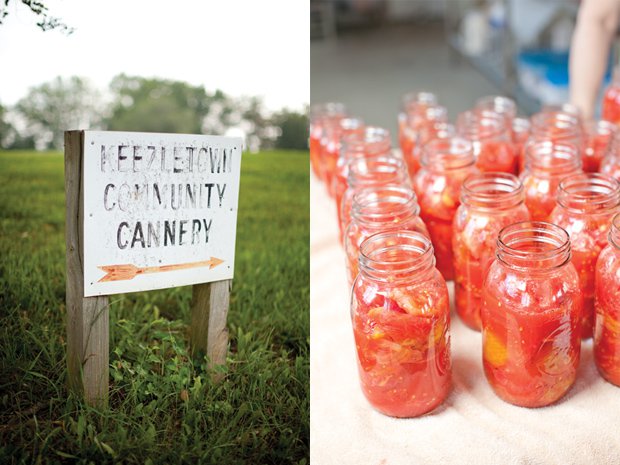
Community canneries have had their ups and downs over the decades—but owing to several factors, they are now making a comeback. Call it preserving a tradition.

Putting up the harvest – feature

putting up the harvest 1
Mornings heat up quickly inside the Keezletown Cannery.

putting up the harvest 2
Kenny Hammer pouring cooked apples (left); Stevie Velker, with daughters Deidrah and Miriam, at the Keezletown Cannery (right)

putting up the harvest 3
A board showing processing temperatures and times (left); Royce and Trudy Hammer at the Keezletown Cannery (right)

putting up the harvest 4
New London Cannery facility operator Pat Frazier (left); Hanover County Cannery assistant Terrence Quarles seals cans (right)

putting up the harvest 5
Hanover County Cannery operator Carol Van Goor (left); a special paddle for stirring applesauce (right)

putting up the harvest 6
Bill and Brock play outside at the New London Cannery (left); Herbert Jones, who helps out at the cannery (middle); steam from the cooker (right)

putting up the harvest 7
Applesauce cake (left); Hanover County Cannery’s Rose Jennings prepares the applesauce cake for canning (right)
Bee Patrick, a home health care provider from Gladys, Virginia, fondly recalls the summer days of her youth spent at the town’s community cannery. “Everybody came together to work on getting their food stored up for the cold months. It was a lot of effort but also a lot of fun,” she says. As an adult living in Lynchburg, she longed to relive that experience, but the Gladys facility closed years ago, and Patrick assumed the same had happened to the other public canneries that used to be scattered throughout the area. So she was thrilled when, this past July, she saw a local television news broadcast about the New London Community Cannery operating in nearby Bedford County. “I can’t believe it’s been here all these years,” she said of the facility, which has been operating since 1942.
The following week, Patrick, 67, took a day off work and arrived at New London with a half-bushel of string beans purchased from a local farmer and a few peaches she picked from a neighbor’s tree. Only vaguely recalling how the process worked, Patrick walked up the worn wooden steps of the small cinder-block building feeling slightly nervous. When a woman sitting on the narrow porch offered her a welcoming smile, Patrick said hello and volunteered that she had never been there before. “Next thing I knew,” Patrick says, “the lady flung the screen door open and yelled inside ‘We’ve got a new one!’”
Patrick walked through the doorway into the cannery’s bustling work area where she was met with a chorus of helpful voices telling her where to put her things and how to get started. A few hours later, she walked out the door with a broad smile across her face, a few new friends and her produce securely sealed in cans ready to be enjoyed this winter. When asked if she would be returning any time soon, she didn’t hesitate: “Honey, I’ll be back next week with squash and more beans!”
July signals the opening of canning season, the yearly ritual of “putting up” the summer harvest. That’s old-fangled talk for sealing fresh food in an airtight container and subjecting it to high temperatures—and in some cases also high pressure—to destroy micro-organisms that cause spoilage. Properly handled, the contents should last for a year or more. Canning can be done in home kitchens, but at least 11 Virginia counties, most of them in the rural central and southwest portions of the state, offer facilities where people may process their produce on commercial-grade equipment under the watchful eye of trained operators. Work that might take an entire day or more in a home kitchen takes only hours in a cannery. As an added benefit, many of the facilities have equipment that allows customers to seal their harvest in metal cans. The finished product is not as aesthetically pleasing as the glass jars used in home canning, but it is sturdier and easier to store.
Virginia’s community canneries, many of which date back 60 years or more, have experienced their ups and downs over the years but today are in the midst of a comeback. Joell Eifert, of the Department of Food Science and Technology at Virginia Tech, says that in the last two years there has been a marked increase in the number of inquiries to her office from people curious about the facilities. She has even had calls from a few counties wanting to open new canneries. And customers are showing up at the existing ones in record numbers. Last year, New London had its most successful season in years, drawing people from several surrounding counties and even out of state. Compared to 2008, the facility doubled both the volume of cans it processed and the number of its patrons. The Hanover County Cannery also had a banner year in 2009, processing more than 9,000 cans and jars, compared to under 6,000 two years earlier.
Several factors are behind the revival of community canning. For one thing, the weather has been good for growing—at least last year. In the spring and summer of 2009, the rain never seemed to stop, which meant a bumper crop of produce in many areas of the Commonwealth. But even with the drought-like conditions this year, many of the facilities still report being busy. Certainly, the shaky economy has played a major role in the re-emergence of public canneries according to Carol Van Goor, who runs the Hanover County facility. “People are looking to be self-sufficient and save money. Growing your own food and canning it fits that bill pretty well.”
The cost of using the facilities varies, but tends to be nominal. At New London, where food is processed in metal cans, the customers pay only the purchase price of the containers: thirty-five cents for pints and forty-five cents for quarts. In Stuarts Draft, customers bring their own glass jars and pay a service fee of thirty-three cents per pint and sixty-five cents per quart.
Not all cannery customers are on a budget, though. Van Goor also has noticed an upswing in health-conscious customers, especially parents picky about what their children eat. “When they buy processed foods from the grocery store, they don’t know what’s in the container,” she says. “If they buy it fresh and can it themselves, they know exactly what they’re getting.”
Mary Chris Moore of the Keezletown Cannery in Rockingham County sees another catalyst for renewed interest in canning—the local foods movement. Canning is environmentally friendly and “ties in perfectly with the big “green” buzz word and sustainability issues so important these days,” she says. Eifert offers yet another explanation. Many of the calls to her office are from young people looking to connect to the past. “They say, ‘My grandma did this and I want to learn to do it.’ They want to experience the tradition.”
And, of course, canneries offer community members a place to socialize while working. “Everybody loves food,” says Van Goor, “so they automatically mix. There’s a lot of fun and joking around in the cannery, even among complete strangers. It’s an experience that ties people together. We are one big happy family.”
The canneries typically open their doors to the public each year around Independence Day, when tomatoes, squash and string beans are ripening. As the summer progresses, customers arrive weighed down with beets, carrots and corn. September and October bring apples, pumpkins and black-eyed peas. In early November, the harvest winds down making way for hunters with venison and maybe even bear. Many of the facilities lack central heating and thus close by early December. “We stay open until the pipes freeze,” says Moore in Keezletown.
Tradition is at the heart of the community canning experience. It has been a part of American agricultural life since World War I. With many of the nation’s farmers and field hands fighting in Europe, the United States faced a severe food shortage. The federal government encouraged citizens to grow their own produce and, in the words of a famous slogan, to “back up the cannon with the canner.” The modest-sized home kitchens of that era were ill-equipped to process the tremendous volume of food being grown, and so state governments began to build community kitchens where the work could done safely, comfortably and efficiently.
When the war ended, the farmers returned from overseas and community canning dwindled in importance. Yet, the practice refused to die out entirely. Collective food preservation had established itself as a thrifty and neighborly means of supplying healthy, tasty food that could be put to good use even in times of peace.
The peace following World War I didn’t last, of course. World War II brought another food shortage—and a resurgence of community canning. An estimated 20 million Americans planted “victory gardens” in backyards, school playing fields and even urban lots. With financial support from the federal government, states again began to invest in public canneries. The Virginia Department of Education embraced the cause wholeheartedly, building facilities that were turned over to local school districts to operate as part of their home economics programs. It is estimated that, in the 1940s, 120 public canneries operated in cities, towns and rural areas across the Commonwealth. Summers at the cannery became a way of life in many Virginia communities.
Once again though, after the war ended, the popularity of community canneries faded. Not only were the farmers back in the fields, but home freezers became popular and large supermarkets sprang up across the country offering customers an enticing assortment of prepackaged foods. By the 1960s, usage had dwindled and many communities around the country found it difficult to justify the expense of keeping their canneries open.
The Commonwealth was no exception. “In a lot of Virginia counties, the budgets started getting tight,” says Susan Prillaman, a Virginia Cooperative Extension agent for Bedford and surrounding counties. “School systems had to choose between educating children and keeping the canneries open. In many cases, they chose the children.” By 1965 more than half of Virginia’s canneries had closed. In the years since, the number of facilities in Virginia and around the country continued to drop off. As was recently reported in The New York Times, the old community kitchens devoted to putting up the summer harvest largely have disappeared from the American landscape.
That Virginia has at least a dozen public canneries operating today—there is no official state inventory of the facilities—is to the credit of loyal enthusiasts who have worked hard to keep the tradition alive. In Stuarts Draft, when the county terminated funding to the cannery thirty years ago, local citizens could not bear to see the doors close on an operation that had meant so much to the community. A group banded together to assume responsibility for the facility. They refurbished the equipment themselves and have been running it on a shoe-string budget with private funds ever since.
In Hanover, when the last of the old public canneries wore out in the 1970s, a committee of citizens petitioned the Board of Supervisors to build a new one. “We’re a rural county! Of course, we have to have a cannery!” was the rallying cry of Rose Jennings who spearheaded that effort. A new facility with gleaming stainless steel countertops and modern appliances opened in 1980, but the fight was not over. In the past thirty years, the county has considered closing the facility at least four times due to budget constraints. Jennings and her committee have been there every step of the way, pleading to keep it open.
In addition to budget battles, the facilities have faced difficulty finding qualified staff. As the “Greatest Generation” ages, people with the necessary experience have become scarce. That was the case in Rockingham County when the long-time operator at Keezletown retired in the 1990s. The county would have closed the facility but for finding Royce Hammer, a local retired food inspector who agreed to run it with his wife, Trudy, for one year. “If we live through this season, it’ll be sixteen years,” 81-year-old Royce said this past July. He and Trudy “fell in love with the place” and hope to continue for years to come, but acknowledge they will not be around forever: “Age has clipped our wings a little bit.”
The same could be said of the facility they operate. Stepping through the screen door of the one-story wood-frame building is a trip back in time. Whitewashed board and batten paneling on the walls, a ceiling open to the rafters, worn wooden worktables and a potbelly stove hark back to days past. Adding to the feel is the vintage equipment, some of it dating from World War II. There are no modern food processors here.
But Hammer dismisses the idea that gadgets are necessary to get the job done: “All you need is somebody with a strong back and weak mind. Women tend to bring along men for those jobs.” He bets that anyone who gives the Keezletown cannery a try will be back. He likens it to “getting a burr in your blanket—it sticks with you.”
The community-canning comeback bodes well for the future of these facilities. In Bedford, the Board of Supervisors recently invested in updated equipment, including a new boiler. “The county does not make money on the cannery but was ready to bite the bullet to support it given all the grassroots interest,” says Prillaman. Yet, longtime canning supporters are careful not to assume the outlook is secure. “We’re fortunate this year in Hanover to have enough money to operate,” says Jennings. “Next season? That’s always a question mark.” If she catches wind of any plans to cut funding, she is ready to leap into action. “We have fought like tigers to keep this place open,” says the 74-year-old grandmother. “And we’ll fight again if we have to.”
Eifert, at Virginia Tech, credits this type of attitude as the salvation of Virginia’s community canneries: “There is a life blood running through them that you cannot kill.” The people who run and support the canneries “deserve tribute,” she says, for embracing this part of the Commonwealth’s history and keeping at it year after year. “You can’t help but appreciate the sweat, dedication, and passion that keep the community canning tradition alive.”