
For painter John Borden Evans, the act of painting is not just a means to an end, but the end itself.

Primitive Landscapes
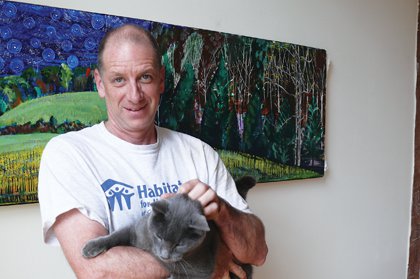
Evans with his cat, Graybeard

“Four Cows at Night”

“House at Night”
John Borden Evans’ Solitude Farm, just south of Charlottesville, is pastoral and peaceful. There’s a large garden, birdhouses and beehives and it has a mismatched bohemian quality that is authentic, individual and stylish. Beside the farmhouse are two studios Evans built himself—a brick studio for his wife (couturier Beth Neville Evans) and beyond, a sky blue clapboard structure—which looks like it came straight out of one of his paintings, which is his.
The son of a minister, Evans grew up in the South, spending time in Virginia and North Carolina. He’s amiable in a diffident way, and seems slightly embarrassed by the attention of a journalist. I get the impression he would much rather be painting than talking about painting.
Though I have known Evans’ work for many years and admired its cheerful, naïve quality and simple themes, I had no concept of his painting process, which is both unusual and complex, involving a whole other “painting” underneath the finished image. To explain it, Evans shows me an artist’s book he made for his son that describes his process using Thurber-like cartoons, collage and pithy Wolf Kahn quotes. On a whim, he took the book to his most recent show and discovered unexpected PR benefits: His sales went up. He thinks this is because once people understand his process, they appreciate the work all the more.
As the book explains, Evans starts a painting by covering the canvas with any leftover paint he has lying around (he uses acrylic paint, which gives him bright, flat color). He sometimes covers the canvas with words; sometimes he paints an elaborate “crazy quilt” of color. These initial efforts have no real significance and bear absolutely no resemblance to the finished work; they’re purely random doodles. But they are important, functioning as a kind of loosening up exercise and laying the foundation of a surface that will be built up and rubbed, scratched or partially sanded away to produce the richly textured quality that Evans is known for. In some cases, he will further break up the surfaces by using collage or by dividing the paintings into diptychs and triptychs.
Evans tries not to intellectualize the painting process. He keeps his standards high, but he’s not afraid to produce a bad painting: If worse comes to worse, he says, he can always paint over it. This attitude keeps him loose and his production fluid. But he does set himself a rigid schedule, devoting 100 hours per month to painting.
When Evans began his career straight out of Davidson College, he painted abstracts exclusively. But slowly the landscape that surrounded him crept into his paintings. Abstraction continues to inform Evans’ work, evident most notably in his great attention to his surfaces, as well as his non-literal representations of the world.
In the past ten years, Evans has ceased painting from his imagination. Now, he only paints what he sees, focusing on scenery that is within walking distance of his studio. It’s a good move; his paintings are more rooted and less whimsical. Aside from keeping it real, he says it doesn’t matter what he paints, just so long as he’s painting. For him, the act of painting is not just a means to an end, but the end itself.
So there will be fewer farm animals, though occasionally one of his hapless cows or scrappy chickens will appear. But there’s plenty to occupy Evans right outside his window: He is surrounded by the beckoning landscape of the Virginia Piedmont.
Painting in a primitive style and focusing on rural landscape could so easily produce cloying results, but Evans’ work has a raw power that results from his highly charged surfaces and a faint aura of bleakness that cuts through the sugar. There’s a mystical quality to the works. His quotidian views of countryside bespeak a spiritual relationship with the land, and his nocturnal scenes seem to vibrate; looking at them one can almost hear the tree toads and crickets ringing in the air.
Lyn Warren of Les Yeux du Monde gallery in Charlottesville, who along with Addison Ripley in Washington D.C., represents the artist, says of Evans: “When I first encountered John’s work in 1984, it stopped me in my tracks. He was later one of the first artists I showed upon opening my gallery in 1995, and I’ve continued to show his work since. His idyllic scenes of central Virginia landscapes and livestock have a sense of heightened intensity and power that makes them seem more real than the scene itself, in a similar way that Van Gogh’s paintings seem to pulsate with a magical underlying life force.”
When not painting, Evans helps his wife with the Ixtatán Foundation, which she founded in 2001 and which runs a high school in San Mateo Ixtatán, Guatemala: Evans is vice president of its board of directors. But he is most content to apply his workmanlike approach to painting, taking everyday scenes and transforming them into almost spiritual discourses on the joy, sweetness and sometimes angst of the rural landscape.
Evans’ work can be seen at the Beverley Street Studio, in Staunton, in January, and at Les Yeux du Monde in March.