
In 2007, Claire Colbert Mills visited the “Salty Dogs” of Marattico who bring in the crabs that make it to our tables as delicious soft shells. A look back now at her story:


At 6:00 a.m. every morning, as the sun begins its ascent, Edwin “Junior” Barrack climbs in his 14-foot skiff and sets out from the village of Morattico, on the Rappahannock River, to haul in some blue “peeler” crabs. Barrack doesn’t use conventional crab pots to catch peelers, which are crabs ready to shed their hard shells as part of the molting process. Instead, he builds peeler traps himself, using wire leader and a two-by-three-foot box. He leaves the traps along the shallow edges of creeks, where peelers like to hide.
On a good day, the veteran waterman will catch two bushels of peelers with his 17 traps. He’ll then sell the catch to wholesalers at a price of $24 a dozen for the jumbos, up from $9 a dozen 15 years ago. The wholesalers, in turn, will sell the crabs to restaurants, where they’ll soon appear on dining tables as crunchy, fried soft shell crabs. Barrack, 71, has been crabbing, tonging for oysters or fishing for most of his life—he’s got the weathered face and callused hands to prove it. It can be a tough life, he acknowledges with a shrug, but “I love crabbing.”
Morattico was once a thriving Northern Neck fishing village, full of salty dogs like Barrack. Old photos show dozens of crab boats and shedding shacks lining its shores. RCV Seafood, one of the largest crabmeat businesses on the East Coast, was located on Colbert Point at the end of the village. The crabmeat was steamed, picked and packed. Three tractor-trailers rumbled away from the plant every week, delivering crabmeat to other states. Owned by Morattico resident Weston Conley, RCV operated three plants in the region, including the one in Morattico. “RCV had been an oyster-shucking facility, then became just a crab-picking plant,” recalls Conley. “Thirty years ago, pickers produced 600 to 800 pounds of fresh crabmeat per day, while machines picked 1,000 to 1,500 pounds of claw meat.” After the area crab populations waned, the once thriving seafood plant fell on hard times. It was razed in 2002, and condos were built in its place.
Like other river communities, Morattico is in a state of transition. It’s becoming more of a holiday and retirement town for people who’d rather eat than catch crabs. Today, most of the boats moored to the docks are recreational types, not commercial fishing. Because there are far fewer crabs in the water nowadays, the village’s watermen culture is fading. George Shelton, who retired as a crabber last year, says the catch had fallen off about 85 percent over the last decade. That’s partly why young people in the area are finding other ways to make a living. “Most of the peeler potters are dying or retiring, and not many are replacing them,” says Barrack. His 39-year-old son lives and works in Richmond. “It’s hard to afford health insurance and benefits on what a waterman makes. Being a waterman is hard work. It’s easier to work in AC all day.”
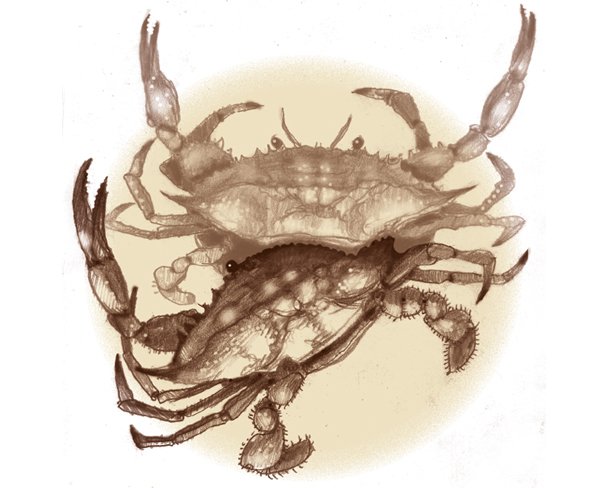
Barrack’s cinder-block crab shed doesn’t have air conditioning—but (sign of the times) if does have satellite TV. The first sound one hears inside the building is rushing water. A pump throbs constantly, forcing water from Mulberry Creek through pipes and into the wooden troughs that are the focal point of the waterman’s seafood business. Barrack culls the ripe, red peelers from the “green” ones that take longer to shed, dropping them in separate shallow “floats” inside the crab house. When a red line appears on a crab’s rear swimming leg, it’s a sign that the creature will soon back out of its shell. “When it’s red, it sheds,” explains Barrack. The reds and the greens must be kept in different tanks or some unpleasant Darwinian violence will ensue. “You can’t put ripe and green peelers together. After the ripe ones shed, the green ones would eat ’em up,” he says. “Crabs like to eat anything.”
Though the crabbing business is ebbing, Morattico remains a friendly, tight-knit community. The parking lot of Emmanuel United Methodist Church is still full on Sunday mornings. New residents inhabit some of the scenic 19th-century frame houses built for former boat captains in the village. The village recently renovated the general store, turning it into a museum to preserve the watermen’s heritage. Old oyster tongs hang from the museum ceiling—they’re so long, they nearly touch the floor. A massive ship’s wheel steers visitors to rooms of wooden crab floats. The collection also includes a hand-crank oyster scrape. “When we started the museum, we were surprised by how many relics came out of people’s barns and attics and were donated,” says Geri Vick, a former board member of the museum, and current volunteer. She moved here with her husband in 1986. “This is a place with drop-dead-gorgeous sunsets over Lancaster Creek,” she says. “The sunsets in Hawaii are not more beautiful than they are here in little Morattico.”
George Shelton, who spent 50 years working the water before his retirement, was a third-generation crabber. “My dad done it before me. If you lived on this street, that’s what you did,” he says. “You were either a waterman or a farmer. It’s in your blood.” Though the 67-year-old sold his crab house in 2006, his fishing instincts are still strong. This spring, when the waters warmed and the crabs started running, Shelton couldn’t resist firing up his 23-foot Seahawk to fish a few peeler pots, as he had for so many years—except that now they end up on his dining table rather than someone else’s.
Shelton was born just after the heyday of the steamboat on the Rappahannock. In the 1920s, he says, Morattico was bustling stop number 15 on the line to Baltimore. The village had the longest wharf on the Rappahannock, its massive arm reaching out to the navigable depths of the river. But the great storm of 1933 wiped out the wharf, and Morattico settled into a quieter rhythm of fishing and farming.
In the 1960s and ’70s, Shelton brought in seven to 10 100-pound barrels of crabs per day. He would keep the peelers to shed and sell the male hard crabs. According to Shelton, his wife’s grandfather, Captain John Walters, was the first person to ever shed a soft shell crab on the Rappahannock. The Walters family was among those who moved to Morattico from Tangier after the storm of ’33 devastated the Chesapeake Bay Island. The Tangier transplants showed the locals how to build enclosed cedar floats in the water, where peeler crabs were placed until they could molt. Eventually, the wooden floats were moved from the shallow waters of the river into specially built crab shacks where electric pumps sent river water bubbling over the peelers. Tangier Island remains the self-proclaimed soft-shell capital of the world.
And even though the iconic blue crab isn’t caught in big numbers anymore, the feisty creature is still tied inextricably to the culture. There is a crab pot bobbing at the end of most docks in Morattico. There’s a Crab Festival every spring in nearby Kilmarnock. And neighbors still stop by Barrack’s crab house to accept the gift of a few velvety soft shells, which will be promptly fried and eaten down to the last claw. “I could sell this crab house today and get more for it than I could get crabbing the rest of my life,” says Barrack. “But crabbing is what I do, and enjoy, so I’m gonna keep at it.” That’s the crusty resilience one expects from a waterman.