
Not content to be just a pretty show garden, UVA’s Blandy Station marries popular gardening and serious botany. PAULA STEERS BROWN goes to Clarke County, where the estate stands at the forefront of environmental education.

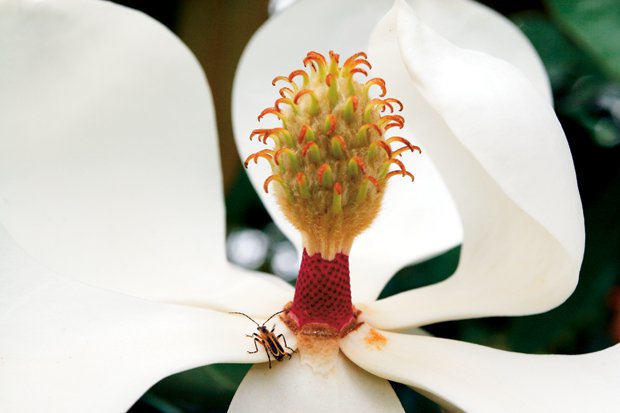
A magnolia close up

Rhododendron

Dogwood

A portrait of Graham Blandy

Garden sale
Have you visited your State Arboretum?
Perhaps you didn’t even know you had one. The Orland E. White Arboretum was officially designated as such for the citizens of Virginia by the state in 1986. It is a part of the Blandy Experimental Farm, a 700-acre research center of the University of Virginia. But when you get ready to go, don’t head to Charlottesville. Turn further north to another exquisitely beautiful part of the state—Clarke County, in the northern corner of the Shenandoah Valley between Middleburg and Winchester—to enjoy a living museum of the largest collection of woody plants in the mid-Atlantic states. And while you are there, you can have lunch on shaded picnic tables in a serene setting of natural beauty, bird watch and learn about environmental conservation.
The Blandy Experimental Farm has been a part of UVA since 1927, when Graham Blandy, a New York stockbroker, left the University 700 acres of his estate, the Tuleyries. The first director, Orland E. White, a plant biologist, started the plant collection that became the Arboretum as we know it today. His successor, Ralph Singleton, a plant geneticist, first began to invite the public to come in and kept the field station very much alive until 1965, when the Biology Department, considering the future of their research to be in cellular and molecular biology, withdrew their programs. “Blandy was essentially mothballed,” says its current director, Dr. Dave Carr, “until around 1983, when Ed Connor saw many applications for his students and great potential for public education and outreach” in his discipline and so persuaded UVA’s new Department of Environmental Sciences to adopt it. As director, Connor hired two full-time scientists, who brought in their graduate students and revived on-site academic courses; at the same time, Blandy’s first educational director began its K-12 program.
Today, undergraduates from all over the country come to live in the research village and get their first big chance to conduct their own research with a mentor. The traditional missions of large-scale research and environmental education remain primary, but by increasing the focus on investing in innovative programs for public education and outreach, directors are trying hard to create a synergy between the two. Candice Lutzow-Felling, the new education director, hopes to create a bridge between local schools and Blandy’s outdoor laboratory. Current ecological programs range from seed germination to worm activities. New interactive computer stations aid in identifying plants from the collection, alocating them on a marked map and even providing a printout to facilitate learning.
The Foundation of the State Arboretum, an essential group of volunteers known originally as “Friends of Blandy,” oversees important collections, volunteer efforts and fund raising and runs most of the events, such as Garden Fair in the spring and ArborFest, which opened this past October with a Beer and Barbeque Bash in the Peetwood Pavilion. Popular programs include heirloom plants and cooking with herbs, speakers on creating backyard habitat, and workshops in pruning and perennial gardening. Native plants are sold, and children delight in following the nature walks. A fall art show is hosted by the Blandy Sketch Group, a group of artists who are naturally drawn to the beauty of the site. The Gingko Grove, planted by Dr. White to study the ratio of male to female trees, is ablaze in yellow-gold each fall. Blandy also hosts a summer concert series and other performances conducted in the amphitheatre. Picturesque wedding ceremonies have been held in the niche of a double wall of limestone overlooking a large meadow.
Holiday offerings include wreath-making workshops and a “Fresh Greenery-to-Go” option for crafters who have supplies but lack the lush mixtures of pine boughs, yew, arborvitae and boxwood. Blandy also serves as headquarters of the American Box Society, a logical choice since its Boxwood Memorial Gardens boast the most extensive collection of boxwood varieties in Northern America. The “Graham Blandy” variety of Buxus sempervirens is a striking cultivar in the landscape, pencil-like in its narrow, upright form. Visit also the Herb Garden and its many varieties of English lavender. The Pollination Garden ties in with Assistant Director Dr. T’ai Roulston’s studies of the ecology of pollinators, primarily bees. The Virginia Department of Forestry put in a Rain Garden as a demonstration on how to incorporate such a feature as a landscape tool to slow the release of water into local streams; one of the biggest problems with the Chesapeake Bay, Dr. Clark laments, is that, “from roads to roofs to parking lots to streams, runoff causes flooding and tends to increase erosion and sediment.”
For the horsey set who enjoy seeing the Arboretum from a different vantage point, a 5-mile-long Bridle Trail winds through farm fields and woodlots and skirts the wetlands. The active Equestrian Committee of Blandy Farm recently hosted a trip to see the American tour of the world-famous dancing white Lipizzaner stallions. For those who prefer a more conventional ride, a Driving Tour is mapped out around the landscape through meadows, maples, wetlands, woods and conifers. The Arboretum collection includes more than half the world’s pine species, many of which are planted together on a hill with an understory of azaleas, spectacular in the spring.
One of the biggest parts of the Arboretum is the Virginia Native Plant Trail, which exhibits species present in Virginia before Europeans arrived. Large hackberries provide a canopy of high shade over young oaks and ashes that will one day contribute to the cover. Under these grow dogwood, redbud and spicebush surrounded by countless woodland perennials, ferns and wildflowers. In May, the woodland wildflowers and the Native Plant Trail will be at their peak—white dogwoods on Dogwood Lane (the old carriage lane to the house) form clouds of white, and the drifts of spring ephemerals are prized while they last.
Open 365 days a year at no charge, Blandy is a prime destination in any season.
Extensive information on happenings at Blandy are at virginia.edu/blandy/. Click on their photo gallery for an informative picture page of native Virginia plants.
Birding at Blandy
November brings the Bird Festival Seed Sale and birding workshops of the Northern Shenandoah Valley Audubon Society, also headquartered at Blandy. The 75-pound bird feeder is proof of how big bird watching is. A constantly updated chart shows recent bird sightings with dates, species and locations listed, and the Society sponsors an annual photo contest. Fifty volunteers, “ordinary citizens who want to do hands-on conservation and make a difference,” according to aide Kaycee Lichliter, help monitor 110 bluebird houses. Lichliter is mindful that “birds are our environmental indicators,” as became apparent when the thinning shells of bald eagles and peregrine falcons revealed what DDT was doing to the environment.
Habitat education is also important, for example, to warn against wholesale clearing of land and fencerows, which causes the population of cavity nesters such as bluebirds to plummet. MAPS (Monitor Avian Productivity and Survivorship) volunteers set up mist nets in a field to capture birds, measure their wings, weigh them, sex them, then release them in a breeding bird survey that runs from April to August. “Data loggers”—dime-sized computer chips that measure warmth—are inserted into nests beside eggs to record when the mother leaves to feed and when she returns to the nest. The data is recorded as part of a Citizen Science Network run through Cornell University. Last year at Blandy, volunteers logged 1,500 hours.
—Orginially published June 2006