
With no money, let alone a gym, Virginia Union basketball soared for five magical years.

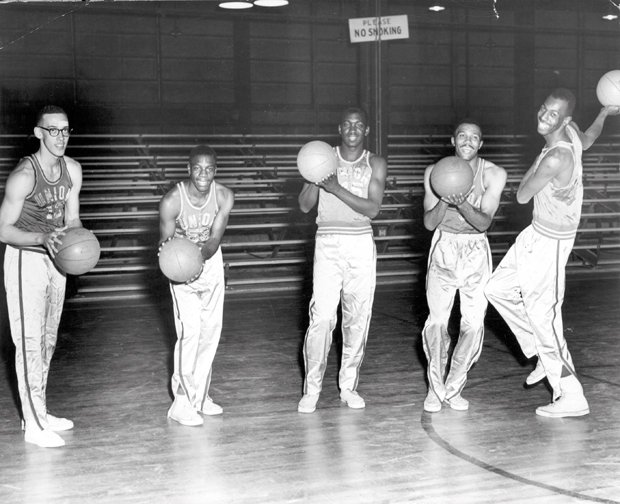
Unidentified photo of team, from archives

Elmer Howard

Henry Hucles and his wife

Robert Daughtery, Spottswood Robinson, General Johnson and Hucles

Headline from 1955


Headline from 1955


Unidentified VUU team

VUU men’s basketball as 1980 CIAA Champs
On an early March night in 1941, 2,800 people crammed into the cavernous Richmond Blues Armory on East Marshall and 6th streets in the city’s Northside. The crowd kept piling in under the dim lights. Cigarette smoke rose above the multitude, and soon the armory, never bright, became almost dark. The Harlem Globetrotters, winners of the national professional basketball championship the previous year and just beginning to develop their comedic play, out of necessity because they routinely destroyed opponents, served as the main attraction. The Trotters’ owner, founder, former coach and occasional player Abe Saperstein sat down, waiting for his squad to grab an early lead and begin their famed clowning. Then he could count his money.
But the joke was on Saperstein. His squad was about to tip off against possibly the greatest college basketball team in the Commonwealth’s history—the Virginia Union University Panthers, known for five magical years as the Dream Team, through the late Depression and into World War II.
“Saperstein was laboring under the delusion that the fans had turned out to see the Globe Trotters’ [sic] bag of tricks. They hadn’t. They’d been forewarned that the Globe Trotters, good as they are, would have no time for frills and furbelows playing Union,” wrote Richmond Times-Dispatch sports editor Chauncey Durden two days later.
At that moment on game day, the Dream Team felt two emotions: anger—they had lost their bid for a third consecutive Colored Intercollegiate Athletic Association title earlier in the week to arch rival Virginia State (in later years, the word “Central” replaced “Colored”), and fear, because the CIAA had promised it would ban the squad if Union played the Trotters.
The Globetrotters, noticing the Panthers’ small size—their tallest player stood 6-foot-2—began bringing the ball inside, but VUU’s defense, with a possible assist from the ever dimmer lights, threw the flashy visitors off their game plan. Union, in much better condition and putting together a gritty performance, kept up with the pros. The lead, never more than four points, switched nine times.
Saperstein grew fidgety. The Globe-trotters, in too much trouble to commit their comedic mayhem, became grumpy. The Panthers, known around Richmond and in the national black press for their speed and efficient offense, shut down the visitors’ attack. The usually electric Trotters spent the game’s final moments holding the ball for a final shot, and with two seconds left, Les Brown saved the day for the pros with a game-winning half-court basket and a 40-38 win.
Afterward the Trotters, in a sour mood, initially refused to come back on the court for an exhibition of their routine. Saperstein, angry about the closeness of the game, the arena’s conditions and his squad’s lack of offense, tore after his players and demanded they perform.
Now, for Virginia Union, there would be hell to pay.
In the local press, three types of reactions came from the contest. The next morning’s Richmond Times-Dispatch carried a game story that assaults the reader with phrases such as “Tall, dark and hefty” and “the dusky foes were tied.” A set of photos of the two all-black squads was headlined with a cringe-inducing “Pardon Me, Boy.” The day after that, Durden’s column offered a mellower view of the contest, focusing on Saperstein’s unease, praising the Panthers’ tactics and calling the squad “best team in [the] state, [the] south perhaps.”
Still later, in Richmond’s weekly Afro-American, readers saw a different angle. A game against Howard University was cancelled. The CIAA, which had phoned Union head coach, athletic director and physical education professor Henry B. Hucles ahead of the game to say they wouldn’t look kindly on a game against the Globetrotters, banned the school for the rest of the year. Nationally read black-sports columnist Art Carter wrote in outrage over the league’s sanction.
Hucles, the players and the school probably didn’t care too much. The program needed the money.
And besides, at this point, who in their right mind would permanently kick out Union? The Panthers quickly returned to the league.
•••
Choosing the best college basketball team in state history is a difficult enterprise. The University of Virginia became a regular in the top 10 during three-time national player of the year Ralph Sampson’s career, between 1979-83. The Cavaliers reached the final four the year after the all-world center from Harrisonburg left for the pros. A sentimentalist might pick George Mason’s amazing run last March or VMI’s magic ride to the final eight in 1976. Roanoke College’s squads in the late 1930s, known as the “Five Smart Boys,” were downright unbeatable, and earlier in that decade the University of Richmond had posted an unbeaten season. An argument might even come from Virginia Union itself, since it has won three Division II national championships since 1980, with an undefeated season in 1984-85, known as “The Super Year,” and over the past 25 years produced NBA stars Charles Oakley and Ben Wallace.
Virginia Union almost certainly wants to be known for more than basketball. Having held its first classes just months after the Civil War, in what had been only recently a slave jail, the institution evolved into a small four-year university. Sometimes struggling for survival—the name Union comes from other institutes running out of money and folding into the Richmond campus—VUU packs a strong cultural and historical punch. Famous alumni include former governor and current Richmond Mayor L. Douglas Wilder, National Urban League founder Eugene Kinkle Jones, Samuel Gravely, America’s first black admiral, and the nation’s first black female bishop, Leotine Kelly. Visit campus and find one of Virginia’s overlooked architectural hotspots, a wonderful mix of gray-stone Romanesque Revival buildings and the International Style Belgian Friendship Building—originally the Belgian exhibition at the 1939 World’s Fair, which the university acquired after Nazi Germany invaded that nation.
“Many of the students who graduated are from the first generation of college students,” says E. Dianne Watkins, who grew up on campus with her uncle, university President John Ellison, and now runs Bells For Peace, a movement to help restore the Belgian Building. She remembers students attending the school, lacking money and taking classes with the promise that one day in the future they would pay the full tuition. “I think it’s the motivation, a thirst for the education,” when asked about the institution’s oversized historical footprint.
Union holds a long athletic history as a CIAA charter member and for many years matched its profile as a small and striving place. In its earliest years, the CIAA served, as one book put it, as “the Black Big Ten.” Founded in 1912, the organization included some of the elite institutions of the east: Howard, Hampton and Pennsylvania’s Lincoln. Other colleges were state-supported: North Carolina State College (now N.C. Central), Virginia State, Greensboro A&T (now North Carolina A&T), Morgan State and West Virginia College. In many ways, the Richmond school was the runt of the litter.
Hucles, better known as Huc, knew a lot about coaching and VUU. As a student at Wayland Academy, he guided teams during World War I, and when the institution folded into Virginia Union, he became the team’s quarterback. After a collegiate career that included New York University and Springfield College (where he acquired two degrees) and a spell coaching at several black colleges, he moved back to New York and became a porter. For blacks in the first half of the 20th century, working on the trains meant a large income, and Hucles was good enough that he was about to take one of the highest paying jobs in the field. But when the Richmond school began looking for a new coach, Huc headed south.
“They thought he was crazy,” says Henry Hucles IV, the coach’s grandson.
With no gym, coaching Virginia Union basketball wasn’t easy. The squad played and practiced at a municipal auditorium shared with the city’s black high schools, but only two or three days a week, augmented by the occasional dusty outdoor practice on a mild day. Players ran the mile-and-a-half from campus to the facility. Sometimes, the Panthers played games at a funeral home. The school rarely offered full scholarships and augmented grants with offers of nearby jobs.
“You have to keep in mind the conditions and era at the time,” says Henry Hucles IV. “These young black men didn’t have a whole lot. They were striving to do better and struggle, and here was a man who not only brought them in and furthered their education and furthered their aspirations, but brought them in as a family member. … I was told my grandmother used to feed them and bought clothes for them—this was before the NCAA said you couldn’t do that. This was basic subsistence that did it for those guys.”
Slowly, and after many lean years on the court, Hucles developed a strong recruiting network across the Northeast. He started convincing prep stars from New York and New Jersey, including a hot-shooting player from the Big Apple, named Melvin “Salty” Glover, to head to the Confederate capital. Hoopsters streamed in from Philadelphia. When Duquesne played at the University of Richmond in 1937, the Pittsburgh school’s black trainer, Bruce Jackson, stayed at Hucles’ house. Suddenly, Union possessed a remarkable contact allowing the program to scoop up the best black players in Western Pennsylvania. In came all-state player Wiley “Soupy” Campbell, about whom Jackson had raved on his visit, and Obie Knighton.
But it is still mysterious that Union became such a power overnight.
“What happens was the colleges would graduate teachers who became physical education teachers or whatever. Players who went to the local high schools would go to the college their high school coach would tell them to,” says Bob Kruska, author of the book, Hot Potato, which chronicled black basketball in New York and Washington in the 20th century’s first two decades. “Magic would occur seemingly suddenly.”
With this sudden infusion of talent, the Panthers entered the winter of 1938-39 with a young, hyper-talented squad modeled after the New York Rens, the best professional basketball program of the era. The team used passing (sometimes the ball didn’t even touch the floor), speed, conditioning, high-percentage shots and ferocious man-to-man defense. As they scored unheard-of numbers of points, Simeon Booker, a student with a flair for publicity and later one of the nation’s top journalists, with famed stories for Jet magazine, cooked up the name, “The Dream Team.” The Panthers, at first taking a back seat in the Afro-American to more established Virginia State and Hampton, stormed to their first CIAA title with an 18-2 record.
One Richmond Times-Dispatch writer, in awe after Union and an opponent scored a then-blistering seven baskets in the first minute, felt that the Panthers were “not only the best in Virginia, but quite possibly the best in the East, as far as putting the ball through the basket goes.”
As Union, also known as the Jumpin’ Jive Five, racked up victory after victory, a scan through the season’s newspapers hints of the coming World War and the Civil Rights movement that would follow. Hitler invades the Sudetenland. The Daughters of the American Revolution bans African American opera singer Marian Anderson from performing at its Constitution Hall. Richmond’s Bill “Bojangles” Robinson, already a Broadway legend, makes a comeback in a new play called The Hot Mikado at the New York World’s Fair in 1939.
Yet, as the storm clouds of war gathered and thickened, the only school in the CIAA without a gym, and boasting a 550-person student body, generated enough notice to continue playing after the season with a two-game exhibition series against Long Island University, which had roared to an undefeated season and won the National Invitation Tournament—far more prestigious than the NCAA tournament at the time—and was seen as the nation’s unofficial champion. Even though it was an exhibition, the games pitted the unknown Panthers against basketball royalty.
•••
Study sports history and find a rich stew of biography, sociology and, if snooping around in the days before sports information departments and unified record keeping, mythology. The common use of “legend” in sports—as in former Virginia basketball legend Ralph Sampson or Maggie Walker High School’s legendary football player Willie Lanier—seems clichéd. We know they exist, and information on their careers is easily available. But look far enough into the past, work through scattered scraps offering ghostly glimpses into the old days—and the term fits.
One object, a trophy rediscovered a year-and-a-half ago at Virginia Union, ties together the disparate elements of sports and history. This summer, awaiting its date with a restorer, the trophy was tarnished, dented around the rim and flecked with white paint. Look closer, and its inscription reveals that this was the cup Bill “Bojangles” Robinson donated to Union after the basketball squad won the CIAA title in 1939. Robinson, too busy performing to attend a banquet honoring the Panthers, donated the trophy to salute the squad’s conference championship. A cherished emblem, players posed with it for the camera. The trophy shows the power of Union’s accomplishments that year.
After winding up its season, the Panthers fell to Long Island, coached by hall of famer Clair Bee, in the first game, 61-50. But the second contest took place at Harlem’s Golden Gate Arena at 143rd Street and Lennox Avenue. VUU, known mostly for its offense, held the mighty Blackbirds to only eight first-half points, and the Panthers scored a massive 36-28 upset. It lives on as one of the top achievements in school athletic history.
Yet little detail exists about the game, and what’s there is filled with small contradictions. The oral tradition of the contest at Union skips the earlier game, and while the win was certainly a stunning event, another historically black college, Kentucky State, pulled off the same feat a week later.
Like the Robinson trophy, the upset originated in New York and lives on proudly, but as the cup takes on antiquity, so also the game. With the collapse of New York City college basketball in the early 1950s, Long Island University’s glory years became a foggy memory—including the game, the season and the trophy.
One might even call all three legendary.
•••
“There’s not a whole lot. … There’s fragmentation in terms of the records,” says Hucles’ grandson, Michael Hucles, a history professor at Old Dominion University. “Within the family, we have these stories. There are some who are diehard Unionites. Who probably sort of bleed, what would you say …”—here, the New York-raised man pauses to remember VUU’s school colors—“maroon and steel. My father’s church in Brooklyn would have the choir come up and perform on a yearly basis. … I can practically sing the Union song because of that.”
The Hucles family history richly combines education, athletics and public service. Huc’s father, the patriarch, served as one of the founders of the Richmond Planet—an African-American newspaper that’s today heavily studied by academics—and as the first treasurer of Virginia State University. The name might stem from Hercules, and the legacy, if one includes a few extended family members, leaves a Herculean impact: an Episcopal bishop of Long Island and two of the key founders of Norfolk State University. Michael Hucles’ wife, Janis Sanchez-Hucles, chairs Old Dominion’s psychology department, and their daughter, Angela Hucles, is a regular member of the U.S. women’s soccer team, playing on the 2004 gold-medal-winning squad.
Small glimpses bring Huc to life. He loved gardening and spending summers in Gloucester, crafted legendary mint juleps and was a bit tough when it came to coaching (Michael Hucles: “When my brother and I were fairly young, we were interested in tennis. He gave us a tennis racket and ball, and [said] what you do is go against this wall 1,000 times with a backhand and 1,000 with a forehand”).
He also had a wonderful relationship with his wife. “It was my granddad and grandmother, they were a team,” Henry Hucles IV says, noting the players also adored her. “When he was inducted in the CIAA Hall of Fame and I got to speak at the induction, I said, ‘You inducted my grandfather—it was the team of my grandfather and grandmother.’ I never saw them not together. And [that legacy] carried on with my mother and father.”
Michael Hucles, considering his grandfather’s small salary and the family’s ability to take care of a family and players, says, “I credit my grandmother with financial wizardry.”
Henry Hucles IV, who served as a youth coach and referee for years, remembers his grandfather as tight-lipped about those days. “I got bits and pieces—he never really talked about those teams. He was proud that he had all those pictures in the basement,” he says from his home in Capahosic. “I just remember he happened to mention that these things did occur, and as a young man at the time, I was like, ‘Yeah, right.’ ”
And then one day he found the old man’s scrapbooks in the basement.
“Damn. He wasn’t lying.”
•••
In a historic sense, Virginia Union’s Dream Team left behind ambivalence, one major moment in the university’s history and a long string of everyday triumphs.
The Panthers won the CIAA four out of five years. VUU, continuing its northeastern pipeline, battled what’s now North Carolina Central, which brought in players from the hoops hotbeds of Kentucky, Kansas and Indiana. In a way, the Union-N.C. Central rivalry served as a harbinger of the beginnings of ACC basketball in the years after World War II, when North Carolina State brought in athletes from the Midwest and New Yorkers began playing at North Carolina. Union regularly earned plaudits for its play, and it even defeated an all-CIAA all-star team. The Richmond News Leader stated, “Team for team, the CIAA probably is far superior to the Southern Conference on the basketball floor,” back when the Southern Conference included schools such as North Carolina, N.C. State, Duke, Clemson, Maryland and Virginia Tech.
Yet the Dream Team always appeared like Tantalus grasping for the elusive fruit of mainstream success. In the 1930s, New York promoter Ned Irish saw the popular potential of college basketball and began putting on doubleheaders at Madison Square Garden. Already popular at small gyms, the sport quickly built up a larger following, and other cities began conducting tournaments. The National Invitation Tournament took place in the Garden, and the NCAA tournament, which superseded the NIT in later years, also began a year later. The Panthers regularly played in smaller New York City venues, and even defeated then-powerful Brooklyn College 54-38 early in the 1940-41 season. Irish knew of the Panthers, and some thought the winner of the game would receive an NIT bid or at least one date at the Garden, but none came.
“We again are wondering if their ebony hue will keep them from matching with the ‘cream’ of the country,” wrote the school newspaper.
The next season, cities across the northeast wanted the Panthers in their arenas, but one by one, the proposed match-ups fell apart. Hartford, Conn., wouldn’t pay the team’s travel expenses. A Cleveland Coliseum event collapsed. A national tournament for African American institutions held in New York City under the auspices of the Negro National League launched, then sputtered. Kentucky State backed out of a showdown in Roanoke. The Philadelphia Toppers, a highly regarded professional team, offered too little money. A big-time match-up against the Rens never made it out of negotiations. Union thought it had hit paydirt when Long Island University suggested a rematch in Washington. Amid much hype, the Panthers took the court, only to discover LIU had disingenuously fielded its freshman team. Feeling duped, the Panthers clobbered the Blackbirds but received withering criticism in the press. Union closed the season by playing a collection of all-stars from the Big Apple’s college squads as part of a doubleheader dubbed The Basketball Epic of 1941-42, but, playing sluggish ball in front of a disappointingly small crowd, the Panthers fell in embarrassing fashion. VUU won the CIAA the following season, but with the war at its peak, the Dream Team era ended.
The Dream Team’s success impressed so many people in Richmond that it paid off in one gigantic physical legacy. A student at the all-white University of Richmond became a fan of the squad, impressed by its skill and precision despite its lack of a gymnasium for practice. He told his father, Sidney Henning, about the team. Henning—a New Yorker, a treasurer of Union’s board and a key member of the American Baptist Home Society—began a campaign for VUU to receive the Belgian Pavilion from the 1939 World’s Fair. Though Union was the only historically black university and one of 27 prospective schools, it pulled off a major upset and won the complex, which included a gym, room for classrooms and a library. As one columnist put it, “That’s the one time an athletic team—and not a football team—has proved of real value to a university.” John Ellison, a university administrator, marshaled the fund-raising effort while running the university’s day-to-day operations (the school’s president was dying) and guiding Union through the late Depression and early war years. With his success, Ellison became a local hero and the university’s first African-American president.
Another great legacy, not as tangible as the Belgian Friendship Building but still enduring, came from the close-knit relationship between Hucles and his players that lasted for years. Some had some degree of fame: Larry Doby, the first black in the American League, played hoops briefly in the Dream Team era; Garnett Blair became the top pitcher for the Homestead Grays, probably the greatest of the Negro League baseball teams; and an earlier player, William H. “Demitasse” Robinson, served in the Illinois state legislature for a decade, chairing a committee in the days before the Voting Rights Act and later heading up the state’s department of education. Some were life’s everyday heroes—teachers, social workers and doctors who scraped every penny for their education. All were part of their old mentor’s devoted following. They became known as Huc’s Boys.
Hucles left coaching in 1950 and continued as a physical education instructor and head of the intramural program until 1968. “They did not renew his contract, that’s what it came down to,” says Henry Hucles IV. “Some of that had to do with me, ’cause I attended Virginia Union at the time—I was boisterous and so forth. You have to keep the context of the times—I was a student radical, OK. I did not like a lot of things …, so I got thrown out of the university.”
A year later, in honor of the retirement and the 50th anniversary of his involvement with the school, Huc’s Boys held one last function for the old man. Former players, their family members and others, who found themselves helped into successful lives despite those long odds, packed the school for a sendoff.
“I was able to attend my grandfather’s ‘not his renewal of his contract’—that’s when Huc’s boys threw a big event for him. It was when I really realized the players that had played for him really had a respect for him,” says Hucles IV. “It was a man who on the one sense was a legend, on the other sense was underappreciated.”
In the folders on the event in Virginia Union’s archives, testimonials point to a heritage bigger than those long-ago triumphs on the basketball court and possibly taller than the Belgian Building’s tower:
“May not be able to be with you, but my heart & soul will.”
“I have always cherished the memories of my association with him during the days long past.”
“To my coach … If it had not been for sports at V.U.U. perhaps I would have been Mr. Nobody?”