Veteran photographer William Allard seems as fearless as the individuals in his iconic pictures.
1 of 3

Anthony Albert Allard
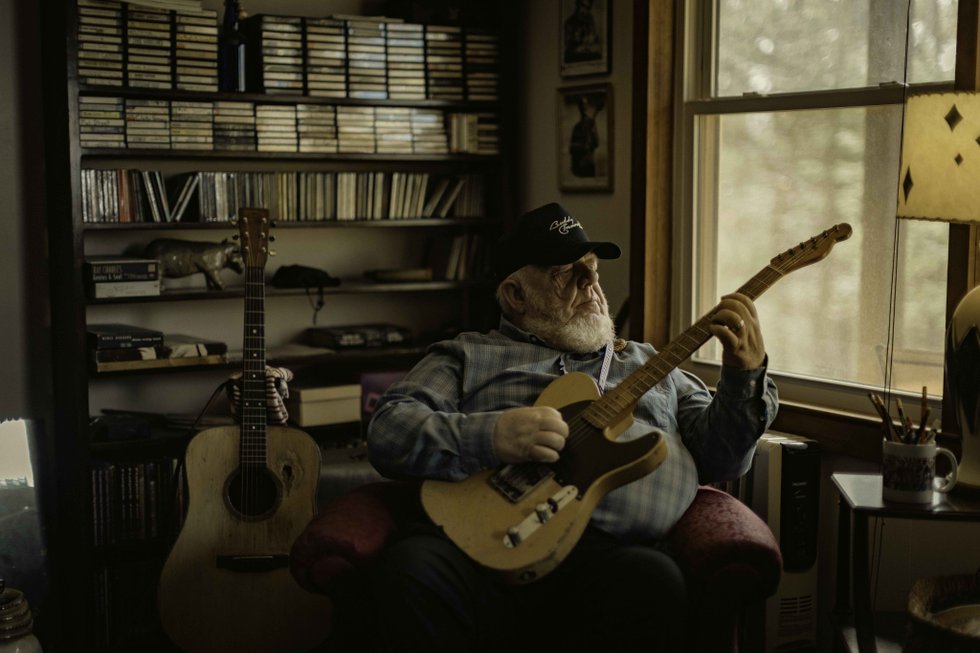
Allard with his dogs Buster (left) and Lizzy.
2 of 3

A Hutterite girl in Montana (2005) for National Geographic
3 of 3

Sicillian actress Benedetta Buccellato (1994) for National Geographic
Renowned photographer William Albert Allard’s log cabin, perched on a mountainside near Charlottesville, is a fittingly rugged setting for an artist so closely tied to Western themes. We meet in his book-filled study, a pleasant room at the top of the house, painted a sunny yellow. Cozy and masculine, it is decorated with objects and pictures that speak to the occupant’s interest in outdoor pursuits like hunting and fishing. His photograph, “Brian Morris, Circle A Boss” is on an easel behind him and I find my gaze drawn again and again to the striking image as we talk.
A consummate storyteller, Allard produced his first significant series of photographs in 1964 while an intern at National Geographic. Regarded as a landmark in the history of the magazine, his piece on the Amish also had a profound effect on him, channeling his focus definitively on people. Over the years, he has contributed more than 40 articles to National Geographic both as a photographer and writer. He relished its lengthy assignments that were almost like mini grants, allowing him to delve deeply into his subjects and polish his oeuvre.
Allard comes across as a fearless individualist who saunters to the beat of his own drum. One can understand his affinity for cowboys and the Anabaptist Hutterites of Montana, a pacifist communal people who trace their roots to the Radical Reformation of the 16th century. Both these groups are composed of independent souls, within which a trenchant code of honor and integrity exists. Allard, who with his wife Ani owns a second home in Missoula, Montana, possesses a genuine magnetism; he’s confident without being arrogant, warm and sincerely interested in people, whether they’re subjects for his lens, or the photography students he’s so willing to nurture.
Calling himself a “street photographer,” Allard says that he runs with the conditions at hand: “Whatever light I’ve got, I’ve got,” is how he puts it. On assignment, he never has preconceived ideas about what kind of photographs to take, but embarks on his forays with an open mind. He says that he prefers taking pictures on the “edges of a situation,” where perfect little serendipitous moments happen—a fleeting glance across a café, children running down a street, sunlight raking a pony’s mane. Allard is known for his innate color sense and the grace and balance of his compositions. According to New York gallery owner Steven Kasher, “Allard is Manet with Kodachrome, wielding slashing strokes of blood red and bullhide black. Allard is Hemingway with a Leica, crafting complex tales of matadors and cowboys, of fishermen and farmers. His characters struggle, with dignity and grace. They attend to the ceremony of their own survival, alone, but in touch with sympathetic others.”
While Allard enjoys flying off to exotic locales for a story—Paris is a favorite destination—his enduring love affair has always been with the American West. He has enormous admiration for the Hutterites, counting one of their leaders among his best friends. He originally photographed the group in 1969, following up with a return visit in 2004. During the latter sojourn, the oldest of his five children, Scott, succumbed to melanoma. The end came so quickly Allard couldn’t make it back to his son’s side; utterly bereft, he was sustained by the quiet fortitude of his Hutterite friends. The circumstances demanded a very special story, and Allard planned to spend the following year honing it to perfection. But National Geographic fast-tracked the deadline, giving Allard a mere six weeks to produce it. The June 2006 story and photographs are are an account of personal loss and redemption told through the Hutterites. Allard says it was important to him to produce an article that would also serve as a tribute to his son.
Over the years, Allard says that he has seen photography change profoundly. Back in the day, processing color film was time consuming and fraught with a certain amount of suspense. Digital advances have speeded everything up and made the art form more assessable and largely fool proof. To stand out today, you need passion. And so these days, at age 73, he takes pictures to please himself and does only projects that inspire him. He’s not interested in quick, one-off assignments and admits ruefully that, as a result, the marketing of the William Albert Allard brand has suffered. The publishing world has changed markedly, too. Venues such as Life and Look are defunct, and constrained budgets dictate less involvement on the part of contributors in editing and layout decisions. The bottom line has also affected fieldwork; in the old days, five-month assignments were not unusual; now they’re eight weeks, tops.
Though more famous for his photographs, Allard is also a gifted writer. He maintains his most important equipment is the pad and pencil he keeps handy in his breast pocket. He says, “Words and pictures can work together to communicate more powerfully than either alone,” and he’s been able to combine the two on various projects. He’s published a number of critically acclaimed books—among them, Vanishing Breed, The Photographic Essay, A Time We Knew: Images of Yesterday in the Basque Homeland, Time at the Lake: A Minnesota Album, Portraits of America and Five Decades.
In addition to the aforementioned subjects, Allard has also covered such diverse topics as the untouchables of India and America’s hunting and music culture. Currently, he’s on the lookout for arresting faces, fodder for a new series of those photographic stories he’s so good at telling. This latest project, entitled Found Portraits, may take him a while to suss out, but he’s in no hurry. His radar is infallibly attuned to what makes great pictures.