
The Federal-style home in the middle of Carrington Row was considered sleek and modern when it was built in 1818—and, thanks to its current owner, it’s still very much so today.

baskerville feat

Baskerville entry and living room
Left: In the entrance hall, with a Palladian window above the door, a Hepplewhite side table holds a Wedgwood black basalt bowl and a Chamba figure from Nigeria. Right: A Mies van der Rohe easy chair by Knoll sits before an 18th-century chest of drawers

Baskerville and reliquary
Left: Lee Baskerville. Right: an early-19th-century Fang reliquary guardian, from Gabon or Cameroon.

Baskerville kitchen
The kitchen, located in the basement, features cabinetry designed by the owner, countertops of Italian honed absolute black granite, and taupe commercial quarry tile on both the walls and floors.

Baskerville paints
Baskerville paints in his studio on the second floor.
Richmond artist and designer-cum-architect Lee Baskerville wasn’t in the market for another historic property when he received a call from a friend in 2004, informing him that the center home in Church Hill’s Carrington Row on East Broad Street was for sale. Baskerville’s friend was casting around for a historic house project and invited him to take a look and offer a second opinion on the place. Within an hour, Baskerville, who then owned a 156-year-old house on East Franklin Street, had gotten hooked on the Federal-style house built in 1818. “I saw more potential in this house than any other I’d ever had,” he says. The friend passed, and Baskerville bought it the next day.
Church Hill’s cobblestone streets and mélange of neatly preserved architectural styles spanning the last two centuries evoke misty images of tobacco and shipping magnates, colonials and secessionists. But it wasn’t just the history of the neighborhood, built on a promontory above the James River in the 1740s, that attracted Baskerville. “These houses were slick and modern when they were built,” he says. “They worked pretty well for contemporary life.” And, he adds, they still do.
The design of the row is attributed to Otis Manson, a builder-architect originally from New England. He was commissioned by three sons of Ann Adams Carrington, whose home was around the corner at 2306 E. Grace St., to build the three houses, the earliest known row houses built in Richmond. Dr. R.L. Bohannon, one of the founders of the Medical College of Virginia, was one of the row’s early owners; he lived at 2309 in the 1840s.
Fast-forward to the 1950s, and the whole of Church Hill had deteriorated, Carrington Row along with it. The Historic Richmond Foundation came to the rescue. In the 1960s, it purchased the three houses as part of what was known as the Carrington Square “Pilot Block,” an ambitious plan to restore the block bounded by 23rd and 24th streets and East Broad and East Grace streets. A dramatic moment occurred during the restoration when, in 1964, as city workers were drilling to connect the sewer line to the basement, the entire façade of 2309 slid down in one piece. It was re-secured, and today this the only house of the three that looks as it did in 1818, the other two having made additions to their front porches in later years.
An artist with a degree in art history from the University of Virginia, Baskerville’s work has appeared in exhibitions with contemporary artists like Robert Rauschenberg and Clive Head. Yet he comes by his interest in architecture naturally. He is the grandson of Henry Coleman Baskerville, an architect, and the great-grandson of Henry Eugene Baskervill (who dropped the “e” from his surname), an engineer and founder in 1897 of Baskervill, a Richmond-based architecture firm whose notable early projects include a 1903 addition to the Virginia State Capitol Building and work on Major James H. Dooley’s Maymont in Richmond.
“Like me, my great-grandfather was not an architect, but he began an architectural firm. He was an engineer. I’m an artist, but I love building,” explains Baskerville, who is an avid outdoorsman, hunter and equestrian. He spent a year after high school working on private game reserves and cattle farms in South Africa.
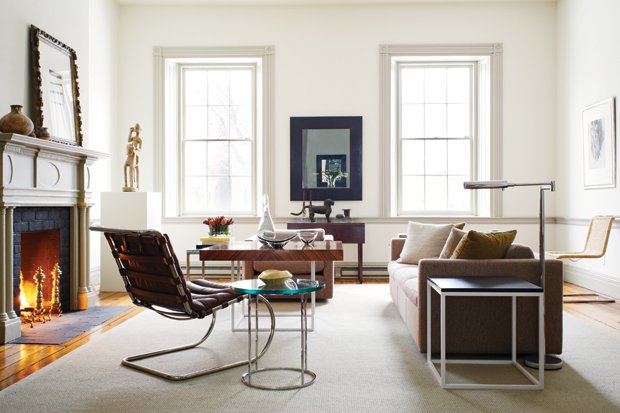
Baskerville’s design ethos is straightforward: “I try to make spaces comfortable, honest, flexible … and interesting.” He chose a neutral palette of gray and what he describes as the color of wet finished plaster for his Carrington Row house. “It’s an interesting color because it can look green and sandy red. It sets off warm and cool colors equally well.”
The subtle palette emphasizes the sturdy austerity of the house’s Federal-period architecture, a style emphasizing light and symmetry. Original heart pine floors throughout the 6,000-square-foot, three-story house are covered with taupe Karastan wool carpets with custom French linen borders. Recessed lighting in the ceiling augments natural light from a Palladian window above the front door and unadorned windows throughout the house. The overall aesthetic is modern and serene, and creates a warm background for Baskerville’s wide-ranging collection of art and antiques.
In the generous entrance hall, a Wedgwood black basalt bowl and a Chamba figure from Nigeria sit atop a Hepplewhite mahogany and pine side table with original fire gilt pulls, possibly from Charleston, S.C. Mies van der Rohe side chairs, upholstered furniture designed by Charles Pfister for Knoll, and powder-coated steel tables topped with honed absolute black granite (designed by Baskerville) create a conversation area before the fireplace in the living room. Identical carved mantels in the living and dining rooms display a collection of Neolithic Chinese terra-cotta vases and an 8-foot Masai spear, a gift from Baskerville’s father, who is a professional safari guide in Africa and South America.
There is harmony in the rooms despite the varying origins of their numerous treasures. “Anything that’s real, that you truly appreciate, you can always mix and match,” Baskerville says. “All the time I spent in Africa, I learned none of this stuff has any value if you’re not at peace and enjoying your environment.”
The second floor displays an equally diverse collection of artifacts and furniture, including a 16th-century Italian refectory table and a Ban Chiang vase from Thailand (2000 B.C.-200 A.D.). Baskerville uses the two ample-sized rooms on this floor as a studio and an office, and is currently installing a master bath in what was once the trunk room. Two more bedrooms and a full bath are located above on the third floor.
A half-bath and the kitchen, both modern additions that would have been located behind the house as dependencies in 1818, are in the basement. All of the cabinetry is Baskerville’s design, three-quarters of an inch higher than standard to make it more comfortable, and topped with countertops of Italian honed absolute black granite. Baskerville installed taupe commercial quarry tile on the floor and walls. “My great-grandfather used quarry tile all the time, too. It’s really hard to hurt this tile, and in a functional space like a kitchen I want it to work.”
How has Baskerville achieved this seamless blending of history and modernity? “I look for an inherent honesty in the work I collect and produce,” he explains. And having a spacious house helps, too. •