
Blackbirds swarming in the light of day.

nat_Grackle
Illustration by Robert Meganck, Meganck.com
nat_Grackle
Illustration by Robert Meganck, Meganck.com
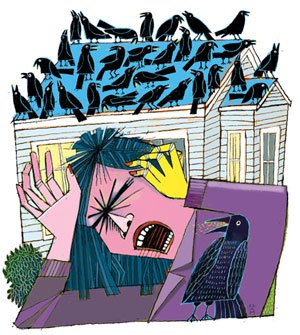
Illustration by Robert Meganck, Meganck.comSometimes, when another male is present, the call is preceded by a rather comical threat display in which the bird seems to inflate to nearly twice its girth.
Sometime in February, somewhere in Virginia, a torrent of blackbirds rushes past a window—hundreds of them. They swoop up in an undulating cloud, and down again to pepper a lawn. Then, as if by secret signal, they take off and swirl over to cover a neighbor’s roof. Something startles them and they rise again, darkening a bare oak.
No worries. It’s not a reenactment of Hitchcock’s The Birds but, rather, one of the earliest signs of spring: “The grackles are backle,” as Virginia writer Caroline Kettlewell titled a blog post this time last year. And it’s not just grackles; the common grackle often travels with red-winged blackbirds and brown-headed cowbirds in the same flock—fellow members of the blackbird family, Icteridae, and not the crow family, Corvidae, with which the common grackle is confused.
While multi-species flocking in The Birds—crows, seagulls, etc.—brings decidedly grisly results, the real-life gathering of blackbirds leads to comparatively little harm. Unless, that is, you’re a backyard birder who wants to keep songbirds around, or a farmer who wants to protect crops from being decimated by the swarm (somehow the word “flock” doesn’t really cut it). Golf course owners don’t much care for grackles, either. Unfortunately, there’s not much to do to scare them off beyond banging pots and pans, investing in feeders that birds can access only by hanging upside-down, or withholding feed until the birds move on.
All right, we admit it: Quiscalus quiscula is a pest. But don’t fret—the throngs will disperse before long as the birds find their preferred nesting sites, most often high in tall evergreens. And along the way, these omnivores will also eat many, many grubs that would otherwise grow up to be gypsy moths—which in 2001 defoliated more than 440,000 acres of Virginia’s hardwood forests. There’s always a trade-off.
At a glance, the plain, black bird doesn’t have much else going for it. But a closer look reveals its plumage as an iridescent festival of blues, greens and purples against which the bird’s sunshine-yellow eyes make a stark contrast. It’s the bird’s call that’s homely: This is hopefully not the blackbird the Beatles heard “singing in the dead of night,” with a cry described in the National Audubon field guide—and everywhere else—as sounding like a rusty hinge. Female grackles find those tones downright euphonious, and the rustier the better. Sometimes, when another male is present, the call is preceded by a rather comical threat display in which the bird seems to inflate to nearly twice its girth.
Grackles have a couple of interesting behaviors that are somewhat unique in birdland. One of these involves ospreys, with which they appear to have a symbiotic relationship. Ospreys build bulky nests of sticks, usually high up in a tree or even on a telephone pole, and add to them over years. Grackles and a few other small bird species have been observed nesting in these structures, which can grow to be 10 feet deep. Apparently, the small ones act as a warning system for the ospreys against larger raptors that may prey on them and their young. The ospreys in turn provide the birds with a healthy diet of insects that are attracted to rotting fish and rodent bits in the nest.
Another grackle behavior is known as “anting” (who knew “ant” was a verb?), which is pretty much what it sounds like: The birds allow ants to crawl on them, apparently so that the formic acid secreted by the insects can kill parasites among the feathers. Grackles will also ant with limes and even mothballs, rubbing these pungent substances into their plumage. Of the 10,000-some existing bird species, only 250 are known to ant.
The Birds featured a know-it-all bird watcher, Mrs. Bundy, who was wrong about almost everything except this: “Birds are not aggressive creatures. They bring beauty to the world.” Yes, that, and a bit of chaos, weirdness and fun. The common grackle wraps all of that into a not-so-neat package.