
The Taubman Museum is transforming Roanoke’s cultural landscape and attracting a new kind of tourist to the city—and downtown eateries are striving to keep up.

Norah’s Cobb salad, with steamed lobster, bacon, egg, tomato, avocado, scallions and cheddar on a bed of mixed spring greens and iceberg lettuce. Norah’s Café in the Taubman Museum.

Norah’s fresh chicken noodle soup is made daily. Suzanne Bird delivers the food.

Front window. Roasted beef with arugula, shaved Parmesan cheese, walnuts and wild mushroom viniagrette.

Table 50’s rack of Colorado lamb with goat cheese, truffled honey polenta, fall spiced apples and plum demi-glace.

New Orleans-style barbeque shrimp. Chef Mike Caudill.
Architect Randall Stout’s sweeping steel-and-glass masterpiece, the Taubman Museum of Art, teased me during my last visit to Roanoke in 2007, when it was little more than a skeleton of cranes and I-beams. I dined well (202 Market, The Seafood Co.), but my cultural timing was terrible. So I waited until long after the museum’s completion to return to Roanoke. Since opening in the fall of 2008, the Gehry-esque structure has radically transformed the architectural and cultural landscape of the city. Applauded by modernists and blasphemed by traditionalists, the Taubman is visited by busloads of cultural tourists (like me) each week.
With its versatile performance space (we peeked in to catch a professional children’s theater troupe rehearsing), top-notch traveling exhibitions (Rembrandt’s beggars juxtaposed with Houston and Mazorra’s “tent city” installation), constantly revolving permanent collection and endless events, the Taubman has given this old railroad town a cutting-edge cultural center with growing room galore.
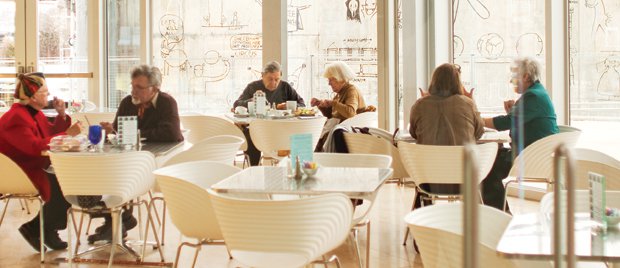
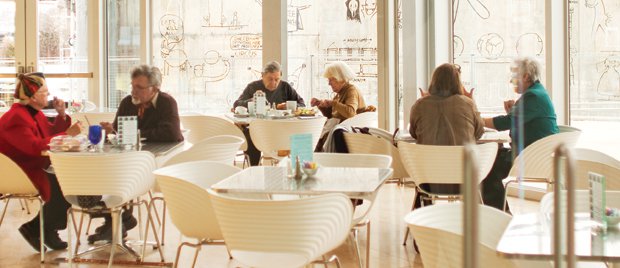
I spent a leisurely Saturday morning exploring the galleries, soaking up the spaces of this inhabitable sculpture, catching interesting glimpses of the urban and natural landscape outside. By lunchtime, I was in no rush to leave this artistic oasis and, thanks to the museum’s restaurant—Norah’s Café—I didn’t have to. I was curious to discover whether the Taubman’s cuisine was of the same caliber as its collection.
Named after the subject of the John Singer Sargent portrait (of Mrs. Norah Gribble) hanging proudly upstairs, Norah’s does a fine job of feeding museum-goers as well as downtowners in style. In addition to a bustling lunch business, the café is also open for the occasional Sunday brunch as well as dinner (tapas, wine flights) in the warmer months, when diners can enjoy the outdoor patio as well as the interior café, with its floor-to-ceiling windows and urban-elegant feel.
My companions and I decided to share a few salads and sandwiches, not realizing how hungry we were until we dug in. Norah’s Cobb has chunks of lobster tail, bacon and avocado on top of mixed greens, while the spicier Old Southwest salad starred chicken, sweet corn, black beans and a delicious house-made chipotle ranch dressing. Tempted by the salami and provolone of the Conductor sandwich, we went vegetarian with the Raleigh Court—hummus, raw veggies and piquant peppers in warm flatbread. For dessert, hot coffee and warm, homemade carrot cake hit the spot.
Dazzled by the setting and satisfied by my lunch, I still couldn’t help wishing that the café’s menu reflected more local and seasonal ingredients, such as those showcased just a few blocks away at Roanoke’s City (a.k.a. farmers’) Market. But culinary revolutions tend to be slower than artistic ones, so it’ll likely just be a matter of time.
Many downtown bakeries and restaurants are striving to nurture the local food scene while also offering top-notch eating experiences for Roanokers and out-of-towners alike. The centerpiece of any meal—at least in my Eurocentric world—is always a perfect loaf of bread, and that’s just what I discovered at On the Rise Bread Company. Founded by Steve Hartman 16 years ago, the bakery-café was recently purchased by Teal and Jeff Batson. A novice bread baker with high ambitions, I was lured inside by the stacks of crusty round loaves displayed in the window.
On this late Saturday afternoon in On the Rise, families and couples sat at little marble tables enjoying coffee or a late lunch. I found Teal Batson busy in the enormous kitchen, single-handedly assembling panini and ladling soup into bowls.
She and her husband, Jeff, who runs their other restaurant, Wildflour Café at Towers Shopping Center, wanted to be faithful to Hartman’s original vision and thus have kept the same bread recipes—classic French batards and baguettes, sourdough and their signature walnut raisin. But they’ve also added to the menu several sandwiches, salads and sweets along with Teal’s trio of commendable homemade soups: carrot ginger, potato rosemary and (my favorite) tomato cheddar. A former food and beverage manager at remote Denali National Park in Alaska (“We used to wait hours for the delivery truck to wind its way up the mountain,” she says), Teal can now do her produce shopping by simply stepping out the door.
If I hadn’t needed to save room for dinner, I would’ve eagerly sampled the wares at two other bakeries that have recently opened downtown: the artisan bakery-café Bread Craft (flaky croissants, pain au levain, ciabatta, chocolate cherry bread) on South Jefferson and the chic little cupcake haven, Bubblecake, on soon-to-be-trendy Kirk Street. (Look out for the gastropub Lucky opening this spring on the same street.) If bread and cupcakes can be considered barometers of excellence, Roanoke’s foodie forecast looks bright.
Much as I tried, I had a hard time straying from Market Street. Not only because farmers and artisans line the sidewalks all day, but especially because it’s home to a few fine eateries. Newly located at the corner of Market and Kirk, Mezé World Café specializes in small plates from the eastern Mediterranean (Greece, Israel, Lebanon) as well as frequent live music. I pulled up a stool at the bar, ordered a glass of sauvignon blanc and spent at least 20 minutes reading the four-page menu—pomegranate-wilted chard, Cyprian ouzo shrimp and sausage, Turkish (100 percent grass-fed Virginia) lamb burgers, seared saganaki (sheep’s milk cheese) with sesame and lemon. Sister restaurant to longstanding local favorite The Isaacs, which has a similar menu, Mezé has a nutritionist on staff in order to verify and celebrate the health benefits, as well as the flavor, of its cuisine.
Tempted by everything but limited in girth, I ordered dishes of chopped kale sautéed in garlic, olive oil and spices as well as a trio of sautéed black-eyed pea cakes topped with lime-infused Greek yogurt. I didn’t know a soul but was so enthusiastic about the flavors that I found myself inviting others at the bar to grab a fork. I didn’t get any takers, but that just left more for me to enjoy. Roanoke tends towards conservatism in the culinary arena, but I certainly hope there are enough adventurous palates out there to support this beautiful food—at least until my next visit.
Just a few blocks away, Table 50 seems to have found Roanoke’s sweet spot. The two owners—Mike Caudill (chef) and Eric DiLauro (award-winning sommelier/manager)—met while working at another popular downtown eatery, Frankie Rowland’s Steakhouse. When, after renovating their space on Market Street, it came time to choose a name for their own, intimate bistro, they decided to dub it Table 50, after the most requested table at the steakhouse. Now in their fourth year of business, the pair has not only weathered the recession, but they claim that 2009 was their best year yet. As I discovered at dinner that night, the recipe for success in Roanoke could be a simple one: excellent service, an attractive setting (copper tables, warm amber lighting), a superior wine list, a well-equipped bar and a varied menu that sneaks in innovation while offering up big, satisfying portions of simply delicious food.
“I like to eat the small-plate way, but people in the Valley prefer to leave a restaurant with a to-go bag,” says Caudill, a Roanoke native. I knew this was true even from our first course at Table 50, a bowl of plump Prince Edward Island mussels, steamed in a tangy saffron-white wine broth that quickly disappeared with the help of a baguette from On the Rise.
Mike is a big fan of Low Country cooking, and it truly shows in his shrimp ‘n’ grits, which would shine even in Charleston: perfectly creamy white corn grits saturated with Tasso ham, Andouille sausage and crab “gravy” and shrimp that looked lovely and tasted fresh. The blackened pink Ahi tuna also hit a high “Low” note by being paired with a perfectly cooked, tender and savory crawfish-and-sausage risotto. A bouquet of just-tender baby carrots made the perfect garnish (Caudill buys from local farmers whenever possible).
Given the owners’ steakhouse pedigree, I felt compelled to order the dry-aged ribeye. My first impression of this dish, created by Table 50’s talented executive chef, Myles Wallace, was “get the doggy bag ready!” but after biting into the almost buttery-tender steak, a touch of Gorgonzola hidden underneath it, I did a respectable job of polishing off half of it—with a little help from my friends and a few sips of Malbec. While our server prepared our to-go bags, we shared a generous slice of Caudill’s signature chocolate mousse torte. To be honest, this type of dessert usually fails to impress me—it’s either too cold, too heavy or too sweet. But this one managed the engineering feat of being light and airy while also holding tall and firm with the help of an Oreo-praline crust, which added texture and crunch, as did the cocoa nibs blended into the mousse. Equally outstanding, the house-made lemon sorbet took us from chilly Roanoke to sunny Sicily in a single bright bite.
In other fine dining rooms around the state, we might comment on the artful presentation, the odd-shaped plate, the exotic spice, the molecular mystery. But at Table 50, we found ourselves repeating, over and over, a very simple mantra: “This tastes so good.” When it boils down to it, isn’t that what matters most in a dining experience? For Roanoke, a historic city with a new, ultra-modern museum, the answer would seem to be a hearty yes.
On the Rise Bread Company
303 Market St.
(540) 344-7715
*****
110 Salem Ave. SE
(540) 204-4133
*****
Mezé World Café
315 Market St. SE
(540) 206-3164
*****
309 Market St. SE
(540) 904-2350