
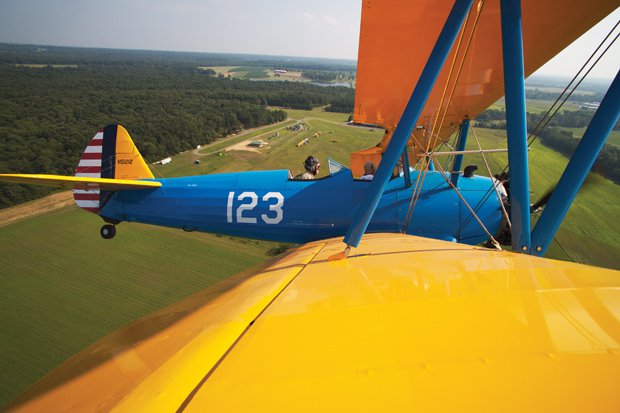
In Bealeton, on a summer Sunday, you can get a firsthand look at the early days of American aviation, when daring pilots and sturdy biplanes helped to win world wars and then went “barnstorming” across America.

Flying Back in Time

Flying Back in Time
The planes arrayed before the crowd.

Flying Back in Time
Pilot and wing walker Chuck Tippett (left), with his military Piper Cub. Says he of wing walking: “There is absolutely no room to be scared.” John Corradi (right), who flew in Vietnam and later for United Airlines, with his 1942 Waco. The pilot sits in the back cockpit, with passengers in front.

Flying Back in Time
The Black Baron

Flying Back in Time
A close-up of a cockpit

Flying Back in Time
Announcer Chris Edwards talks to the spectators.
Bealeton, Virginia, is a quiet place—most days. The Fauquier County village, located about halfway between Fredericksburg and Warrenton, boasts little more than feed stores, grain silos and dusty roadside mailboxes. On summer weekends, however, Bealeton’s country calm is supplanted by the buzz of propellers and a tableau very much like that of a Hollywood movie set. During a recent visit, I was nearly strafed by a World War II vintage biplane as soon as I turned off of Route 17. The old plane rumbled directly overhead, no more than 700 feet off the ground. Moments later, a quarter-mile away, a group of iridescent biplanes appeared in the sky, dipping and turning and flitting about like mechanical butterflies. The scene, in fact, evoked the 1975 movie The Great Waldo Pepper, starring Robert Redford as a frustrated World War I pilot who seeks fame and eventually finds it as a jaunty stunt pilot and actor. (The director of that movie, the great George Roy Hill, apparently had a passion for flying.)
Of course, the biplanes in Bealeton were not there by coincidence. Nor was I. From May through October, a 200-acre field off Ritchie Road becomes a nostalgic showcase for the early decades of American aviation when the Flying Circus Aerodrome puts on its weekly show—a swirling mix of genuine skill, bravery and (very) old-fashioned fun. A typical Flying Circus show features about 10 sturdy, open-cockpit biplanes—mostly early 1940s (Boeing) Stearmans, the U.S. military’s primary flight trainer prior to World War II, along with a pair of Wacos, a couple of single-wing Piper Cubs and a 1929 Fleet Model 7, the oldest plane in action. All but one of the classic aircraft are owned by their pilots. The planes are in prime condition, have their original Navy or Army Air Corps paint schemes—and very much capture a big-stakes era of scrap drives, big-band music and, above all, global conflict: “Hand me my goggles, baby, and I’ll see you after the war!” In the air or on the ground, they are a colorful sight.
During the 90-minute Flying Circus extravaganza, the pilots fly in formation, pop balloons with their propellers, drop “flour bombs” from the sky, grab a mail bag and perform aerobatic stunts that shame other men whose most daring display of courage might be climbing atop a riding lawn mower. The acts are loosely built around a loopy narrative starring a dastardly Prussian ace named the Black Baron and a ditzy dame named Fifi (in a sequined dress) whom he’s teaching to fly. There is also a parachute jump and an amazing, high-speed aerobatic routine featuring a modern propeller-driven plane.
“We’re an educational foundation trying to share aviation with the public,” says Bryon Stewart, a former Oklahoma crop duster-turned-F16 fighter jockey-turned-United Airlines Boeing 777 pilot. He owns the 1929 Fleet and performs a two-minute aerobatic routine with it, doing loops and rolls, a Cuban Eight and a Hammerhead, in which the plane roars straight up in the sky, pivots and then plunges straight down. “With a little practice, you can do it,” says Stewart in that wonderfully understated way that defines pilots. An emcee, dressed like a carnival barker, details the history of the planes for the crowd—about 100 who sit, wide-eyed, on long wooden benches alongside the field. On the day of my visit, the Flying Circus was putting on a special show for about 100 employees of Airbus, ironically—the European commercial airline manufacturer that is Boeing’s chief competitor.
According to John King, a pilot who runs the event and is president of the Flying Circus Foundation, the first aerial show in Bealeton was held in 1971. A group of aviation enthusiasts from northern Virginia bought the property, built a couple of hangars and started an aerial act with World War I biplanes—including the renowned Curtiss JN-4 (Jenny). King’s father, a former Navy pilot, was living in Maryland at the time. When he heard about the show, he started driving down to Virginia to do volunteer work. King, working for United Airlines and based in Chicago, moved to Maryland and joined his Dad at the Circus. “We weren’t flying but helped out with the ground crew,” says King, sitting on a chair under a tent not far from the field’s grass runway. In the mid-1970s, the pair bought a piece of “long, straight” property in northern Virginia, built homes and, says King, “fulfilled our dream of having our own private airstrip.” He and his father and other relatives live about five miles from the Circus.
The first Flying Circus proved a financial disappointment and closed after two years. Undaunted, some of the airplane jockeys in the original group tinkered with the concept. “We said, ‘Let’s use some younger planes—from the 1930s and 1940s—and call it a barnstormer show,’” says King. That idea proved more appealing to the public, perhaps because barnstorming—a genuine post-WWI phenomenon—had some romantic appeal. After WWI, pilots with too much time on their hands, and not enough money in their pockets, flew their military planes around the country, putting on aerial shows for the locals.
The military had a surplus of planes after the war and sold many of them for a song. The pilots would fly through a rural town to attract attention, find a farm field to use for a few hours, then come back and buzz down Main Street, dropping handbills advertising the show. The pilots performed flying stunts for those spectators who turned up—most of whom had never seen a plane—and earned a few bucks for their efforts. At night, they’d sleep in barns (hence the term) or outside, under the wings of the aircraft. “Nobody was getting rich, but it was a luxurious lifestyle,” says King. “Real flying. If only we’d been born then—what fun we would have had.”
King and the roughly 30 people who constitute the Flying Circus team—pilots, ground crew, sundry support personnel selling food and souvenirs, all dressed in brown khaki—seem to be having plenty of fun recreating the post-war era. Before the show, King gathers the pilots, skydivers and wing walkers in a weathered wood-and-batten shed adjacent to an old hangar in which hangs a replica of a Wright Brothers wing assembly. The paneled room is stuffed with aviation memorabilia: old photographs, a circa-1960s painting of a TWA plane, a wooden propeller, a light-blue model dirigible hanging from the ceiling. King, standing on a chair, points to a blackboard. It lists the roughly dozen acts in the show, beside each the initials of the pilots who will be performing it.
While King takes note of the good weather—he had earlier complained of weathermen who keep customers away with their frequent, dire predictions of “afternoon thunderstorms”—skydiver Jim Wine pulls on his red jumpsuit and two parachutes. King mentions that the Circus’ new restrooms are fully operational—no more need to use the outhouses. The pilots applaud. King then offers a mea culpa to the group: “Any of the sloppiness in the formation last week was my fault,” he says almost bashfully. He had been the formation leader. “And the timing … my fault, too.” The pilots laugh. Moments later, after King tells the group to “keep their bragging to a minimum,” the pilots all pile into a converted convertible hearse, painted with red, white and blue stripes, and are ferried out to the field to start the show, with music by Glen Miller and Tommy Dorsey blaring from the sound system.
As one might expect, the pilots are a sturdy group of men. Most of the airmen are currently commercial airline pilots (for United, American or others) or recently retired from commercial jobs. Many of their fathers were either commercial or military pilots, or both. King, who has been associated with the Flying Circus for 35 years, recently retired from a flying career with United Airlines. So did pilot John Corradi. With his handlebar moustache, NASCAR cap, tanned face and bluff, outgoing personality, Corradi is right out of central casting. He owns a beautiful, maroon-and-white 1942 Waco biplane worth at least $200,000. The Circus has a female pilot—a United 777 captain named Carol Young, based in California, who owns a Stearman and flies with the Circus a couple of times a month, though she was absent on the day I was there.
Scott Francis, an engineer for a defense contractor in Fairfax, doesn’t have that old-school look—but there is no debating his skill. In the one nod to modernity in the Circus, he zooms through the sky in his compact Giles 200 aerobatic airplane like George Jetson, determined, it would seem, to defy the laws of physics. He recently won a regional aerobatic competition. “I fly for fun,” Francis says wryly when asked why he opted to become a stunt pilot. “I got tired of flying straight.” At one point in the show, he rockets his speedy plane straight up in air, then lets it descend straight down on its tail. Spectators watch, heads back and mouths agape in silent amazement. He also does a so-called “outside loop,” a maneuver that begins with the plane flying straight and inverted (upside down). Francis then brings the plane around a full 360 degrees. “It’s easy to do but hurts the most because of the negative G forces on the body,” he says. In layman’s terms, those forces pull the pilot out of the seat rather than push him back in it, as happens with positive G forces. Francis concludes his act by flying a quarter-mile upside down, at an altitude of about 500 feet and at roughly 220 miles per hour.
Chuck Tippett, a 47-year-old lineman for a power company, may be the nerviest guy in the bunch. He is both a pilot and a wing walker. He claims there are only 11 active wing walkers in the world—and four work at the Flying Circus. (Besides Tippett, they are Chad Jacobs, John King II and Jana Leigh McWhorter. See her sidebar.) Unlike most wing walkers, says Tippett, “we do not use tethers.” According to Tippett, who has sky dived and flown to Alaska in a kit plane he built himself, “There is nothing in the world that compares to wing walking. It gets your heart pumping. There is absolutely no room to be scared.”
When not hanging from a plane, Tippett flies one. He owns and flies a WWII L4, a military Piper Cub with stars and bars on it. “They called it the ‘grasshopper,’” he says. “It was for reconnaissance; it did everything that helicopters do today—got down low, flew from field to field. In all the old movies, you see the L4.” More generally, he says, “I love the old biplanes and the beginning of World War II. I wear the original style boots, goggles and helmet—got them off eBay. I’m just passionate about flying.”
That’s a comment one hears frequently from the Flying Circus crew. Even the announcer, Chris Edwards, holds a private pilot rating. “The show is all about the camaraderie and a love of aviation,” says Teresa King during a break from playing her Fifi role.
The biplanes are the big attraction at the Flying Circus, marvels of early industrial engineering. Between 1938 and the early 1940s, the U.S. military made about 10,000 Stearmans, and some 3,000 are said to be registered and in existence today. The planes were originally built by the privately owned Stearman Aircraft Co. of Wichita, Kansas, which in 1934 became a subsidiary of Boeing. The planes are rugged, which made them valuable as military trainers for thousands of aspiring pilots. “They were a stepping stone for pilots,” says King, “a way to get them up to heavy-duty fighters and bombers.” (The Stearman was not used for fighting.) “If you couldn’t fly this plane, you washed out,” says King. “They are quirky—not that easy to fly.”
According to pilot Dave Brown, you could buy one after the war for between $500 and $1,000. “I’ve seen pictures of dozens of them stacked up on their noses in hangars.” He says the planes were “made to be abused.” The two wings are held together by struts and a pair of wires (known as flying wires and landing wires), which, Brown says, “give the wings strength and rigidity and support the weight of the aircraft. We consider the wings one unit.” The wings are mostly hollow, with two wooden spars that run the length of the wing, supporting the ribs and cross-bracing. The wings were originally covered with cotton but are now covered with a more durable, painted synthetic material.
The planes have a single 220 horsepower radial engine, with seven cylinders arranged in a circle. The planes’ top speed is about 125 mph, though they are typically flown between 80 and 100 mph. Both the Stearman and the Waco have two cockpits, and the pilot sits in the back. Corradi calls them “tail draggers,” because the steering is in the back. The design makes forward visibility a challenge—but not a problem. As Corradi puts it, “You learn to peek around the engine—it’s not that big a deal.” Former President George H.W. Bush flew a Stearman in World War II. Gus McLeod made history when he flew one to the North Pole in 2000—the first pilot ever to do so in any open-cockpit plane. (Brrrrr.)
At one time, the Waco was also in the running to become a military trainer. Wacos were easier to fly than Stearmans, but also easier to damage because the wings were lower. That’s one reason Boeing Stearman got the military contract. Corradi says the Waco, made originally by the Weaver Aircraft Co., were “playboy toys—custom made and expensive.” He says that Howard Hughes owned one, as did Clark Gable and Charles Lindbergh. “They were made to look pretty, and the Stearman was made to be functional.” Wacos have a front cockpit that can seat two passengers, while the Stearman has room for one.
The Flying Circus is not just about the barnstormer show. The pilots spend a lot of money rebuilding, buying, operating and maintaining the old planes. To buy a refurbished Stearman costs about $100,000, says King. “On any given day, there is a lot of money sitting out there on the grass.”
To recoup some of their costs, the pilots sell rides before and after the show. “It’s really the heart of the operation,” explains Brown. “We’re not a bunch of rich guys.” He flies his Stearman about 100 hours a year and incurs annual operating costs of about $15,000. So earning money to support his hobby is important. That’s partly why he’s got a funny period logo on his plane—a WWII style pinup girl with a $100 bill stashed in a stocking. It reads, “No Bucks, No Buck Rogers.”
Brown, 48, started working at the Circus when he was 14 years old. He cut grass, helped visitors into the planes. Nowadays, he gives about 150 rides a year. “I try to make people happy, giving them an opportunity to experience this aircraft, and that’s how we keep it all going. Demonstrating these aircraft—that is our mission.”
Adds Corradi, who flew a P3 Orion in Vietnam in the 1960s, “Half the joy of having an old airplane like this is sharing it with others. The visitors like the rides, we like giving them, and the bucks that change hands help pay for the airplane. It’s a synergistic experience—and a lot of fun.” He charges $130 to take two people up for a spin; a one-person ride in a Stearman costs $70.
Corradi took me up for a ride—and it was a thrill. I pulled on a cloth “helmet” with radio communication back to the pilot, and off we went. The grass/ground runway wasn’t bumpy at all, and in a few seconds we were cruising over the countryside with nary a care: 800 feet high, 85 miles an hour. There is no better way to see the world, especially when you are in the hands of a veteran pilot. Corradi says he and his wife have flown to St. Louis in the Waco, as well as to Florida and Michigan. “She loves this airplane and will go anywhere with me so long as I don’t go upside down. Thank God for women with no taste in men.”
As one might expect, the show went off without a hitch on a day with what one pilot described as “tricky” wind. The only hair-raising moment occurred when the cords on Jim Wine’s parachute got entangled immediately after he plunged from the plane. After a few scary moments when he seemed out of control, spinning in circles, he cut loose the primary chute and deployed his backup, drifting safely to earth. Whew. “I’ve not had that happen before,” he said afterward.
Was he scared? “The fear doesn’t come ’til a half-hour from now, when I explain to my wife that I can’t find the $1,500 canopy.” (Wine’s Circus colleague, skydiver Joe Callen, has made 1,700 jumps—and told me he’s had five “cutaways.”) Chad Jacobs performed a flawless wing-walk routine—and the show concluded with a formation routine by four pilots: They first flew a “changing combat formation” to the stirring sounds of “America the Beautiful,” then came back from behind the crowd, over the treetops, in a fleur-de-lis design. As pilot Edwards has quipped: “It’s just like the Blue Angels, only 500 miles per hour slower.”
For the curtain call, all 11 planes taxi up to face the crowd—lining up wing to wing. The crowd claps, the bouncy tune from the 1965 movie Those Magnificent Men in Their Flying Machines blares from the loudspeakers, and people young and old make their way onto the field to inspect the classic planes and to hop rides.
Those magnificent men in their flying machines. / They can fly upside down with their feet in the air. / They don’t think of the danger. The really don’t care. / Newton would think that he had made a mistake. / To see those young men and the chances they take. / Those magnificent men in their flying machines.
This article originally appeared in the October 2008 issue.