
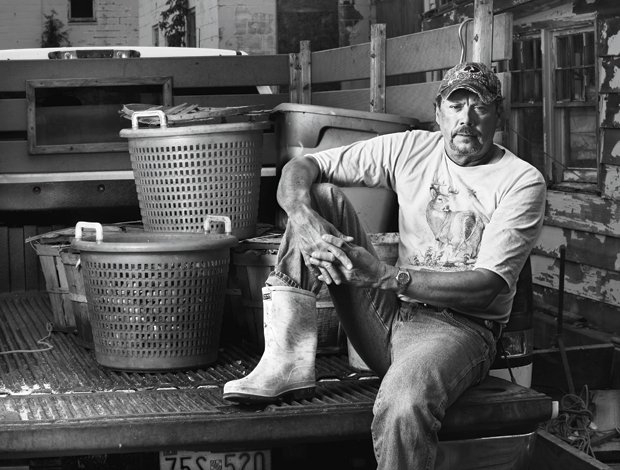
Photographer Glen McClure traveled around the Chesapeake Bay, taking pictures of an “endangered species”—the watermen who fish and crab, and work on wharves and in seafood processing houses. Here are a few of McClure’s honest portraits.

Charlie Quade, crabber, Churchton-Shady Side, Maryland

Bill Hickman, crabber, Saxis Island

Clarence Payton Jr., Tom’s Cove Oyster Procesing, Chincoteague

Nettie Brown, Little Bay Processing, Chincoteague

Eddie Carter, scalloper, Newport News

Anna Jones, crab picker, J.M. Clayton Seafood Co., Cambridge, Maryland

Josh Melzer, Newport News

Nelson Firth Sr., oysterman and crabber, Poquoson

Leslie Croxton, New Point

Sonny Hanson, Poquoson

Steve Powell, crab-potter, peeler-potter, haul-seiner and gill-netter, Poquoson

Stuart Owen, crabber, Poquoson

Melissa Parks, Hedy Bowden and Mary Parks, Tangier Island

Gary Parks, Tangier Island

Josh Meltzer, croaker fisherman, Deep Creek Wharf, Newport News

The Payne sisters (Catherine Payne Via and Beatrice Payne Taylor) crabbers, Urbanna

James “Ooker” Eskridge, waterman and mayor, Tangier Island

Freddie Wheatley, Tangier Island

Amanda Parks, crabber, Tangier Island

Robert Hogge, Fisherman and crabber, Newport News

Ronnie Glover, Amory’s Seafood, Hampton

Junius Barnes Sr., Amory’s Seafood, Hampton

Todd Smith, croaker fisherman, Gwynn’s Island

Curtis Hall, Virginia Blue Crab Co., Wicomoco

Dennis Gray, shucking house manager, Little Bay Processing, Chincoteague
On June 29, 2002 while I was in Chincoteague, Virginia working on a photography portrait project called “A Random Portrait of Virginia,” something special happened that would launch a brand new series for me. Near the town, I noticed a man getting off of a fishing trawler moored in the Chincoteague channel. The man, whose name I learned was Alfred Lima, was taking a break and happened to walk down the street near our sidewalk portrait set-up. I was drawn immediately, visually, to Mr. Lima’s white rubber boots. We asked to photograph him, he agreed-and in that instant, the idea to photograph more watermen popped into my head.
I was struck by Lima’s focus on his work, and by the basic nature of his job—fishing. It is an elemental job, a dangerous job, and something of a humble “trade” with respect to its rewards—a modest wage for piecework and the thrill of spending days out in the waterways. And yet watermen seem committed to their work.
Bob Behr was with me in Chincoteague that day. Bob works with the Chincoteague Cultural Alliance, and he’d originally helped me set up the “Random Portrait” shoot in Chincoteague, one of 12 shoots throughout Virginia for that forthcoming project. I mentioned to Bob—right then, when I saw Lima—my idea of a photo series on watermen. Bob liked it, and agreed to help me. We traded encouraging e-mails for a few years, and then finally met, in January of 2009, in Onancock. Bob brought along Neil S. Kaye, M.D. (we would later meet his wife, Susan). The Kayes had helped start the Tangier Island Museum & Interpretive Cultural Center. Neil agreed to help us find willing subjects to photograph on Tangier Island, whose residents make their livelihood on the water. That is where we all agreed to launch the project, in July of 2009.
That spring I met with Tom Moore, photography curator at the Mariners’ Museum in Newport News, to see if he might have some ideas or resources he could share. Tom listened while I laid out my plan, and then mentioned a wonderful contact, Charles Davis of Yorktown, another doctor who would later help us find watermen in different places. Without my knowledge, Tom went back to the museum and pitched my plan to his colleagues. Not long after, the Mariners’ Museum asked to become the lead partner in the project. The museum wanted to exhibit my watermen photographs, and also to publish a book. We all then gave the project and the book a name—Endangered Species: Watermen of the Chesapeake. After that, I had to organize the work—in real time and geographically—and compose a list of possible contacts.
As with “A Random Portrait of Virginia,” I wanted to learn a little about each person I photographed so we could include a caption beside each portrait in the museum exhibit. My wife, Marshall Rouse McClure, agreed to come and talk to each subject so we could get the real stories behind the extraordinary folks we were photographing. We both thought this could be a great adventure, and we were right!
In all, I spent 11 months shooting pictures of 166 watermen, finishing in June of 2010. Sixty-six of the pictures were enlarged, some to life size, for an exhibition at the Mariners’ Museum. The others were ganged in three-foot-long strip images.
Nearly all the watermen I shot worked along the Chesapeake Bay, though a couple toiled on the Atlantic Ocean. They were located as far north as Churchton-Shady Side and Anne Arundel County, Maryland and as far south as Hampton, with lots of places in between—Gwynn’s Island, Willis Wharf, Reedville, Saxis Island, Bayford, Wicomico, Newport News and Poquoson; there were 19 locations in all.
The logistics were daunting. We had to find watermen, pinpoint their location, schedule a day and time on which to photograph each of them, then find lodging, travel routes and more. It took a lot of time and energy. With the help of many knowledgeable and generous folks who served as “recruiters” and “fixers,” I was able to get a lot of pictures that I think get at the heart of a waterman’s life—the equipment, the boats and, most of all, the faces, which reflect the hard, honest lifestyle of people who spend most of their lives on, or—for those who labor in wharves and seafood processing houses—near the water.
The show’s title is apt: Watermen all over the world are facing a seismic shift in their lives and that of their families as their jobs disappear. Most of the watermen we met were shy, yet generous, curious and supportive when we asked them to help us in this enterprise. Our motivation was basic. We were in awe of these resourceful citizens who put the wonderful bounty of the waters onto dinner tables. We wanted to introduce them to the outside world—and convey a sense of each person we met.
Each face has a different story, but they are all alike too. They are a community of the water, but endangered by pollution, overfishing and development. The Chesapeake Bay effectively is where all these watermen live, and its future remains in question.
I took all of the pictures with a digital camera. I am what some would call a “straight” photographer: My photography employs the basic aesthetics I learned using film, which are focus, light and composition. Two photographers whose work I especially admire are Paul Strand, an American, and Josef Sudek, a Czechoslovakian. I have learned much from studying their work. Like them, I try to be straightforward, honest and observant, looking for insightful physical characteristics in a subject that a casual observer might not spot. In this case, I noticed the strong hands of the watermen—and, typically, their upright posture. These folks are strong. I saw the texture on many of their faces—the lines, the tan from working outside. I am always on the lookout for textures, be it on a wall or a face. You could tell just from their clothes that these people did hard, dirty work. And I worked hard to capture tiny but telling details—the tiny bits of broken oyster shell on the face of a waterman named Clifton Johnson, for example, or a rip in a pair of blue jeans. All are visual clues about the life of a person.
My goal is to make a photograph be about the subject, not about me and my photographic technique. When I am successful, it is almost as if I was not even there.
The first portrait we made was of a man named Freddie Wheatley on Tangier Island. When we arrived we saw Freddie down in his boat with oil all over him. His engine had died, and he was working on it. I noticed he was wearing a Boston Red Sox hat. As it happened, I was wearing a New York Yankees hat! Freddie looked up at me, and said in a slow Tangier drawl: “Well, I was thinking about doing this till I saw that hat of yours.” We all laughed as I quickly turned my hat backwards and said, “What hat?”
The other cool thing was that, as I was setting up my light and getting ready to start shooting, I noticed Freddie talking with my wife off camera. I took that picture, and it was not only the very first exposure for the project but also the first photograph to be selected for the exhibition. We saw Freddie many times after that during our three days on Tangier, and he always kidded me about my hat.
—Glen McClure