
The Galápagos Islands have 250 animal species that exist nowhere else in the world—and a boat trip with just a few folks and a guide is the way to see some of them. Don’t mind the guano.


Bartolomé Island

A frigate bird and pelicans harrass a Santa Cruz fishmonger.

A blue-footed booby.

Brujo (wizard) fish, Santa Cruz.

Opuntia cacti on Rabida Island.

A brown pelican.
A Sally Lightfoot crab.

Big tortoise smile.

Valerio Repetto and Egbert Ennulat consider a tortoise on Santa Cruz Island.
Valerio looks for whales as we motor in on the last night in the islands.

Waved albatrosses nesting.
Photography by Christine Ennulat
Standing on the tarmac of the Baltra Island airport, I stared. The modern-looking terminal, built on the remains of an American WWII outpost, was incongruous amid the barren, red-clay landscape dotted only with strange tree cacti and naked, gray shrubs. “Nice,” I thought. In the little reading I’d been able to squeeze in before the trip, I’d learned that the Galápagos were not exactly verdant, but this was downright bleak.
I needn’t have worried.
A naturalist guide would soon meet us at the airport, then take us to the 84-foot yacht, the Sea Cloud, where we would stay for the next eight days—my father, my sister and me, with four other passengers and a few crew members. My father had gotten inspired to go to the Galápagos after seeing my sister’s enormous coffee table book on the subject, and he wanted his two “caretakers”—sister Daniela and me—along with him. So, once we found a mutually acceptable date, he began to arrange everything.
Before we left for the islands last July, I loved telling people I was going. For a while afterward, it was hard to talk about. Words were too small.
Six-hundred miles off the coast of Ecuador along the juncture of the Nazca and Cocos tectonic plates, the Galápagos are 13 islands of six square miles or larger, six smaller ones and a few dozen rocks and islets. Their appearance is relatively recent, geologically speaking—the archipelago was uplifted from the ocean floor thanks to what’s known as a “hot spot,” where magma pushes up into the earth’s mantle and occasionally squirts through. All the species there, from giant tortoise to marine iguana to blue-footed booby to penguin, arrived from somewhere else, whether by air or by sea, landing where three ocean currents converge: the cold and nutrient-rich Humboldt, up from the Antarctic and predominating from June through November (it brought penguins and fur seals to the islands); the westward-flowing, warmer Panama current, which takes the Humboldt’s place from January to May; and, every few years, the warm, nutrient-poor El Niño, which pushes away the bounty of the Humboldt and sometimes causes devastating population crashes among some species.
The landscape is so inhospitable that many of the castaways had to become something else in order to survive. The islands harbor more than 600 native species (compared to the mainland’s 20,000), and 250 of those are endemic—meaning they exist nowhere else in the world, having diverged so much that they can no longer be classified as related to their original ancestors. From a single finch ancestor, we now have the 13 species of what are known as Darwin’s finches. A couple are tool users—think cactus spine as fork. One is a vampire.
It’s obvious why the islands were the spark for Charles Darwin’s landmark Origin of Species (1859). What’s less widely known is how long it took for him to connect the dots: He visited there for only five weeks in 1835, at age 26. His first impression compared the Galápagos to what “the cultivated parts of the Infernal regions” might look like. But the islands, as they tend to, set something evolving inside him.
Inside the terminal, we paid the required $100-per-person entry fee to Galápagos National Park (which comprises 97 percent of the archipelago) and waited for our guide. We met our fellow Sea Cloud passengers, two pairs from England: Gregory and Flavia, visiting the Galápagos as part of their sabbatical year touring South America, and Peter and Deny, two years retired, she from the fire service and he from Her Majesty’s Royal Guard (“I’ve seen Camiller in her nightie!” he later confided). Our guide arrived, a twinkling, pony-tailed fellow named Valerio Repetto, and herded us onto the bus that would take us to a small harbor where a handful of boats waited.
At the dock, several Galápagos sea lions reclined on benches like so many old drunks. After a brief talking-to about policies and laws (no flash photography, stay on the trails, don’t touch the animals), we stepped onto the ramp—over a young sea lion dozing—and down to the dinghy that would take us to the Sea Cloud.
We’d heard the animals had no fear of humans because there are no real predators to speak of, but this was a little ridiculous.
After lunch on the boat—each of the tour boats has its own chef—there was a half-hour sail to our first island visit, North Seymour, which provided a fine sampling of the animals we would encounter throughout our tour. Black marine iguanas lay collapsed on the trail, which is clearly marked by black and white, knee-high one-by-ones sunk at intervals in the ground. Without much of a zoom on my camera, I inched closer to one of the scaly critters for a close-up—so close, I was sure it would startle and scuttle away. But it just looked at me impassively before sliding its eyes shut.
Blue-footed boobies nested alongside the path. (The word “nested” is used loosely: A booby nest is a bare patch on the ground, ringed by a sprayed wreath of white guano. There’s a lot of guano in the Galápagos.) We saw booby families with progeny at all stages, from incubating eggs to stringy hatchlings to downy toddlers to fledglings. In courtship, females honk and males whistle—an airy, high “shweeeeee” that flings high and then trails down an atonal scale.
Male frigate birds perched in the bushes, displaying their flamboyant red gular pouches to the females whirling in the sky above. Valerio explained that, while both species of frigate—magnificent and great—are the best flyers in the islands, they die if they hit the water because they have inadequate oil in their feathers for waterproofing. The pirates of the Galápagos, they feed by stealing from other birds. Blue-footed boobies are favored victims of the frigate, which will tear at a bird’s tail feathers—in flight—until it vomits its catch. The frigate bird may even catch it mid-air.
Our circuit of North Seymour took us around to a beach where we saw our first sea lions in the wild. These were as fearless as those back on Baltra, although the “beach master,” the alpha bull, barked at anything he thought came too close to his cows and babies. Valerio told us, “The worst thing you can do is run. Lift your arms up to make yourself taller. If he keeps coming and his moustache is pointed at you, bare your teeth—rrrrr.” A couple of us would later have occasion to use that advice. It works.
On the equator in early July, as brutal as the sun is, the temperature stays within five degrees of 70 F—and doesn’t vary much from there year round. We told people we had come to the equator to cool off. Also year round, the sun rises at about 6 a.m. and sets about 6 p.m. That’s what determines the opening and closing times of the Galápagos National Park, and it means visitors must be offshore by sunset.
The first evening, as Captain Pepe and the crew got us underway for our nighttime sail, the seven of us gathered in the main cabin for dinner. It was warm and humid in the enclosed space. Manuel, the onboard chef, and cabin boy Luis laid out the meal of beef stew—all meats and vegetables are organically grown or grass-fed on the islands, Valerio proudly informed us—and then passed around small glasses of something tropical and intensely sweet, laced with rum, and we toasted our voyage.
The boat pitched side-to-side.
The food looked appetizing, but I wanted to walk away from it. Across the table, my father was pasty, his eyes glued resolutely to a spot above my head.
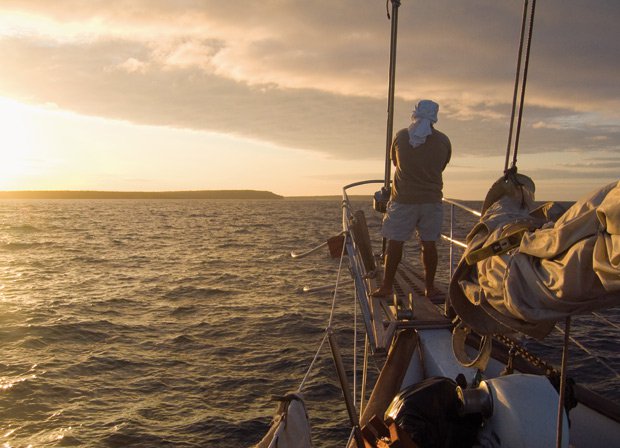
During the seven-hour sail north to Genovesa, we crossed the equator. (There was no bump.) Dad took over a bench on the bridge and felt all right as long as he stayed horizontal. A bit wobbly myself, I found my refuge up on deck, where the cold wind in my face kept nausea at bay. The stars, and then a spectacular moonrise, provided diversion. No one joined me there for longer than a few minutes—too cold and windy—and that was fine.
Life became very simple over those few days, and I never tired of sitting and watching the water, even after I got my sea legs, no matter that the moon rose later and later each night. Venus, so bright she made a wide green stripe on the water, kept me company.
We never knew quite what things would look like when we woke up each morning. On opening my eyes, in the top bunk with the ceiling a few inches from my nose, I would scrooch down until I could see through the potato-sized porthole. Sunday, Genovesa was a black ring of cliffs around blue Darwin Bay. Monday, Bartolomé Island was a tall, brown hill against a gray sky. Beaches might be black, white or red. I heard of, but never saw, green beaches.
After breakfast—eggs or French toast, cereal, yogurt, toast with guava jam, melon, pineapple—we would don our life jackets and our shoes, either sandals or “strong” shoes, per Valerio’s instructions and depending and on whether the landing would be wet or dry. We’d take a meandering hike around an island, always gentle but sometimes with scary footing, then back to the boat for lunch, then another hike, perhaps on the other side of the island or on another island entirely, after a short lunchtime sail. Within that daily rhythm, the landscape, fauna and flora varied widely. Sometimes there was snorkeling.
I had no intention of snorkeling—whether because of the 60-degree water temperature or the likelihood of sharks, I don’t know, but I rationalized that there was enough happening on land to keep me satisfied. Then, finishing the visit to Bartolomé—arid, but a veritable museum of lava formations with very little wildlife—we stood ankle-deep in the (bone-chilling) gentle surf at a beach where a dozen or so four- to six-foot white-tipped sharks basked within a few feet of us. Valerio identified females by their dorsal fins, ragged thanks to what he called “love bites” from the males. A pair of young sea lions swam over to stir up the sleepy group of sharks, without success. “They’re herbivorous night-feeders,” Valerio said. “The waters are so rich, they are satiated.”
Snorkeling was next, and I knew I would kick myself if I didn’t at least try.
The cold was—literally—breathtaking. The shock of it when I hit the water set me hyperventilating, and it took a moment for me to gather my wits enough to manage my snorkel. And then I looked down. And I forgot everything else.
On the ocean floor a few yards beneath me lay a foot-wide Panamic cushion sea star, pale orange spots like Christmas lights against the crimson of its body. A few gold and gray triggerfish zipped past. The dinghy following nearby, we swam along the cliff, where blennies, small fish resembling worried old men, peered out from their hidey-holes. I saw a funny-looking, pale starfish with what looked like Tollhouse chips radiating from its center; Valerio later told me it was a chocolate chip starfish. Sometimes he would swim down to ear-popping depths to retrieve some treasure for a closer look: a bright blue starfish, a live sand dollar, a sea cucumber. He pointed out a black-tipped shark resting on the white sandy bottom, directly beneath us, then, later, a hieroglyphic hawkfish. Gregory and Flavia called us over to see a stingray. The water was so clear, we could see for yards and yards.
Back in the dinghy, crewmember Juan handed us thick, sun-warmed towels to wrap up in.
On a later snorkeling outing, four large green sea turtles swam under me, and I reached down and brushed a shell with one finger. On another, I played with sea lions, their eyes petulant as they batted lime-green sea urchins with their noses, challenging, “Keep up with me if you can!” I tried to, and some of my years fell away.
The fourth night on the boat, I wrote in my journal, “It’s only Tuesday, and if we stopped right now, this would be enough.”
Wednesday, we awoke in the harbor of Puerto Ayora, on Santa Cruz Island, the tourism hub of the Galápagos. After breakfast, Valerio shepherded us into a minivan that barreled us into the misty Santa Cruz highlands, much less populated and, with its comparatively high altitude, one of the few lush areas in the islands. There we saw, in the wild, our first tortoises—enormous, ancient, glistening in the rain. We spent the afternoon back in town, touring the Charles Darwin Research Station (CDRS), getting a small taste of its far-reaching efforts on behalf of the Galápagos ecosystem, from breeding and repatriating giant tortoises and land iguanas to their islands of origin to using biological controls against invasive species, the greatest threat to the islands.
Throughout the tour, Valerio had as much to say about the plants as the animals, which, perhaps by virtue of having faces, filled my mind. I felt guilty toward the plants—species that exist nowhere else on earth, such as the opuntias, the crazy tree cacti I’d seen on Baltra whose heights differ from island to island and account for the shape of the giant tortoises’ shells, saddle-back or dome-shaped depending on how high they have to stretch to reach the cactus pads. Then there are the endemic scalesias, related to (but resembling in no way that I could see) sunflowers, 15 species and five subspecies all descended from a single ancestor. Showing us a lush example at the CDRS, Valerio sighed, “This is my favorite,” and brushed his hand lightly over its ruffled leaves. The scent of fresh flowers after rain filled the air.
Learning some of the science—how animals adapt, how they work together, the many ways the park service manages the archipelago (Valerio called the 300-some park rangers “heroes”), how an El Niño event can nearly wipe out a species—deepens the experience of the Galápagos. By the end, my brain felt stretched—in a good way.
There’s too much to learn about the islands in only eight days, even in the intimacy of a small boat with very few people and a knowledgeable guide who is passionate about the islands and their future. It’s hard to imagine how larger boats, especially the cruise ships that are trying to gain access to the islands, could touch that experience. And there is grave concern among conservation-minded folk about the sustainability issues such boats would entail.
The beauty of the Galápagos lies not in any postcard-worthy landscape or sunset, but in the golden fur of a sleeping sea lion pup seen super-up-close, or in the deep brown, expressive eyes of the gorgeous waved albatross, with its precisely choreographed, highly undignified mating dance. It lies in the crepe-y neck of Lonesome George, the last of the Pinta Island tortoise species, and the slow swing of his venerable head toward a lucky onlooker visiting his pen at the CDRS. It lies in the bright gold and orange of the tiny, spidery mollugo herb growing against the glinting black of an otherwise desolate lava field.
People speak of returning to “real life” after a vacation. At the end of a tour of the Galápagos, real life is what you leave behind.