
The Virginia Beach house Shibui still echoes with the touch of architect Lewis Rightmier.

Contemporary Revival
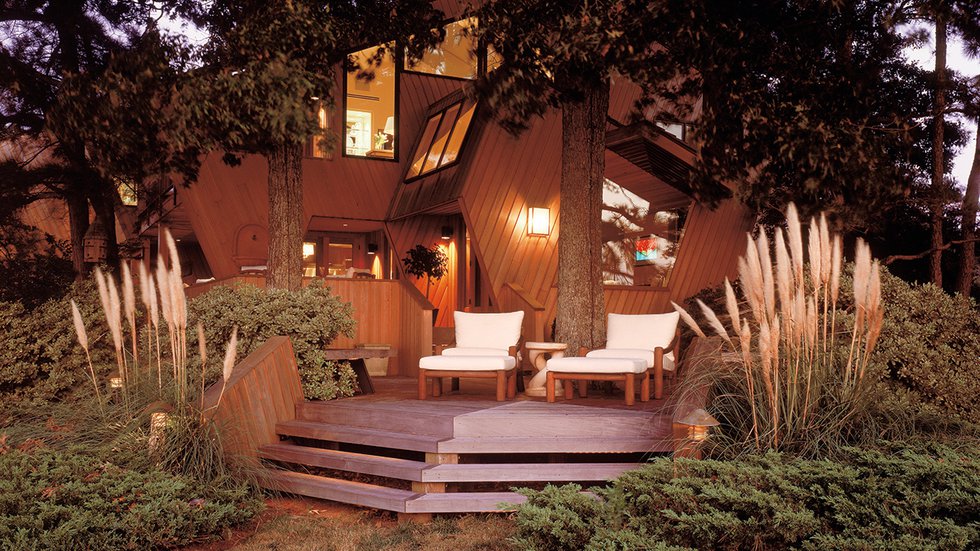
A view of Shibui at night

Martha Mednick Glasser, the interior designer/owner who took on the remaking of the house’s interior.

The Glassers turned a galley kitchen into a modern, gourmet kitchen.

Dining just off the kitchen

A view through to the dining room

The living room, where Rightmier’s fireplace divides the room in two. The main change is that the chimney is no longer riprap.

The other side of the fireplace

A Rightmier trademark is to have a view of the water in almost every room.

The dressing closet of the master bedroom

A porch off the master bedroom

The master bath

The Glassers with Phoenix at the front entrance
Shibui is a Japanese adjective that suggests understated elegance and quality, the kind of beauty that doesn’t need announcement. It’s an inspired name for a singular Virginia Beach home.
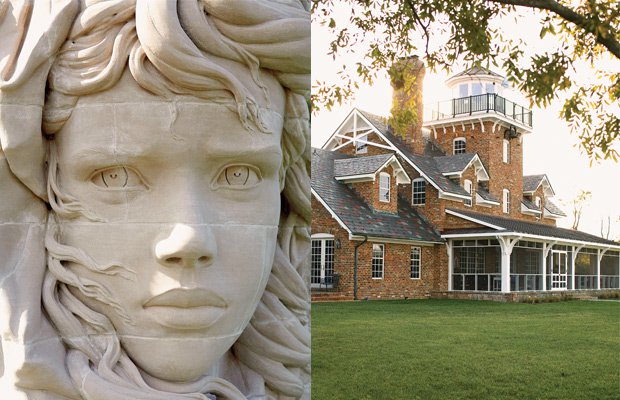
The house named Shibui perches on a narrow point of land, its angled walls dipping towards the waters of Linkhorn Bay like some great seabird unfolding its wings before taking flight. Even after 35 years as a waterfront landmark, the Birdneck Point residence designed by the late Lewis A. Rightmier still seems daringly contemporary.
The architect’s creativity was fueled by the fortuitous combination of an intrepid client and a lovely waterfront site. Tom Turner was a Navy flight surgeon whose aesthetic sensibilities had been sharpened by living in Japan for more than a decade. Lew Rightmier was a transplanted Kansan who’d fallen in love with Virginia Beach’s watery vistas and maritime forests.
Architect and client decided to site the house on the most challenging part of the two-acre parcel, the slender finger of land pointing into the bay. This was 1972 and the Chesapeake Bay Preservation Act, with its increased setbacks, was 16 years beyond the horizon. After Turner told Rightmier that he wanted a house that looked like a piece of sculpture, the architect was emboldened to design a structure unlike any other in coastal Virginia.
As in all Rightmier houses, capturing the view was paramount. Every room had a window on Linkhorn Bay. Nature was so integral to the design that the sight of the wind-tossed water whipped up by coastal storms could be downright unsettling, especially to unsuspecting landlubbers. With exterior walls angled about 70 degrees off vertical and cantilevered over the water, the illusion was almost like being on a boat.
Rightmier’s love of nature extended to selecting materials that made a home seem part of its setting. His trademark was his use of riprap, the broken chunks of granite used to prevent erosion in front of bulkheads and around pilings. Shibui’s foundation is faced with riprap and seems to grow out of the piles that secure the shoreline. The chimney and retaining walls are also made of the rough-hewed stone.
The architect’s understanding of the power of weather, especially on such an exposed location, dictated a support structure of timber pilings linked by steel I-beams. He enlisted the expertise of structural engineer and longtime friend Al Abiouness to figure wind loads and beef up his design if necessary. The result is an uncommonly sturdy structure with a reassuring solidity, comforting shelter from an outdoor environment that is always in motion.
The Turners lived in Shibui for six years before moving to another house designed by Rightmier in southern Suffolk. They sold to Jane and Frank Batten, now-retired publisher of the Virginian-Pilot and founder of Landmark Communications. The Battens installed the tennis court, which doubtless attracted the third owner, tennis great Martina Navratilova.
Richard Glasser, the home’s fourth owner, was drawn to Shibui as much for its architectural presence as its incomparable water views. The Norfolk attorney respected the architect’s pride of authorship and consulted him before undertaking any project. “From the beginning, Lew and I had a clear, if tacit, understanding. I sensed his deep feelings for this house, and he recognized that I would never do anything to it without his approval.”
“Working with Lew meant you had to wait for the muse,” Glasser remembers with a chuckle. “He knew what I wanted, what he wanted, and he didn’t want to be rushed. When he got back to me, the plan was nothing like I’d imagined, but it was exactly what I wanted.”
From 1985, when Glasser purchased Shibui, until Rightmier’s sudden death in 1989 from an aortic aneurysm, the Norfolk attorney had the architect add a west-facing window, design a gate for the driveway and cover the front entrance. Their last discussions concerned a design for a new pier. Rightmier died before he completed the plan.
Glasser’s zest for new projects waned in the absence of Shibui’s architect, until he was confronted with the need for a major renovation. Jim Sykes, the Virginia Beach builder responsible for many of the Resort City’s finest new homes, called Glasser with bad news. In the process of replacing a kitchen window, his employees had made a couple of unsettling discoveries. Asbestos in the drywall compound and aluminum wiring met building codes when Shibui was built, but not present-day standards.
Richard and wife Martha Mednick Glasser both realized that the scope of the problem meant that walls and ceilings would have to be replaced. Fortunately, Martha is an experienced interior designer, and she and Richard agreed that putting the house back together was her opportunity to take a fresh look at the interior spaces and see how they could work together even more harmoniously.
Many aspects of the interior that seemed daringly new in the early ’70s were showing their age. The extensive use of exterior siding throughout the interior was one of Rightmier’s ways of bringing the outdoors in, but Martha felt white plastered walls would better highlight Shibui’s angled beauty. Another Rightmier trademark was the fireplace faced in riprap. While an elegant usage for a commonplace material, the riprap ate up considerable square footage around the hearth, the home’s central architectural element. Martha decided to replace the riprap on the soaring chimney and double-sided fireplace with limestone panels. This change in materials freed space between the fireplace and the windows, making it easier to move back and forth between the two rooms sharing the fireplace.
Martha asked her friend, Tom Jones, a fellow interior designer and co-owner of Calvin & Lloyd in Norfolk, to be her sounding board. “Martha’s idea was to strip the house down to its bare essentials so that it became a series of pure shapes. She kept the materials and design as simple as possible to emphasize the architecture,” Jones says. “Now, when you walk into the house, your eye goes straight to the outside. Nothing on the interior distracts you from the realization that every window frames something interesting outside.”
Eliminating color provided another way to keep the focus on the view. Except for the couple’s art, the color scheme is monochromatic. The furnishings blend into the architecture with tones of off-white that echo the color of the limestone on the floor and the fireplace. To warm up the neutral scheme, Martha chose fabrics for their tactile appeal.
One of the biggest changes was the kitchen. The old galley-style kitchen has been replaced with an efficient marvel of stainless steel appliances and Bulthaup cabinets from Germany. California kitchen designer Chris Tosdevin, who lists Emeril’s kitchen among his many credits, worked with Martha in laying out her workspace. Behind the new kitchen, the old laundry room has been converted into a second kitchen with appliances and a sink for caterers, plus additional storage.
The Glassers and their builder, Jim Sykes, didn’t rush the process of renovating. Having to work without Rightmier’s guidance, they let the building suggest how to proceed. Richard Glasser marvels at what he learned after the interior was gutted. “With the walls gone, I began to understand what Lew was thinking when he designed this. I also realized that he would have readily agreed to some of the minor changes I had wanted, because they made perfect sense within his design.”
Sykes is confident that the architect would approve the renovations. He says, “Actually, I think we made the house even more Rightmier in feeling, because the new surfaces really play up all the angles in the house. The Glassers were really respectful of Rightmier’s design. After all, he’s Virginia Beach’s own Frank Lloyd Wright.”