
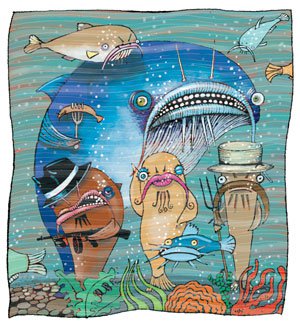
Big ones, small ones–catfish all around.

nat_catfish
Anglers are flocking to Virginia to hook monster catfish from her rivers, hoping to exceed the state record-setting 95-pounder
BIG ONES, SMALL ONES–CATFISH ALL AROUND. By Christine Ennulat
nat_catfish
Anglers are flocking to Virginia to hook monster catfish from her rivers, hoping to exceed the state record-setting 95-pounder
Anglers are flocking to Virginia to hook monster catfish from her rivers, hoping to exceed the state record-setting 95-pounder that Jetersville native Archie Gold once pulled from (and returned to) the James. Who knew the bewhiskered bottom-feeders could get that big?
Actually, the Mekong giant catfish gets bigger—one caught in Thailand was nine feet long and 646 pounds. Catfish run small, too. Consider the tiny, much feared Amazon-native candiru, a.k.a. the penis fish.
Catfish are in fact one of the most diverse animal families on the planet, with about 3,000 species. Virginia’s Department of Game and Inland Fisheries (DGIF) lists 15 statewide, from the blue catfish (Ictalurus furcatus), of which Gold’s behemoth is an example, to the thumb-sized madtom (Notorus spp.).
When reporters call Bob Greenlee, district fisheries biologist for DGIF, they usually want to hear about the splashy trophy blues. But Greenlee likes talking about its smaller cousins as well, starting with the smallest: “Madtoms are kind of cool,” he says. Found in smaller streams throughout the state, madtoms account for most of Virginia’s catfish species, and some are endangered due to habitat fragmentation. Orangefin and yellow madtoms and the spotted form of the margined madtom are listed.
The little guys aren’t helpless, though—their dorsal spine is armed with a stinging protein. “It’s very sharp,” says Greenlee. “You get stung and it’s like you’ve been stung by a bee.” He suggests that madtoms are so named “probably because they hurt like heck.”
At up to about a foot-and-a-half long, bullheads and white catfish (Ameirus spp.) fare better, ranging widely from backwaters and streams into larger, swifter-flowing rivers. The black bullhead is found west of the Appalachians, and the flat bullhead to the east and south. Brown bullheads and white cats are native east of the Appalachians (i.e., the Atlantic slope drainages), and browns have also been introduced in western parts of the state.
“Angler introductions are the primary source of how fish get moved around,” says Greenlee. That’s probably how the flathead catfish, Pylodictis olivaris, native in southwest Virginia, found its way throughout the Atlantic slope drainages after the DGIF introduced it in the James east of Lynchburg. The enforcers of the catfish pantheon, flatheads are sometimes used to help thin undesirable fish populations. “Flats set up shop, get in cavities and go out and forage,” says Greenlee of this beast that can hit 60 to 70 pounds.
Channel catfish and the closely related blues round out Virginia’s cats. Found statewide, channel catfish are also widely farm-raised. Saveur magazine recently insisted it’s the only fish for which farm-raised tastes better than wild-caught.
With channel cats native to Virginia west of the mountains, the blue catfish is the only “come-here” among the bunch. Big-river fish from the Mississippi, blues were introduced into the tidal James and Rappahannock in the mid-1970s as a sport and food fishery (so much for the latter: A consumption advisory is now in place on the James)—and they’ve taken off throughout the state’s tidal rivers. Anglers routinely haul in 70- and 80-pound blues from the James—and release them. After all, if you release a monster, maybe you’ll catch it next year, when it’s packed on 10 more pounds.
No, really: Blue catfish weigh five pounds by age 8, double that by age 10 and may add 10 pounds a year thereafter—to 50 pounds by age 13 or 14. Age 8 is when blues get big enough to start enjoying the James’ gizzard shad forage base, Greenlee explains. “Once they’ve had the first of their gizzard shad, there’s no turning back.” He expects to see 100-pounders before long. (The Rapp’s main forage is white perch; its blues top out at less than 30 pounds.) Scientists estimate that blue catfish now account for 75 percent of the James’ fish biomass—translation: meat. “They’ve gone crazy,” Greenlee once told the Richmond Times-Dispatch. “They reproduce like mad dogs.”
“I’m not sure I said it,” Greenlee says now, “but I like the quote.”
He does not, however, like eating catfish. “I cut a lot of fish to age them … and [examine] gut contents,” he says. “No treatment of fish makes that smell go away.” Give him rockfish instead.