
Beach kids blaze trails in entomological cuisine

By Jiminy – Feature
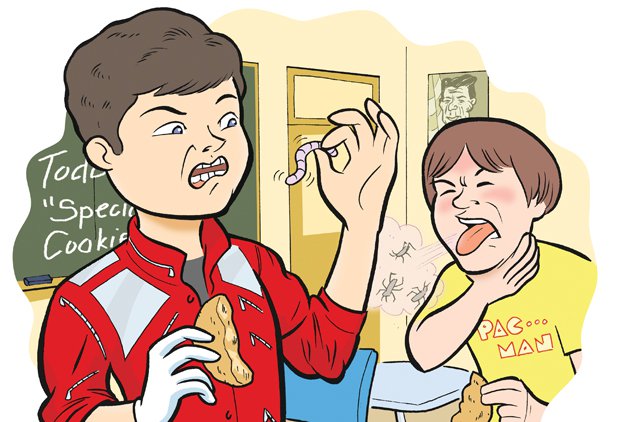
Fourth-graders at College Park Elementary School in Virginia Beach were of course elated when they were served chocolate-chip cookies and popcorn. Their paranoia still poorly developed, they gobbled the goodies down, not thinking to ask why they were being given treats in science class. They failed to notice that the honey-dipped popcorn had a little extra crunch, that the cookies packed a little more protein than most. Both treats contained chopped crickets; the cookies had mealworms as well.
Teacher Liz Berry staged the odd repast to make a few points about nutrition, and the Associated Press picked up the news of the freaky lab exercise. To be her chef, Berry enlisted Elaine Duty, whose bent for insectivory grew out of a survival course she led for teenagers at a church camping program. Her gist was that certain insects could be a good protein source in an emergency.
“If you’re lost in the wilderness, eating insects can keep you from starving to death,” Duty told the children. “Some American soldiers survived POW camps in Vietnam by eating cockroaches.”
Cockroaches? That must have made crickets and mealworms more appealing. Yes and no. “I wish I had been absent today,” said one student, but another said he could have eaten 2,000, and a third asked for seconds.
Elaine Duty was ahead of her time, says David George Gordon, author of the popular Eat-a-Bug Cookbook, published in 1998, which is just what you think it is, a collection of buggy recipes, all tested by Gordon. He’s done much to raise awareness of the culinary potential of insects, as have the TV shows Fear Factor and Survivor. “Then there’s that guy Andrew Zimmer, who’s always eating weird food,” says Gordon, who has demonstrated his recipes in 30 states and three other countries and wowed ’em in May at Broad Appétit, a new food festival on Richmond’s Broad Street.
Despite the popular interest, though, Gordon doesn’t see insects as ever being a mass-market food because “in Euro-American cultures, we hate insects on so many levels.” (Especially the kitchen level, though few of us have a problem with their cousins, shrimp, lobster and crayfish.) In many other cultures, though, insects are real food, not novelty items, he says. In the Mexican state of Oaxaca, for example, grasshopper tacos are a fave, and in South Africa, mopane worms (the caterpillars of a certain moth species) are harvested and dried. “They’re so popular, there are mopane-worm bandits who will raid a village at gunpoint and take the year’s crop,” Gordon says.
For adventurous spirits thinking of foraging for their own insects, Gordon echoes what Duty told the kids: Don’t. “If you start collecting bugs from your own backyard, you probably are exposing yourself to pesticides,” Gordon says. “Home gardeners use three times as many pesticides as a professional farmer would.” His book gives resources, but he says go to a pet store for crickets and mealworms, which they sell as live food for lizards and turtles. As Duty told the students, kill the critters by freezing and, for crickets, just pull off the legs and wings. Toss them into the rest of the ingredients and voilà, bugs in a jiffy!
A sought-after personality who’s been on Late Night with Conan O’Brien, Gordon is making fewer appearances these days as he writes his next book, about his adventures as a bug chef: Travels with My Ant.
(Originally published in the August 2008 issue.)