
Three centuries, several farms, one museum

The slow transformation of Old World Englishmen into New World Americans started when the first settlers arrived in Jamestown in 1607. They didn’t become Americans on purpose—they didn’t even know it was happening. They changed because they came into contact with different sorts of people and cultures—first the Powhatans and other natives, then the Africans brought over by slavers, then other Europeans who came primarily from the German states and Ireland.
“Becoming Americans” is a three-century story best told in three chapters, at three of Virginia’s finest outdoor history museums. Chapter One: Jamestown, where a stunning combination of new museums and recently unearthed archaeology testify to the clash of cultures that occurred here 400 years ago. For Chapter Two, drive 100 years down the road and let Colonial Williamsburg bring the 18th century and the Revolutionary War back to life. Chapter Three requires another short drive, less than three hours from Williamsburg along I-64 to the edge of the original Wild West, the Shenandoah Valley.
At the Frontier Culture Museum in Staunton, see what happens when German and Scotch-Irish immigrants are added to the existing mixture of English, Indians and Africans. The concept is simple. Typical Old World farms of the 18th century illustrate the customs and culture of the various groups who came to America. Typical American farms of the 19th century show the lifestyle that ultimately evolved.
In the 1980s, the Frontier Culture Museum dismantled old farm buildings in Europe and rebuilt them in the Valley of Virginia, a process roundly criticized by some preservationists because it takes the structure out of its original context. True enough, but it also preserves old buildings slated for destruction and allows them to serve as educational tools.
A few years ago, says Director John Avoli, “We realized we were not adequately portraying all the people who came into the Shenandoah Valley and made contributions to the development of a culture that was distinctly American.” Having a Scotch-Irish farm from the 1730s, a German farm from 1710, an English farm from the 1690s, and an American farm from the 1850s was not enough. The museum began making plans for adding examples of West African and Native American farms.
“We went to southern Nigeria last year,” says Eric Bryan, the museum’s assistant director, “to study the farms of the Igbo people.” Why the Igbo and not other Africans? “During the first half of the 18th century,” Bryan explains, “slave shipping records show that this was where most of Virginia’s Africans came from.” Virginia Indian dwellings and farming practices are being studied as well, and the two “new” old farms will be complete by next summer. This summer, the American farmhouse will be moved to a separate area in order to make way for them.
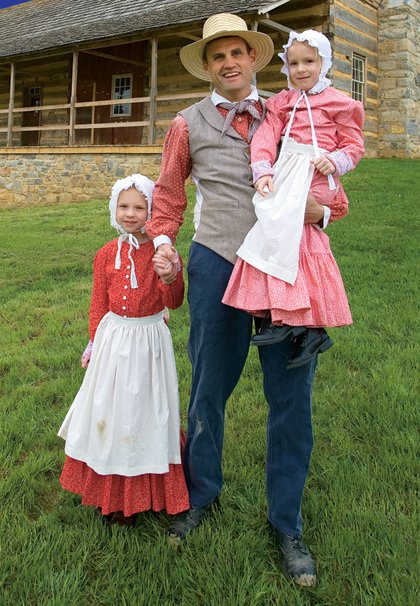
The American section, with two farms, a schoolhouse, a gristmill and a log cabin, has been created a few hundred yards from the Old World farms. The Bowman farmhouse, donated to the museum last year, allows the public to see the evolution of an American farm as it passed through many generations of the same family. The Old World and New World sections are at some distance, making for a lovely walk on a fine day. Families with young children or older people may want to rent one of the golf carts and scoot around from farm to farm.
Many Virginians today can trace roots back to include at least one Scotch-Irish, English, African, German or Native American ancestor. In that sense, the Frontier Culture Museum is a very personal place where those visitors can say, “My family once lived this way.” Because the museum does such a good job of making the abstract clear—and because of its hand-on activities—it is the perfect place to bring to life the lessons being taught in Virginia history or American history classes. Or, if math is your subject, think English + Native American + African + German + Scotch-Irish = American.
The best time for families to visit is weekends in September and October, when the weather and the level of activities peak. No cafeteria, so plan your visit before or after lunch. FrontierMuseum.org