
A century and half later, Civil War trenches have become peaceful hiking destinations.

Earthworks

Earthworks

Earhworks
Winter can be a bit challenging for outdoorsy Virginians. For most, the nostalgic yearning for winter—crisp winds, wood smoke, rustic countryside—gives way quickly to the reality of the season’s disagreeable weather—weather fit to keep folks inside. It turns out there’s a solution to cabin fever, though, a good reason to put on the parka, lace up the hiking boots and head outdoors. Winter, of all seasons, happens to be the best time to appreciate something found in unusual abundance in the Commonwealth.
Virginia, of course, was the nation’s Civil War epicenter. Scores of battles occurred here. Union soldiers tried repeatedly to capture the South’s capital city, Richmond. Confederate troops fought to defend their land, and even made a foray or two that threatened Washington D.C. All this left deep scars—on the war’s participants, on American memory and, importantly, on the ground servicemen fought so hard to take and defend.
Most of these wounds have long since healed. Most, but not all. In fact, if you look in the right places, ask the right people, you’ll find the war’s few remaining physical traces.
“Earthworks are the most visible reminder of Civil War soldiers and the days they spent on the ground,” says David Lowe, a historian with the National Park Service in Washington D.C. “Everything else, you have to dig for. These earthworks were thrown up by flesh-and-blood soldiers using shovels, sometimes even bayonets.”
Earthworks—wartime trenches and forts fashioned from dirt and felled trees—remain part of Virginia’s landscape, 150 years after soldiers constructed them.
Lowe has spent 20 years studying and mapping surviving Civil War earthworks. He and colleagues often do their field work in winter; the trees have shed their leaves, and the enhanced view of the terrain gives observers a better appreciation of the breadth and complexity of the earthworks. It’s easier to place them into context, to see them as Civil War soldiers did, without much foliage obstructing their view.
Many of Virginia’s earthworks are braided by trails that trace the footsteps of Civil War soldiers, and the value, the beauty of these sites lies in their versatility. The trails are ready made for a history lesson if you choose, often marked by signage indicating what transpired where. But for those who just wish to be outside, to leave the confines of their four walls, the trails that twist silently through the earthworks offer the perfect opportunity to simply stretch your legs in the great outdoors.
I had occasion recently to encounter the earthworks from these two perspectives. I’m a history teacher and a father of two boys and on a couple balmy January days visited two sites near my home in Williamsburg where surviving earthworks figured prominently Civil War battles.
As we all released some pent up energy at Newport News Park, then later at Cold Harbor, my wife and kids were simply glad to be outside, more or less oblivious to the significance of the earthworks around them. I was interested in the history, and it got me wondering precisely how we ended up hiking among the handiwork of common soldiers a century-and-a-half after they dug these trenches. It’s an interesting tale. I’ll save you the lengthy Civil War history lesson, but Virginia’s earthworks do have a compelling back story.
Undoubtedly, Civil War battles are an odd spectacle to modern observers; standing in straight lines and firing weapons at one another across an open battlefield seems especially suicidal. Indeed, the battles often had very high casualty rates because the soldiers used old modes of fighting—the disastrous linear tactics—while they employed modern weaponry—the fast-loading rifled musket.
But the foolhardiness of facing the enemy while lethally exposed on the field of battle wasn’t lost on the Rebs and Yanks, and if there was fair warning that opponents were close by, commanders often gave orders to “dig in.” Soldiers constructed earthworks as a barrier against an advancing force, shielding them from a hail of bullets and bombs, hoping the fortifications would be an impenetrable roadblock to enemy troops.
In the 1860s, Virginia was strung with fortifications like tinsel on a Christmas tree. There were many hundreds of miles of them around the Commonwealth. Earthworks ringed both Richmond and Washington D.C., but armies dug them in seemingly far-flung places, Isle of Wight, Danville and Saltville, for instance.
Soldiers built earthworks to absorb all manner of lead and iron shot. The earthworks’ sturdiness also allowed them to put up a good fight against the formidable forces of weather and time, so that long after the war ended, the works remained.
Most of the earthworks that stretched across Virginia have long-since been flattened; farmers had no reason to preserve trenches that cut deep into their fields—and into their profits. Forts that protected major cities, the threat no longer present, quickly gave way to urban development. But there were so many earthworks in Virginia that time and progress could hardly erase all of them. Lowe and his colleagues have mapped more than 120 miles of earthworks around the strategically important city of Petersburg alone.
You’re just as likely to find these vestiges of the Civil War in unexpected places as anywhere. Naturally, some earthworks are protected by national or municipal parks, but others are situated in modern settings, like those dug by Confederates at Gloucester Point, some of which happen to be sandwiched in between the bustling Route 17 and the Virginia Institute of Marine Science. A handful of Virginians literally have earthworks in their backyards. There’s still more lying silently, deep in the woods, undisturbed in the century-and-a-half since soldiers occupied them. Most Virginians can find them within an easy drive of their home.
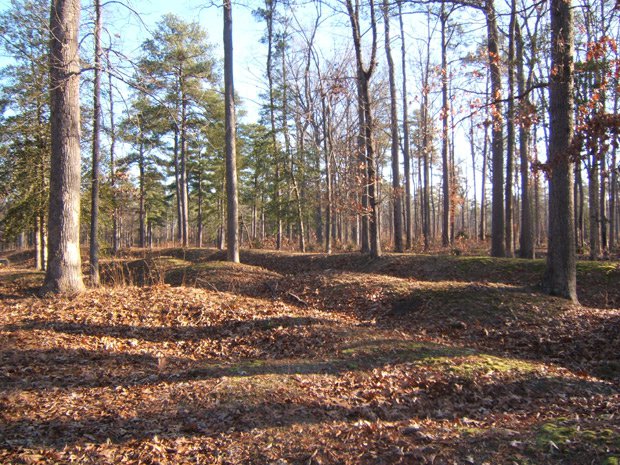
To be sure, the earthworks are showing their age. They’re a far cry from what they were when soldiers constructed them. Erosion has softened the sharp angles, filled in the trenches. Many are grown over, covered in a blanket of moist leaves, the fallen foliage of trees that now grow on the parapets. Interestingly enough, the overgrowth has been the earthworks’ savior.
Cleaning up earthworks and removing vegetation actually makes them erode faster. Lowe notes the irony of efforts by well-meaning preservation societies. “They’ve got a fort or two in their hometown, and the first thing they do is cut down the trees,” he says. “But it’s the leaf litter that saves [the earthworks] from erosion.”
So it turns out that grown over is good. And that’s precisely the condition of the earthworks at Newport News Park, site of the little-known Battle of Dam No. 1 in 1862. My family and I hiked the park’s White Oak Trail, a three-mile lakeside path that follows the perimeter of the city’s reservoir. Running parallel to large sections of the trail are well-preserved earthworks, dug by Confederates to halt the Union advance toward Richmond. Deep in the woods, set back, apparently, from the main line of trenches, are a couple larger gun emplacements, visible because of the trees’ bare branches.
I stopped occasionally to take in the significance of the earthworks, and tried to imagine what normal young men, much like myself, might have been doing, been thinking as they hunkered in these trenches. But the mawkish sentimentality didn’t last too long; my three-year-old was excited to be outside, running like it was going out of style. I hollered constantly at the family to wait for me at the next bend in the trail. It was a lovely hike, quiet, wooded, with few other pedestrians on the trail that day, a handful of dog walkers and runners, and that’s it. I got a history lesson and the boys took a solid nap that afternoon. I was happy.
The following weekend, we visited the battlefield at Cold Harbor, about 10 miles northeast of Richmond. In 1864, Union and Confederate soldiers faced one another across earthworks nearly seven miles long. In a series of ruinous frontal assaults on the Confederate position, nearly 13,000 Union soldiers were killed and wounded, a fruitless attack that General Grant later wished he had never ordered.
Cold Harbor today is a tranquil mix of meadows and woods, and the 2-mile long trail through the battlefield makes for an easy morning hike. As at Newport News Park, my kids were a bit young to appreciate the solemnity of the place; to them it was sticks, dirt and wide open trail. Nonetheless, I was able to briefly pause and reflect a couple times as the path crossed the open pine forest that was a cataclysmic no man’s land long ago. The morning was a pleasant family outing, and meaningful enough to me that we made firm plans to visit Virginia’s earthworks again soon.
And that’s the challenge I’ll leave you with. Find Virginia’s Civil War earthworks and make them meaningful for you—be it learning about the war, simply enjoying the fresh air, or something in between. Below is a list of some hiking trails among some of the Commonwealth’s best-preserved earthworks. It is by no means complete. Know of a site that’s not here? Leave it in the comments. Your neighbors will appreciate the opportunity to walk among historical remnants you’ve found so worthwhile.
Central Virginia:
Richmond National Battlefield Park includes numerous sites in and around Richmond that were significant during the war. These are some with good hiking trails among earthworks:
Cold Harbor – Two-mile hike through Union and Confederate trenches.
Fort Harrison – Half-mile hike among a fort that changed hands from Confederate to Union late in the war.
North Anna Battlefield Park – A Hanover County park with a two-mile hike among earthworks from the battle of North Anna.
Southeast Virginia:
Newport News Park –Three-mile hike along the White Oak Trail, site of the Battle of Dam No. 1.
Fort Huger – Short hike through this Confederate fort in Isle of Wight County with a spectacular view of the James River Reserve Fleet of decommissioned ships.
Yorktown – There’s a seven-mile battlefield loop that’s a driving tour of the Revolutionary War battlefield, including reconstructed earthworks from the revolution. But hike all or part of the interpretive drive, and deep in the woods you’ll find lots of original Civil War fortifications, too.
Northern Virginia:
Fredericksburg and Spotsylvania County Battlefields Memorial National Military Park includes four battlefields, and a couple have spectacular hikes among earthworks:
Battle of Fredericksburg – A couple trails parallel the interpretive drive and offer two-to-three mile hikes among some of this battlefield’s earthworks.
Battle of Spottsylvania Courthouse – Several hikes of up to five miles are available here among well preserved earthworks that saw fighting so fierce part of it became known as “Bloody Angle.”
Harper’s Ferry National Historical Park—At the junction of Virginia, West Virginia and Maryland, the five-mile Maryland Heights hike twists through earthworks around this strategically important town.
Shenandoah Valley:
Hupp’s Hill Civil War Park—Near Strasburg, this Civil War museum has a nice hike through earthworks that were important in the campaign of the Shenandoah Valley.
Southwest Virginia:
Cumberland Gap—There are several hiking trails, many of which have unmarked earthworks which remain from the fortification of this strategic mountain pass.