
Memories of a talented picker and the man credited with inventing the instrument.

Banjo Men
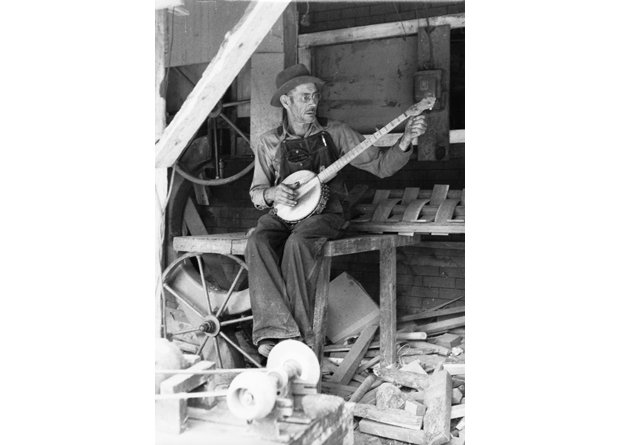
James Yarber in his shop, 1964.

Banjo Men
Joel Sweeney
More than 45 years ago, while on a trip to Abingdon, an acquaintance of mine told me about a celebrated banjoist who lived on a farm east of the city. James Yarber was said to be a shy man by nature, rarely playing before groups and preferring to stay busy in his backyard workshop, where he fashioned ladder-back chairs and other furniture. My acquaintance, Ted Blevins, told me that he’d recently bought an old banjo—and that it might serve as a hook to get Yarber to play.
He was right. When we got to Yarber’s home, in Glade Springs, he was finishing some work in his vegetable garden. Blevins handed his instrument to Yarber and explained that he didn’t know how to tune it. The old man’s eyes twinkled with pleasure as he gripped the neck with his left hand and began plinking the strings with his right. He then took the banjo inside his workshop and studied it from behind his steel-rimmed glasses. He appeared to retreat to a realm entirely his own. During the tuning, Yarber’s expressions would change from concentration to a quick frown as he methodically adjusted one string and then another. And then, just as quickly, the frown would disappear.
Then, without warning, Yarber launched into an ancient and mesmerizing Appalachian ballad, which his wrist and fingers seemed compelled to play. There was a faraway look in his eyes, as if he was trying to visualize where he had first heard the song.
Listening to Yarber’s astonishing, impromptu recital that day in 1964, my thoughts drifted to Joel Sweeney, the man credited with inventing the modern banjo. He was born 200 years ago this year. Living on his family’s farm near Appomattox Court House, Sweeney was captivated by the rhythmic sounds of a primitive, four-string gourd instrument fashioned after ones used by slaves coming over from Africa
In 1823, when he was 13, Sweeney made his first banjo. His mother was not pleased when she learned the instrument had been created from the hide of the family cat. She chided him for being cruel, broke the banjo and threw it into the fire. Her displeasure soon waned, however, as Sweeney made new banjos, each time refining them until in 1831 or so, he added a fifth string, or bass string, to the instrument. This is basically the banjo that we know today—the only musical instrument said to be invented in North America.
The origin of the word “banjo” has never been fully traced. Thomas Jefferson wrote in 1784 about an instrument used by slaves called a “banjer.” Others say it evolved from Joel Sweeney’s group of local musicians, known as “Joe’s Band.” The name was reversed to “Band Joe” and thus emerged the name “banjo.”
By the late 1830s, Sweeney was singing, playing concerts and touring. His minstrel show became extremely popular—so much so that, during a tour of Europe, he gave a command banjo performance for Queen Victoria. It was the highlight of his career.
(Originally published in the October 2010 issue.)