
Lineage societies are reputed to be stuffy, shrinking refuges for the few. But, in fact, many are now growing in size, thanks to an Internet-driven rise in genealogical research, and most do charitable work.

All in the Family
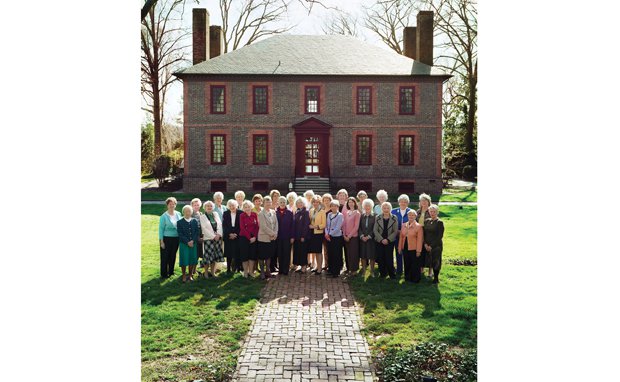
Members of the Virginia Society of the Colonial Dames of America, at Wilton House in May.

All in the Family
Members of the United Daughters of the Confederacy at a March 8, 2008 meeting in Richmond.

All in the Family
The Sons of the American Revolution’s 2006 National Congress in Dallas, at which Harvard’s Dr. Henry Louis Gates Jr. (second from the left) was inducted into the organization.

All in the Family
A Sons of the American Revolution plaque in Charles City County, dedicated to the 26 blacks from the area known to have served in the Revolutionary War.

All in the Family
Sons of the American Revolution, pictured at the organization’s 2007 National Congress in Williamsburg.
Wearing smiles as big as their hats, hugging and greeting friends seldom seen, about 150 members of the United Daughters of the Confederacy are holding their spring executive board meeting at their Richmond headquarters. There are a few elderly ladies present as well as a number of teenagers, some young women and several mother-daughter pairs, but the majority are in their middle years. Listening in on the chatter, one hears talk of scholarships awarded to Virginia college students, a new bit of information someone has discovered about her great-great-grandfather, and the news that the UDC headquarters on the Boulevard in Richmond—built in 1957 and named the Memorial Building—has been designated a historic landmark by the Virginia Landmarks Registry. The hats—some flamboyantly decorated with the UDC’s red and white colors—are a festive tribute to generations past. But are there any real daughters of Confederate veterans still alive? Incredibly, there are five.
Lineage societies—organizations made up of descendants of certain designated ancestors—don’t get much attention these days. It would be logical to assume that even the largest and best known, like the Daughters of the American Revolution (DAR) or the Sons of the Confederate Veterans, are fading into irrelevance due to their exclusive membership requirements and a decline in eligible recruits. Logical, perhaps, but wrong.
There are at least 500 lineage societies in America, and while some of them are, in fact, fusty preserves for the few, most work hard to stay relevant to contemporary society. And, somewhat surprisingly, many of them are growing. The Internet has made searching for one’s ancestors easier and more popular than ever—it’s a real trend. And as far as exclusivity is concerned, well, it’s something of a myth. The fact is, almost every American alive today is eligible to join at least one lineage society. Today’s average adult is about 12 generations removed from the arrival of the first Jamestown settlers. If you could trace every ancestor in your direct line back to that time, you would have 4,096 names. The odds are overwhelming that many of those ancestors fit the criteria for several lineage societies, and when your ancestor fits, so do you. “With the advent of the Internet and home computers, genealogy has become one of the most popular hobbies in the country, and that has brought a growth spurt to many organizations,” says James Raywalt, a master genealogist and himself a member of 32 lineage organizations and the founder of two—the Hereditary Order of the Families of Presidents and First Ladies of America and the Registry of Famous and Infamous Relatives in American Families.
By some estimates, there are 35 million living descendants of the 23 individuals who came over on the Mayflower and produced offspring. If that is even close to accurate, imagine how many more of us are descendants of the hundreds of thousands of men who fought in the Revolutionary War, the Indian wars, the Civil War, the Spanish-American War, the two World Wars and every conflict in between—each of which has many different societies that honor the memories of its soldiers.
And, in the unlikely event that there isn’t a single strand of military DNA in your body, perhaps you are descended from a pirate and eligible to join the Order of Descendants of Pirates and Privateers, or a witch (Associated Daughters of Early American Witches), a tavern keeper (Flagon and Trencher), a clergyman (Society of Descendants of the Colonial Clergy), a doctor (Order of Descendants of Colonial Physicians and Chirurgiens), a whaler (Descendants of Whaling Masters), a slave (International Society of the Sons and Daughters of Slave Ancestry), a lawyer (Sons and Daughters of the Colonial and Antebellum Bench and Bar) or a blacksmith (Guild of Colonial Artisans and Tradesmen). If you suspect a few drops of royal blood are coursing through your veins, you might be eligible to join the National Society of Americans of Royal Descent, or perhaps the Russian Nobility Association in America. Or, if your ancestor was, ahem, born on the wrong side of the blanket, the Descendants of the Illegitimate Sons and Daughters of the Kings of Britain, fondly known as the Royal Bastards, will welcome you with open arms. Says Raywalt, “With the diversity in American culture being greater than ever before, within two or three generations everything will be so commingled that the face of the individual with Mayflower heritage will be the face of the globe—white, black, Asian, Hispanic, native American, all will be direct lineal descendants of the Mayflower immigrants.”
That smug feeling one gets from having royal ancestors fades fast when the hard facts come out. Royal descent is surprisingly common among Americans, particularly those with ancestors who came from England, Scotland, France and Germany. Estimates suggest that 150 million Americans—nearly half—could trace their descent from European royalty. More than half of our presidents and their wives could have, had they known or cared, claimed a royal branch in the family tree—but, at least during the early years of the republic, such pretension was seen as un-American. Thomas Jefferson, a vigorous proponent of meritocracy, had little patience with Americans who would claim superiority based on lineage. “An industrious farmer occupies a more dignified place … than a lazy lounger, valuing himself on his family, too proud to work,” he wrote. His mother, Jane, on the other hand, took great pride in her long Randolph family line. “They trace their pedigree far back in England and Scotland,” Jefferson wrote laconically, “to which let every one ascribe the faith and merit he chooses.”
An interest in genealogy doesn’t necessarily lead to membership in lineage groups, of course, but it’s the starting point. Tracing one’s heritage may not be as much work as you think, especially if you have, say, a grandmother who was a member of the DAR. In that case, you need only prove your descent from her, not all the way back to the patriot. And there is a good deal of published information to draw from, once you move back a few generations.
Most organizations offer help with the process. Each person who joins a group submits his own ancestry information, adding to the body of knowledge available to future researchers. The National Society of the Colonial Dames of America is one organization trying to make the process easier by publishing their records online.
Some lineage societies do suffer from declining membership. The largest lineage group, the DAR, has dropped to 165,000 members nationwide from a high 25 years ago of 220,000. The Virginia chapters, however, are “bucking the national trend,” says Bana Weems Caskey, the DAR State Regent for Virginia. “In 2000, we had 8,000 members; this year we have 8,600. And during that same period, we grew from 131 state chapters to 136, with our newest formed last year in Craig County.”
According to James Dooley, past president of Virginia’s chapter of The Sons of the American Revolution, there was a decline in both national and local membership in 1980s and 1990s, but thanks to word of mouth and publicity from SAR events, the last few years have seen a spike. “The SAR,” Dooley says, “is on the rebound.” Nationally, the SAR counts 28,000 members, of which 1,500 belong to Virginia’s 29 chapters.
Dooley acknowledges that his group must “ battle the perception of a society catering to elderly white people.” That’s frustrating, he adds, because “that’s simply not the case any longer.”
Raywalt, for one, isn’t worried. “The popularity of history and genealogy ebbs and flows, so we see periods of growth and decline,” he says. “A majority of lineage societies was founded in the late 1800s in response to a desire to honor one’s ancestors and get educated in history in general. There was another surge of interest during the 1950s and ’60s, followed by a decline.”
Growing means staying relevant. Every lineage society has a mission, and for most, it is to honor their ancestors through good works. Societies whose work benefits the community as opposed to the organization itself have wider appeal. For the DAR, “the real work goes on at the local chapter level,” says Caskey. “We attract new members by focusing on projects in our own communities. For example, we support historic preservation, literacy, veterans, education, naturalization and genealogy research; we offer scholarships and support Indian schools and VA hospitals.”
The SAR, like all such groups, exists to honor a specific group of ancestors—in this case, those who fought for independence during the American Revolution. “We represent America,” says Dooley. “The patriots, black and white, and the waves of immigrants. We have about 30 African-American members in the SAR now, and we are making earnest efforts to attract more.” Last January, the SAR and the DAR dedicated a plaque in a cemetery in Charles City County to the 26 African-Americans from that area who are known to have served in the Revolutionary War.
Dooley hopes the publicity and educational outreach programs in Charles City County public schools will eventually lead to the formation of a new SAR chapter there. “About 10 percent of Washington’s army was black,” he says, “maybe as many as 20,000, some slave and some free, and they deserve to be honored too.” Among the DAR representatives at the ceremony were two black Virginians who invited the women in the audience to apply. “Our doors are open for anyone with a patriot ancestor,” says Caskey, “and we can help people who don’t know much about genealogy research.”
Many think that all lineage groups are “stuffy, exclusionary, full of pomp and circumstance, and for whites only,” says Maurice Barboza, a member of the SAR since 1980 and one of its black representatives at the Charles City County monument dedication. “No organization had ever welcomed me so sincerely or made me feel so beloved.” The process was not as smooth for his aunt, Lena Ferguson, who, “after a four-year public feud,” became the first African-American woman admitted to the DAR in 1984. As part of a settlement with Ferguson, the DAR agreed to compile a list of black Revolutionary War soldiers—the first ever—which has helped some Charles City County residents and others trace their roots and join the organization. Today, the DAR includes about a dozen black members, and it openly courts more. Even the United Daughters of the Confederacy and the Sons of Confederate Veterans have a few African-American members whose ancestors—black and white—fought for the South. The most prominent, Essie Mae Washington-Williams of California, is the natural daughter of the late Senator Strom Thurmond.
Barboza is passionate about “real American history,” the SAR and the role of African-Americans in the Revolution. He became interested in genealogy as a young man. “I remember my grandmother, who was born at Bermuda Hundred [in Charles City County] and spent her childhood there, had a picture of her grandfather, a white soldier from Maine who served in the Civil War and was wounded at Cold Harbor.” Intrigued, he began researching a family tree that had both black and white branches going back to the time of the Mayflower and included soldiers in both the Revolutionary and Civil wars.
Getting into the SAR or any lineage group isn’t as simple as filling out an application. “It’s a challenge for most people,” admits James Dooley. “Over half the population is probably eligible. Whether their surnames are Italian, Asian, Polish or whatever, somewhere in their line, they have a link to a Revolutionary War soldier; they just don’t know it.” And proving the link with birth certificates, marriage licenses, wills and other documents is time-consuming. Those who haven’t the time or interest to go digging for their roots can hire a professional genealogist to do the research for them. Prices range from $10 to $50 an hour.
Lineage societies are a peculiarly American phenomenon. Even some that sound European, like the Baronial Order of the Magna Charta, the Military Order of the Crusade or the Order of the Crown of Charlemagne, are headquartered in the United States. Perhaps as a nation of immigrants, Americans are more curious about their ancestral origins than people whose families have lived in the same region for centuries. Most Americans are a genealogical mixture of many nationalities. According to the 2000 census, German, Irish, African and English heritages predominate.
A few of these societies have been around since Colonial times, but most were organized during a surge of patriotism that began with the 1876 centennial celebration and continued through the 1930s. Often the founding members had a parent or grandparent they remembered who had fought in the Revolutionary War or Civil War. Some groups have folded, but new ones pop up almost every year. Failing organizations don’t just vanish, they merge with a stronger, similar group. When the Continental Society of Sons of Indian Wars ceased to exist in 2000, its resources were turned over to the Order of Indian Wars of the United States, and its members were invited to join that group.
What is in decline is snob appeal. According to James Raywalt, who has been in the genealogy business for decades, “It’s unfortunate that there are still a few groups so exclusive that you can’t apply to them; you can’t even ask about them or you’re blackballed. I’m quite rigid about not joining those ‘invitation-only’ groups.”
The First Families of Virginia is one such “invitation only” group. Its membership is restricted to descendants of the “adventurers” who settled at Jamestown before 1625—a cohort that runs into the millions—but actively soliciting membership will only disqualify you. None of the three FFV members I found would talk on the record about the group or even knew who was in charge or how many members there were. “It’s a scholarly, quiet group,” says one, on condition of anonymity. Their mission, she says, is to publish genealogical information about the families of these early settlers. Most states have similar “First Family” societies for the descendants of the earliest settlers—the First Families of Ohio, the First Families of Tennessee or the First Families of the Cherokee Nation, for that matter—but virtually all are open to applications from anyone who can prove descent.
Robert Clay, a retired archivist from the Library of Virginia who has worked with genealogists throughout his long career, traces the growth of heritage societies to the last quarter of the 1800s. “Southerners began to realize that they had lost a huge amount of history during the Civil War, due to fires and wartime destruction,” says Clay. “That’s when people started trying to reconstitute the history of the area and the history of families. That’s when enthusiasm for local history took off, and when Virginia’s state government started preserving early records.”
The patriotic surge, strengthened by widespread hostility towards immigrants, fed the belief that the only “real Americans” were those whose ancestors had arrived during Colonial times. Genealogical societies sprang up as scions of Colonial families flaunted their superiority over more recent arrivals.
Early in the 20th century, middle-class white Americans began to get involved. After the 1976 miniseries Roots aired, African-Americans joined the searchers, if not the societies, in significant numbers. In 1990, Ken Burns’ epic The Civil War sent millions of Americans, black and white, scurrying from television set to library to learn about ancestors who’d fought for the Blue or the Grey.
One stereotype holds true: Lineage organizations do cater to an older crowd, if only because retired people have more time to search for their forebears and do volunteer work. Says Raywalt, “People start realizing their own mortality around 40 or 50, and it leads to an interest in their place in their family,” and often, from there, to membership in an organization dedicated to preserving that history.
Bana Weems Caskey considers the DAR to be a lifetime organization. “There are times in a woman’s life when she can become more involved, then less involved, then active again when her life changes. That’s why we have become more flexible in our meetings, holding some during the day, some at night, some on weekends.” Children’s organizations for the under-18 crowd groom new members for the adult groups. For example, the Children of the Revolution (CAR) channels its members into the SAR or DAR without their having to go through the application process.
Many women’s societies have not rebounded from the 1960s, when significant numbers of women started to work outside the home and membership rolls shrank. “It’s largely a function of no time,” says Susie Masters, head of the Virginia Division of the United Daughters of the Confederacy. “Many ladies wait until they retire to join or until their children have left home, or they join when young but don’t become active until they are older.” The Virginia Division of the UDC has seen its membership decline from 2,800 a decade ago to 2,450 today. “We definitely want to grow,” says Masters, “and through word of mouth or public announcements about our meetings and events, we make it clear everyone is welcome. We’re not sitting around rehashing war stories—we’re out in the community, working.” The national group gives $2 million in scholarships to college students ($40,000 of that in Virginia), supports veteran’s hospitals and preserves cemeteries that would otherwise be abandoned.
The National Society of the Colonial Dames of America, founded in 1892, has 16,000 members nationwide and about 1,600 in Virginia. “We work hard on recruiting,” says Beverly Berwick, head of Virginia’s chapters. She, like many, belongs to several societies. Her descent from Governor William Bradford makes her eligible for the Mayflower Society as well as the Colonial Dames and many others. Most of this group’s new members tend to be daughters and daughters-in-law of current members. Their mission is historic preservation, and the relatively small organization operates several museums—Wilton House in Richmond, Gunston Hall in Fairfax County and Dumbarton House in D.C.—in a very professional manner.
Many lineage societies are smaller, single-chapter organizations. The Daughters of Early American Witches, for example, has only 300 members nationally, all of whom are descended from the few witches who were executed in the American colonies. Grace Sherwood, Virginia’s pre-eminent witch and the namesake of Witchduck Road in Virginia Beach, is not included among those honored, because she was not executed. It is not even certain that she was found guilty at her trial in Williamsburg’s capitol building in 1706—the records do not survive. Exactly 300 years later, she was pardoned by Governor Tim Kaine, just in case.
Another small group with links to Virginia, the Descendants of Pirates and Privateers, has only 40 members nationally. Several of Blackbeard’s crew were hanged in 1719 in Williamsburg. While some may think it scandalous to have a pirate in the family, others are proud of their privateers, a more respectable term for those who had government approval to prey on enemy ships and keep what they captured.
A very Virginia group called the Huguenot Society of the Founders of Manakin accepts as members only those who descended from the French protestants who fled religious persecution and settled to the west of Richmond. The group headquarters, consisting of a small library/museum, is situated near the old church in Powhatan County. This genealogical society has about 200 members in chapters in eight states.
Large or small, most lineage societies gather once a year in April in Washington, D.C., during “Colonial Week,” so that people who are multiple members can make the rounds during one trip. “Either you love it or you couldn’t be bothered with it,” laughs Beverly Berwick, of the Colonial Dames. “But these groups do a lot of good, and it’s fun to pass along the heritage to your children.”
—————
Interested? There is no master list of lineage societies, but many partial lists can be found online. One good one is Hereditary.us/Chrono.htm. Nearly all societies mentioned in this article have Web pages with information about their membership requirements and programs.
Associated Daughters of Early American Witches ADEAW.us | Baronial Order of the Magna Charta MagnaCharta.com | Daughters of the Revolution DAR.org | Descendants of the Illegitimate Sons and Daughters of the Kings of Britain RoyalBastards.org | Descendants of Whaling Masters Geocities.com/WhalingMasters | Flagon and Trencher FlagonAndTrencher.org | Guild of Colonial Artisans and Tradesmen AveryMiller.com | Hereditary Order of the Families of Presidents and First Ladies of America PresidentsAndFirstLadies.org | The Huguenot Society of the Founders of Manakin Manakin.ADDR.com | International Society of the Sons and Daughters of Slave Ancestry Rootsweb.ancestry.com/~ilissdsa | The Mayflower Society TheMayflowerSociety.com
| Military Order of the Crusade MagnaCharta.com | The National Society of the Children of the American Revolution NSCAR.org | The National Society of the Colonial Dames of America NSCDA.org | Order of the Crown of Charlemagne Charlemagne.org | Order of Descendants of Pirates and Privateers PiratesPrivateers.org | Russian Nobility Association in America RussianNobility.org | Society of Descendants of the Colonial Clergy ColonialClergy.org | The Sons of the American Revolution SAR.org | Sons of Confederate Veterans SCV.org | United Daughters of the Confederacy HQUDC.org
(Originally published in the October 2008 issue.)