
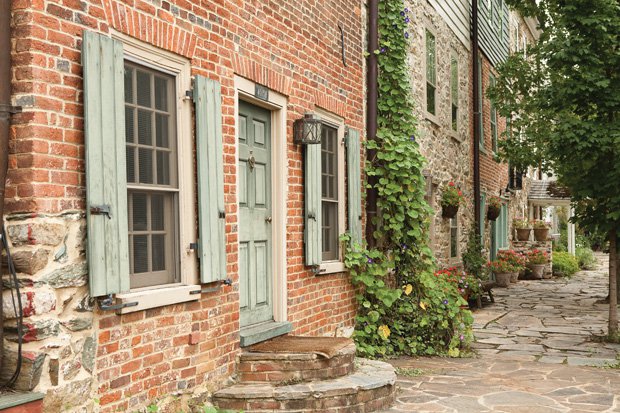
Waterford has a weak water supply, scant commerce and insufficient parking, but village residents don’t complain too much. They are certain that they live in a very special place, with its historic buildings, agrarian heritage and wide open spaces.

A Fine Little Village
Arch Row houses on Main Street, built around 1810.

A Fine Little Village
Kitchen addition at the Hollingsworth-Lee House

A Fine Little Village
Linda Landreth’s sheep

A Fine Little Village
Linda Landreth spins wool

A Fine Little Village
Susan Rocke, a fiber artist from Luray, stands in front of the Schooly Mill

A Fine Little Village
Waterford closes its streets during its annual fair

A Fine Little Village
A juried craft demonstrator shops at the Waterford Fair

A Fine Little Village
Civil War reenactors march during the Waterford Fair

A Fine Little Village
Garden of a house on Janney Street

A Fine Little Village
Craft exhibitors Winton and Rose Eugene of Cowpens, South Carolina
If you ask anyone in Waterford how the quiet village in Loudoun County got its comely name, you will be hard pressed for an answer. The village was originally known as Janney’s Mill when it was settled around 1733, but 60 years later the name changed rather suddenly to Waterford.
“Do you know the story?” asks Kate Magennis Wyatt, a Waterford resident who tells the most widely known, if debated, account of the name change. “A wild Irishman who came after [the town] was settled convinced everybody to change the name from Janney’s Mill to Waterford.” Wyatt is referring to Thomas Moore, who may or may not have come from Waterford, Ireland, and who may or may not have had a pleasant epiphany that the prosperous and lively little mill town—the “rising city” in northeast Virginia—was so special that it should be named after his family’s native Ireland.
Ann Belland, president of the Waterford Citizens Association, says of Moore and the provenance of the town’s name, “I mean, why not? He came here; he had a lot of money, he bought a lot of land, and he had the right to do whatever he wanted to do.” Belland, like Wyatt and most Waterford residents, speaks of historical events and people with a certain logical ease, as if discussing the village’s many stories—enough to fill a textbook—is second nature.
To those who are familiar with Waterford, including its residents and those with an eye on historic preservation and the nation’s agricultural heritage, this village near the south fork of Catoctin Creek is indeed a special place. To a newcomer, the village of Waterford is an enchanted collection of historic buildings concentrated along a handful of streets that gently slope down onto the two central drags of Second and Main streets. Most were built in the early 19th century and created a thriving mercantile district of taverns, livery stables, tanneries, a forge, a hardware store, a bank, and a woolen factory. At one point dozens of mills—the small business of choice in the early 1800s—could be found along the creek. Today, nearly two centuries later, these impeccably-preserved structures are mostly homes, with the occasional art gallery and just one general store.
Waterford was founded by Bucks County, Pennsylvania Quakers, mainly the Amos Janney and Francis Hague families (their wives were sisters) who bought up most of the land only to eventually sell it off when they died. In that way the settlement evolved into a major town. Janney, a surveyor for Lord Fairfax, was a businessman. He built a grist and sawmill using water power drawn from the nearby creek, knowing there was a profit to be made as a miller. His family would expand the mill enterprise significantly, assuring the town’s rapid growth. In its prime, Waterford was the second largest commercial center in Loudoun County. An 1830s Virginia paper described Waterford as “a fine flourishing little village surrounded by wheat and corn land equal to any in the state.”
Waterford today has about 1,500 residents and is far more quiet and less commercial than it once was. The village itself is a compact 20 acres, but opens to 1,400 acres of undisturbed, open space. It is as if modern development somehow skipped over the village, though on every side, just beyond its lush pastures, there exists suburban blight.
Bypassed by the railroads in the late 19th and early 20th century, once-bustling Waterford gradually fell into disrepair. The Waterford Foundation was formed in 1943 to save the place. It set to work, along with the village’s dedicated locals, preserving and then restoring the town—and its efforts were successful. In 1970, both the Village of Waterford and the surrounding rural area were designated National Historic Landmarks. The village earned the distinction for “the balance between the buildings of this intact historic agrarian village and the unspoiled agricultural setting.” In 1972, the Village of Waterford was named an Historic and Cultural Conservation District in Loudoun County.
Those are not its only distinctions. What sets Waterford apart from other historic districts within Loudoun County, and the state, is an innovative land preservation program in which the historic properties of Waterford are protected through open space and façade easements. More than 60 easements have been granted. They are held by organizations like the National Trust for Historic Preservation, the Virginia Department of Historic Resources, and the Commonwealth of Virginia as well as the Waterford Foundation, which launched the initiative in 1974.
For Waterford residents, preserving the village is not the only priority. They are also vigilant about their “view shed”—meaning “what you get when you stand in any part of the immediate village, and you look out and see open fields,” explains Mary Dudley, a 30-year resident of Waterford who lives in an 1890 home, known as the James House. “That is protection of the view shed—in other words, you don’t have this row of carbuncle being built.” Adds Ann Belland, who occupies the same 1762 stone house that belonged to a Union Civil War officer: “Right now, [the foundation’s] focus has been on purchasing and buying property so that the view from anywhere in the village is a beautiful view.”
However, where there is historic preservation there are also challenges, and Waterford residents, for all of their diligence and shared sense of preserving the past, are constantly reminded of them. There is virtually no commerce, limited water and no parking, but plenty of commuter traffic. Lesser problems include no cable and “iffy” high-speed Internet. What’s more, says Linda Landreth, owner of a general store and the only food vendor in the village, “We have some pretty sizable sub-divisions that have developed around here,” and they have exacerbated the traffic problem. “This is an [automotive] cut-through town,” she says. “We get traffic from Lovettsville, Maryland and West Virginia. We don’t like any of it.”
Landreth, who raises sheep behind her shop so that she can sell the wool and wool products, has lived in the Waterford area for 30 years. Her store, the Waterford Market, is, from a retail perspective, utterly non-conformist—a utilitarian 1883 building that inside is dark, musty and sparsely stocked. Yet it is charming with its array of homemade woolen products amid the random grocery selection.
Water is a constant worry. Every building and home relies on individual wells, so water is limited, and there is virtually none for public use. “We are very conservative on water use,” says Kate Wyatt. “You don’t wash your car, you don’t water your plants, you don’t use a hose to wash down a sidewalk.”
When Loudoun County put a sewer system in the village some years ago, according to Landreth, a public water system could not be agreed upon for a number of reasons: “The County put in a sewer system, and they should have put a water system in [at the same time], but the County wanted to put in an above ground [water] tower. People with an eye on trying to keep this place as it is didn’t want an above ground tank.”
That proved a problem when, in 2007, the local auditorium caught fire and burned down. Says Belland: “It was very, very frightening—the water situation was really bad. [Firefighters] were going down Main Street to the creek, refilling at the creek and bringing it back and forth by truck. There is no public water, and no fire hydrant.” Eventually, says Landreth, “some people will have to come to a meeting of the minds.”
The water situation is a big reason why there is no active commerce in Waterford, meaning there are no bakeries, restaurants, coffee shops, inns and the like. Other than Landreth’s store, the only other businesses are the 160-year-old Loudoun Mutual Insurance Company (which sits above the village on High Street), a map maker’s shop, a real estate agency, and Wyatt’s non-profit organization—The Journey Through Hallowed Ground Partnership, located in well-appointed offices in a building that served as a post office and a tin shop. Built in 1875, the post office had to be rebuilt after a flood in 1894 took out the floor and, according to Waterford history, carried off the postmistress.
Parking is, as Mary Dudley puts it, another “bugaboo.” The narrow village streets allow a driver only to pull over slightly to park a car, and yet the car is still rather exposed. Residents use their own driveways, or are otherwise forced to “flush” their cars as closely as they can to the side of the road. When major events occur, such as the Waterford Fair, landowners or the foundation offer open spaces outside of the village to accommodate the multitude of cars.
“There should be more commerce,” argues Dudley. But she notes that any prospective commercial business would need to negotiate a right of way to use the one area—a patch of space on Second Street owned by The Waterford Foundation—where parking is available. There is also a relatively cumbersome review process that would involve, to various degrees, the Loudoun County Historic Review Committee, the Waterford Foundation or one of the state or federal easement holders depending upon the property in question. “There was a group that was very vocal about any kind of commercial establishment—it happens that way,” says Dudley.
Like other Northern Virginia cities and towns, Waterford was fraught with controversy during the Civil War. That’s because Loudoun County was deeply divided over slavery. The cities of northeast Loudoun County, including predominantly Quaker Waterford, opposed secession even though the rest of the state—and most of Loudoun County—voted in favor. Across Loudoun, local unionists and secessionists literally fought each other in what was known as a “Brothers’ War.” On orders from Secretary of War Edwin Stanton, a Waterford citizen named Samuel Means formed a Union Cavalry unit called the Loudoun Rangers.
Waterford, many believe, suffered for its loyalty to the Union—and for its pacifism. The division, some theorize, prompted Virginia’s southern politicians in 1870 to lay down a railroad to the west of Leesburg, thus bypassing Waterford and triggering the village’s economic decline.
But, as one history text published by the Waterford Foundation explains, “Every cloud has its silver lining. Waterford’s stagnation as a commercial center meant it was not worth demolishing the old to make way for new development. The old town and its surrounding farms were able to slumber undisturbed for many years.” Says Landreth: “The fact that we were off the beaten track and the railroad passed us by preserved us. Otherwise, we would look like Leesburg.”
Waterford, then, became a self-sustaining place. John Divine, a Waterford native who died in 1996, chronicled the history of his hometown in his book When Waterford and I Were Young. In it, he observed: “Waterford had been a self-subsisting area. With fertile land and plenty of water power, all the valley of the south Fork of Catoctin Creek needed was an industrious, innovative people.”
When the founders of the Waterford Foundation decided to restore the dilapidated village they stumbled upon in the late 1930s, the same notion applied. “When you move to Waterford you make a commitment,” says Belland, who believes that just about everyone in Waterford is on board with its culture of preservation. Belland herself lives in the home that belonged to the venerable Means, a self- proclaimed “lapsed Quaker” whose Loudoun Rangers changed the lives of many Waterford citizens. As with Belland, the villagers are reminded daily, amid overwhelming evidence, of the remarkable history of the place in which they live, and more poignantly, that it was founded by Quakers—people who looked out for one another.
Though business is scarce, the village knows how to have a good time. It stages a popular annual event, the Waterford Fair, in early October. Now 67 years old, the fair is a huge, concerted local undertaking, and every resident pitches in to help evoke for visitors the village’s 19th century life. The Waterford Foundation hosts the fair—the group’s biggest annual fundraiser—and thousands of people typically attend. Craftsmen, artists and chefs exhibit and sell their wares in a sprawl of booths, displays and bales of hay (for sitting) on the open expanse of “eased” land. At the same time, crowds flock to multiple house tours, curious to see the stunning period homes.
The foundation also hosts the Waterford Concert Series—classical music and opera performances—on select Sundays throughout the year. The concerts were held for years in Waterford’s Old School Auditorium until it was lost in the fire. The foundation aims to raise $1.6 million to build a new and bigger auditorium, to be called the Waterford Old School Culture and Education Center, and proceeds from the concert series are helping the cause.
To listen to Wyatt, Waterford is simply hallowed ground, with its culture of preservation fitting squarely into a larger mission. She is president of a non-profit she calls “The Journey.” Founded about six years ago, its ambitious aims include curbing development and bolstering tourism in a 175 mile swath of historically-rich land along the Route 15 corridor from Gettysburg to Charlottesville. Waterford might well be The Journey’s poster child.
“It is still the only national historic landmark in the country that is both 20 acres of built environment and 1,400 hundred acres of open space,” asserts Wyatt. “And, it was one of the first as a national historic landmark, not just because of the built environment, but because of the context of the farms which surrounded the village. The Quakers had a shared sense of commerce and spirituality and community, so they built close together and then farmed out.”
All of which brings us back to Thomas Moore and how Waterford got its name. He very likely came with the influx of Scotch-Irish craftsmen from Pennsylvania who helped to build the village that had been established a few decades earlier. Moore, a shoemaker by trade, brought his family to Waterford in 1780 and they became one of its most prominent, along with the Janneys, Hagues and the Bonds. A Moore daughter would marry a Bond son in 1794. His son, Asa Moore, would contribute greatly to the development of Waterford’s land and its many mills.
“At the time,” explains Landreth, “I think there were 62 mill towns. Every place along the creek was called Janney’s Milltown, or somebody else’s Milltown, and when this town started to really pick up and drive, the town fathers decided that Milltown was not distinctive enough. I mean this was a special place, and it needed to have a special name, and it was then that somebody, some glib-tongued Irishman, convinced them.”
Across the Atlantic, Waterford, Ireland’s motto is “Urbs Intacta Manet Waterfordia”—“Waterford remains the untaken city.” The residents of Waterford, Virginia would surely identify with that moniker, as their lives as present-day stewards of the village are acutely in tune with the notion of safeguarding its noble origins, its astonishing history and the treasures left behind.